
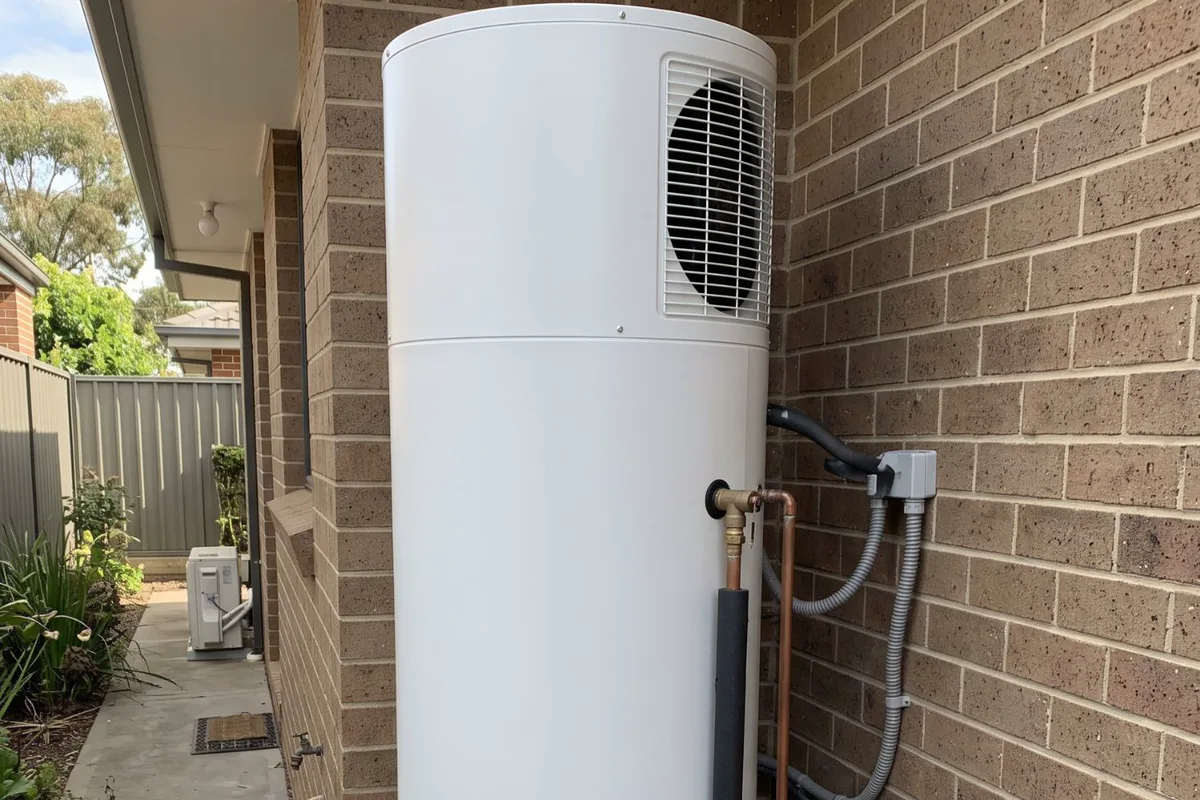
Is an all-in-one or a split heat pump hot water system better?
- For most homes with an outdoor spot that has airflow and sits away from bedrooms, an all-in-one heat pump is the simpler choice.
- A split earns its extra parts when the side path is tight, the tank spot is near bedrooms or the compressor needs to sit elsewhere.
- Both need a level base, a drain for condensation and safety switch protection on the circuit.
- A licensed plumber connects the water, and our team does the electrical side.
Two ways to build a heat pump water heater
An all-in-one, or integrated, heat pump has the fan, compressor and tank in one unit. Air is drawn across a coil, its heat is moved into the water, and cooled air is pushed back out. Everything sits on one base, with one set of connections.
A split heat pump separates the tank from an outdoor unit that holds the fan and compressor, with pipework joining the two. The tank can sit against a wall or in a more sheltered spot, and the outdoor unit goes where its airflow and noise suit the site. The principle is the same, just spread across two parts.
Space and airflow
An integrated unit needs open air around its fan, the clearances from walls and fences that the manufacturer specifies, and room for its chilled exhaust air to get away. Squeezed into a narrow side path, it ends up breathing its own cold air and works harder.
A split frees the tank from those airflow needs. The outdoor unit is smaller and can go on a pad or bracket, as the model allows, where air moves freely. On narrow blocks, such as Yarraville's small Victorian and Edwardian houses, that flexibility can make a heat pump workable where an integrated unit wouldn't sit well.
Noise near bedrooms
Every heat pump hums while it runs, a little like an air conditioner's outdoor unit. With an integrated unit, that hum sits wherever the tank sits. If the only spot for the tank is under a bedroom window, yours or the neighbour's, the noise comes with it.
A split lets the tank stay close to the bathroom and kitchen while the outdoor unit goes further away, around a corner or facing the street rather than the house next door. Running the timer through the day helps with either design, because the compressor isn't working while people sleep.
Installation and servicing
An integrated unit is the simpler job: one base, one set of water connections, one power supply and a condensate drain. With fewer parts there is less to go wrong, and servicing happens in one place.
A split adds pipework between the two parts, which has to be run, insulated and protected, and the electrical supply has to suit both parts as the model requires. More parts mean more connections to check over the years. That is the trade for the freedom to place each part where it works best.
Either way, a licensed plumber connects the water. Our team runs the circuit with safety switch protection, which Energy Safe Victoria's guidance on the Wiring Rules says every final sub-circuit needs, plus any isolator the manufacturer specifies. Hot water services are non-prescribed electrical work, and you receive a Certificate of Electrical Safety.
Cold mornings, and our view
Both designs work less efficiently as the air cools, and July at Laverton averages a minimum of 5.2 °C. Neither wins outright on cold mornings. The model's cold-weather performance, a backup element and a daytime timer matter more than whether it is split or integrated.
Our view: choose an all-in-one where there is a spot with open airflow that isn't beside a bedroom. Choose a split where the side path is tight, the obvious spot is under a window, or the tank would otherwise end up somewhere the fan can't breathe.
Questions that come next
Sources for this article
4 sources, with the date each was checked
- 1.Victorian Heritage Database (Heritage Council Victoria); entry maintained by Maribyrnong City Council: The general character of the Yarraville Residential Precinct is that of small Victorian & Edwardian single-storey detached housing with mainly weatherboard and some brick wall cladding, corrugated iron roofing, front… Accessed 30 September 2026.
- 2.Bureau of Meteorology: Mean minimum temperature (°C) 14.0 14.4 12.7 10.0 7.8 5.9 5.2 5.7 6.8 8.4 10.3 12.2 9.5 81 1943 2026 Accessed 30 September 2026.
- 3.Energy Safe Victoria: Clause 2.6.3.2.2 requires all final sub-circuits in a domestic installation be protected by a residual current device (RCD). A hot water service is included in this requirement Accessed 30 September 2026.
- 4.Energy Safe Victoria: For electrical installation work performed within your electrical installation including but not limited to lights, power points, air conditioning, hot water service etc. Accessed 30 September 2026.