
The key points
- A heat pump water heater moves heat from the outside air into a storage tank, so it uses much less electricity than an element heating the water directly.
- It works less efficiently in cold air, so timing the heating for the warmer part of the day matters in a Melbourne winter.
- Size the tank for your busiest stretch of hot water use, not to match the old unit.
- Placement decides noise and performance: open air, a level base, a drain, and distance from bedroom windows.
- A licensed plumber connects the water, a licensed gasfitter caps any gas, and an electrician runs the circuit.
How a heat pump heats water
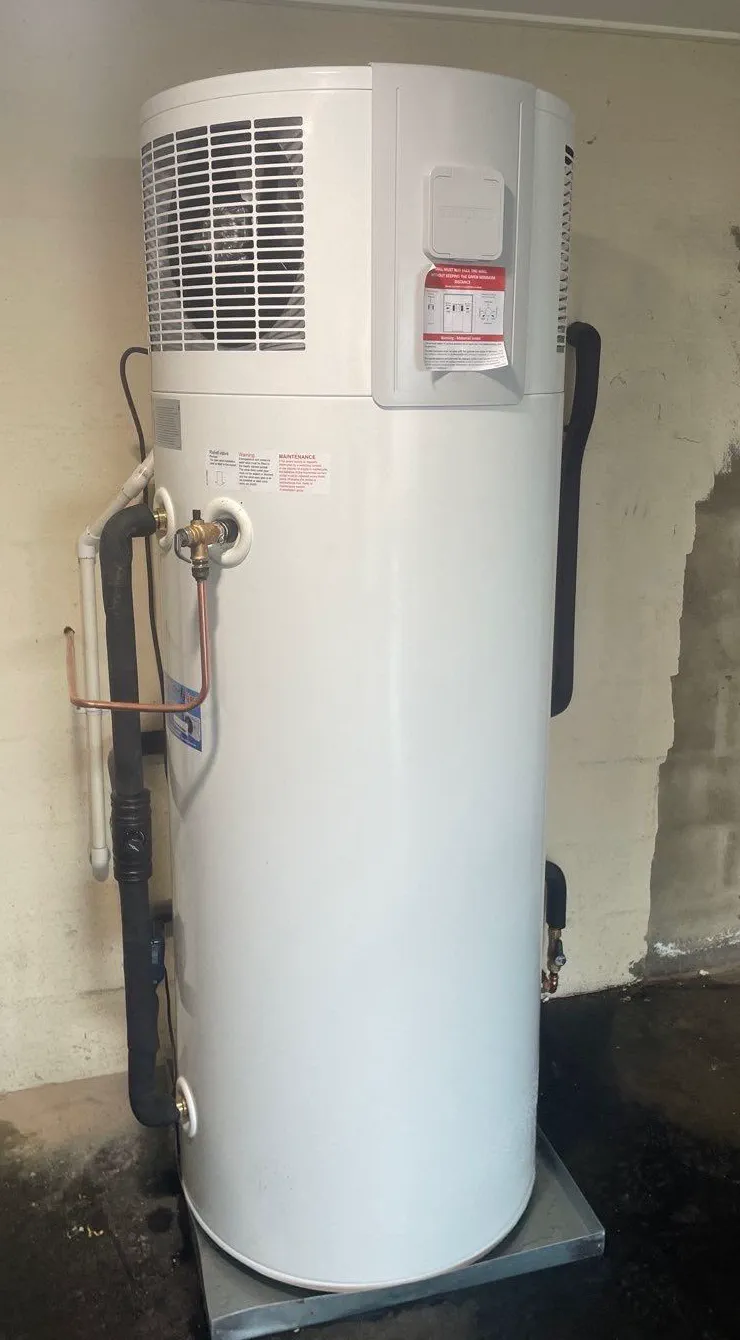
A heat pump water heater uses the same idea as a reverse-cycle air conditioner on heating mode, with a tank of water where the room would be. A fan draws outside air across a coil. Refrigerant inside the coil picks up warmth from that air, even on a cool day, and a compressor lifts it to a useful temperature. The heat passes into the water in the tank, and the cooled air blows out the other side.
Because it moves heat rather than making it, a heat pump uses much less electricity than an element heating the water directly. Most units also carry a backup element for very cold conditions or unusually heavy use.
On most domestic units the refrigerant circuit is sealed at the factory, so there is nothing for an owner to top up or adjust. Releasing regulated refrigerants into the air is illegal, so when an old heat pump is removed, its refrigerant has to be recovered.
Integrated or split units
Integrated units have the fan, compressor and tank in one package, usually standing where the old tank was. They are the simplest to install and service, but the part that hums sits wherever the tank goes.
Split units keep the tank in one place and put the compressor in a separate outdoor unit joined by pipework, a bit like a split system air conditioner. That helps on narrow blocks, such as the small Victorian and Edwardian houses of Yarraville, where the side path can be close to the house next door. The tank can sit against your wall while the outdoor unit goes somewhere less intrusive.
Models differ in how well they cope with cold air, and some use refrigerants better suited to low temperatures. Ask what the unit's rated operating range is, not just its headline efficiency figure.
How big a tank do you need?
Tank size comes down to how many people live in the house and when they use hot water. A heat pump reheats more slowly than gas, so the tank has to hold enough for your busiest stretch, usually the morning showers or an evening of baths, dishes and laundry.
A house where four people shower between 6:30 and 7:30am needs more stored water than one where the same showers are spread across the day. Think a few years ahead too, since teenagers, a new baby or a relative moving in all change the answer.
Don't simply copy the old unit. A gas continuous-flow unit has no tank, so there is nothing to copy, and an old electric tank may have been chosen for a bigger household than you have now.
- How many people live there now, and how many in five years
- When showers and baths happen, and how long they run
- Whether the dishwasher and washing machine use hot water
- Whether you have solar, and when it produces
- Where the old unit sits, and whether that spot has open air
Where it should go
A heat pump needs fresh air in and room for its chilled exhaust to get away. Boxed into a narrow alcove or tucked under a low carport roof, it ends up breathing its own cold air and works harder. It also needs a level base, a drain for the condensation it produces, and clear access for servicing.
It hums while it runs, much like an air conditioner's outdoor unit. EPA Victoria's residential noise rules treat heat pump noise as unreasonable during prohibited times, before 7am or after 10pm on weekdays and before 9am or after 10pm on weekends and public holidays, if it can be heard in a habitable room of another home. That shapes both where the unit goes and when its timer runs.
Keep it away from bedroom windows, yours and the neighbours'. In growth areas such as Tarneit and Truganina, side setbacks on newer blocks can be tight, so the best spot may not be where the old unit stood.
Winter performance
A heat pump gets less efficient as the outside air gets colder, because there is less heat in the air to collect. July at the Bureau of Meteorology's Laverton station averages a minimum of 5.2 °C, so cold mornings are routine here, not an exception.
The answer is mostly timing. Setting the unit to heat through the late morning and afternoon, when the air is warmest, gets more hot water from each unit of electricity. With solar panels, the same window lets it run on your own power. The backup element covers the odd frosty stretch or a house full of guests.
Some frost on the coil on a cold morning is normal, and the unit clears it itself. Ice that keeps building, or water that stays lukewarm all day, is worth having checked.
Who does which part of the install
A heat pump installation involves more than one licence. A licensed plumber connects the water supply, the valves and the condensate drain. Where the heat pump replaces gas, a licensed gasfitter caps the gas supply. Energy Safe Victoria says it is illegal and potentially fatal for unlicensed people to do any gasfitting or electrical work.
The electrical side is a dedicated circuit from the switchboard, usually with an isolating switch near the unit. Energy Safe Victoria's guidance says the Wiring Rules require RCD protection on every final sub-circuit in a home, the hot water circuit included. Hot water services are non-prescribed electrical work, so you receive a Certificate of Electrical Safety, and your copy is due within 30 days.
If the switchboard has no spare position or is an old fuse board, it may need work first. That is far better found before the old unit is taken out.
Timers, solar and tariffs
Many old electric tanks ran on an off-peak circuit that only switched on overnight. That suited an element, but night is the coldest part of the day and the time neighbours are trying to sleep, so it is usually the worst window for a heat pump. When a heat pump replaces an off-peak tank, the circuit switching and timer generally need rethinking.
With solar, a daytime timer uses power you would otherwise export. Without it, the right setting depends on your tariff and routine. Ask for the timer to be set and shown to you at handover, so it isn't left on the factory default.
Common questions
Quick answers
- Is ice on my heat pump hot water unit normal?A light frost on the heat pump's fins on a cold morning is normal.
- Is it normal for my hot water system to drip from the valve?A little water from the relief valve drain while the tank is heating is normal, because water expands as it heats and the valve lets the extra out.
- Should my heat pump hot water run during the day or overnight?If you can choose, run it during the day.
- Why does my hot water smell like rotten eggs?A rotten egg smell that comes only from the hot tap usually starts inside the storage tank.
Sources for this guide
8 sources, with the date each was checked
- 1.YourHome (Australian Government): A reverse cycle air-conditioner is a type of heat pump that uses electricity to warm your home in winter and cool it in summer (refer to Heat pumps below). In heating mode, the system absorbs heat from the outside air… Accessed 30 September 2026.
- 2.Department of Climate Change, Energy, the Environment and Water (DCCEEW): It's illegal to release regulated refrigerants into the air. This is because some refrigerants can stay in the atmosphere for decades or more and can be thousands of times worse for climate change than carbon dioxide… Accessed 30 September 2026.
- 3.Victorian Heritage Database (Heritage Council Victoria); entry maintained by Maribyrnong City Council: The general character of the Yarraville Residential Precinct is that of small Victorian & Edwardian single-storey detached housing with mainly weatherboard and some brick wall cladding, corrugated iron roofing, front… Accessed 30 September 2026.
- 4.Victorian Electoral Commission (2023 electoral structure review fact sheet): New housing developments are planned in residential growth areas including Truganina, Tarneit, Wyndham Vale and Manor Lakes, as well as near activity centres and public transport. Accessed 30 September 2026.
- 5.Bureau of Meteorology: Mean minimum temperature (°C) 14.0 14.4 12.7 10.0 7.8 5.9 5.2 5.7 6.8 8.4 10.3 12.2 9.5 81 1943 2026 Accessed 30 September 2026.
- 6.Energy Safe Victoria: Gas and electricity are inherently dangerous and it’s illegal and potentially fatal for unlicensed and unqualified people to undertake any gasfitting or electrical work. Accessed 30 September 2026.
- 7.Energy Safe Victoria: Clause 2.6.3.2.2 requires all final sub-circuits in a domestic installation be protected by a residual current device (RCD). A hot water service is included in this requirement Accessed 30 September 2026.
- 8.Energy Safe Victoria: For electrical installation work performed within your electrical installation including but not limited to lights, power points, air conditioning, hot water service etc. Accessed 30 September 2026.
Planning advice for homeowners. Installation requirements depend on the property and equipment. Where this guide refers to Victorian safety or rental rules, use the linked official guidance for the current requirements.