
The key points
- New homes needing a planning permit have had to be all-electric since 1 January 2024, and from 1 January 2027 all new homes must be built all-electric.
- Heating, cooling, hot water and cooking all run from one switchboard and one supply, so plan them together from the start.
- Choose the heating, hot water and cooking appliances before rough-in, while cables are easy to run.
- Ask your builder or building surveyor early how the dates apply to your permits.
What the rules are
Victoria has moved new homes off mains gas in two steps. Under the Gas Substitution Roadmap, new homes that need a planning permit have had to be all-electric since 1 January 2024. Planning scheme clause 53.03 stops a permit being granted for a connection to reticulated natural gas when building a new dwelling or apartment development, or when subdividing land for residential use.
The second step is broader. Under the Building and Plumbing Amendment Regulations 2025, all new homes must be built all-electric from 1 January 2027. Victorian Government guidance says the rules work through the building permit: a permit can't be issued for a new building with a new gas connection proposed, and gas appliances for cooking, space heating and water heating can't be installed during construction. The same guidance says appliances running on bottled LPG aren't affected.
Exactly how the dates apply to your build depends on your permits, so raise it with your builder or building surveyor at the start rather than at the selections meeting.
What all-electric means in practice
Without mains gas, every job gas used to do falls to electricity: space heating, hot water and cooking. The usual choices are reverse-cycle air conditioning for heating and cooling, a heat pump water heater, and an induction cooktop with an electric oven.
None of that is unusual any more. New housing is planned across Wyndham's growth areas, including Truganina, Tarneit, Wyndham Vale and Manor Lakes, and from 2027 every one of those homes will be built this way. The difference for you is that the electrical plan carries more weight, because one switchboard and one connection serve everything.
Heating and cooling
Reverse-cycle air conditioners move heat rather than make it, and Australian Government guidance puts them at 300% to 600% efficient. Ducted systems are less efficient than wall units but still more cost-efficient than gas heating. In a new home, zoned ducted reverse-cycle, a set of wall splits or a multi-head system are the common paths.
Victorians usually use more energy for heating than for cooling, so the Victorian Government suggests choosing a unit with higher heating efficiency. Melbourne is in the Cold zone on the Zoned Energy Rating Label, so compare the Cold zone heating figures. Lock in the system before rough-in so circuits, drains, pipe routes and outdoor unit positions are planned rather than improvised.
Read builder inclusions closely. A single split in the living area may be listed as heating and cooling for a four-bedroom house. Ask what the bedrooms get, and whether adding to it later means running new circuits through finished walls.
Hot water
A heat pump water heater is the usual choice. It needs a level base, open air, a drain for condensation and its own circuit with RCD protection; Energy Safe Victoria's guidance says the Wiring Rules require an RCD on every final sub-circuit in a home, hot water included.
Think about where it sits on the site plan. On narrow estate blocks with tight side setbacks, a heat pump can end up beside a neighbour's bedroom window. EPA Victoria's residential noise rules treat heat pump noise as unreasonable during prohibited times, before 7am or after 10pm on weekdays and before 9am or after 10pm on weekends and public holidays, if it can be heard in a habitable room of another home.
If solar is part of the build, plan the hot water timer around it. A heat pump running in the middle of the day uses your own power and works in the warmest air of the day.
Cooking
Induction is the common choice in an all-electric kitchen. It needs a dedicated circuit sized for the exact model, and so does an electric oven. Choose both before rough-in, because a large induction cooktop or a double oven can need heavier cable than a standard allowance.
If you haven't cooked on induction before, a portable induction plate is an inexpensive way to try it, and it shows you which of your pots work on it before you pay for a full cooktop.
Size the switchboard and supply for everything
In an all-electric home, the evening peak is the design point: heating running on a cold night, the oven and cooktop on, the hot water perhaps topping up, and later an EV charging in the garage. Add those loads together, not one at a time.
Many all-electric homes run well on a single-phase supply with sensible planning and load management. Three-phase makes sense when the finished house has big combined loads, such as a large ducted system, two EV chargers, a workshop or a pool heat pump. Decide before the connection is applied for, because changing it later is a bigger job.
Leave spare switchboard positions for what you'll add later, such as an EV charger, a battery or an extra air conditioner. A safety switch is compulsory on new residential installations, and work on the main switchboard, consumer mains and meter box is prescribed work inspected by a licensed electrical inspector.
What to settle before rough-in
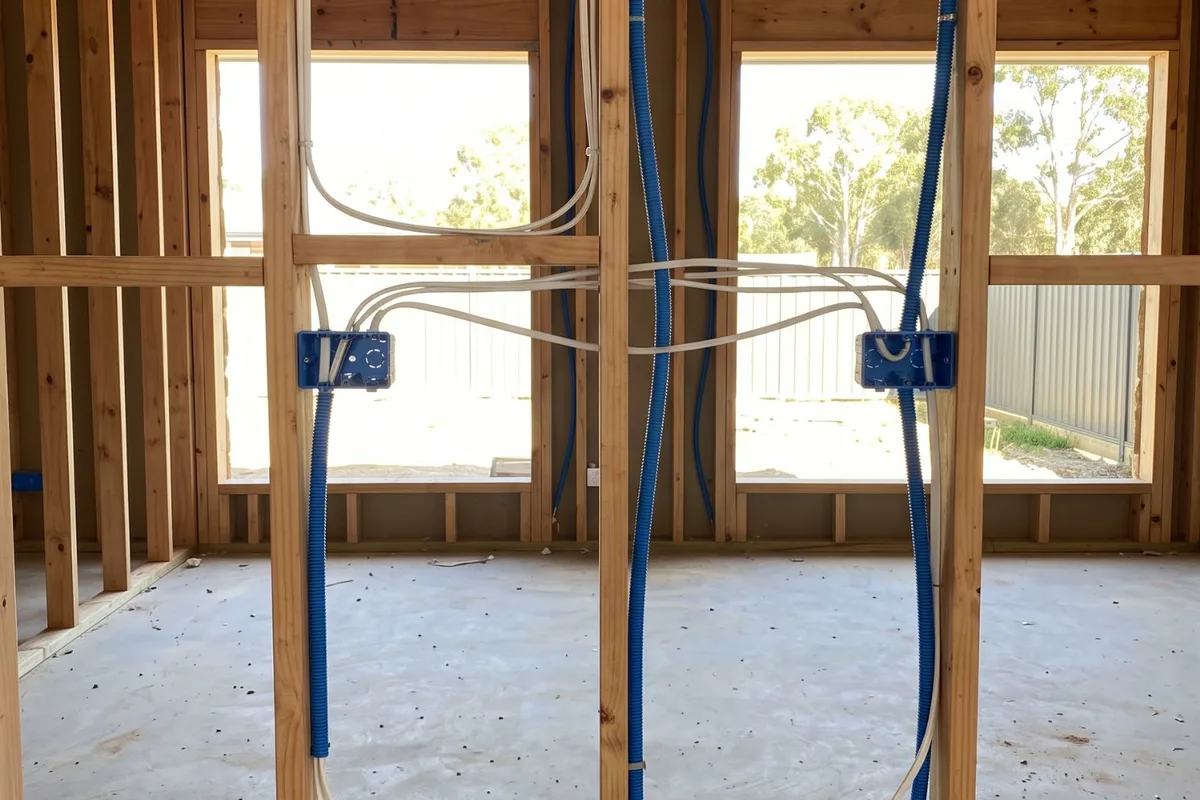
Rough-in is when cables, conduits and boxes go in while the frame is open. Everything decided by then is cheap to wire. Anything decided after plaster costs more and rarely looks as tidy.
Walk the frame before plaster with the electrical plan in hand, check every point and photograph each wall. Those photos will stop someone drilling into a cable years from now.
- Heating and cooling system type, unit sizes and outdoor unit positions
- Heat pump water heater model and location, away from bedroom windows
- Induction cooktop and oven models, for circuit sizing
- An EV charger circuit or cable run to the garage, even if the charger comes later
- Solar and battery plans, with a place for the inverter
- Spare switchboard positions and the supply size
- Smoke alarm positions: new homes need interconnected, hardwired alarms
Common questions
Quick answers
- Should my heat pump hot water run during the day or overnight?If you can choose, run it during the day.
- What is the off-peak or timer switch on my switchboard?It controls an off-peak circuit, usually for electric storage hot water and sometimes for slab heating or a pool pump.
- Is ice on my heat pump hot water unit normal?A light frost on the heat pump's fins on a cold morning is normal.
- Can a rental's failed gas hot water be replaced with gas after March 2027?No.
Sources for this guide
10 sources, with the date each was checked
- 1.Department of Energy, Environment and Climate Action (Victoria): from 1 January 2024, new homes requiring a planning permit are required to be all-electric Accessed 30 September 2026.
- 2.Department of Transport and Planning (Victoria): Clause 53.03 prevents a permit being granted to connect to reticulated natural gas when constructing a new dwelling, apartment development or subdividing land for residential purposes. Accessed 30 September 2026.
- 3.Victorian Electoral Commission (2023 electoral structure review fact sheet): New housing developments are planned in residential growth areas including Truganina, Tarneit, Wyndham Vale and Manor Lakes, as well as near activity centres and public transport. Accessed 30 September 2026.
- 4.energy.gov.au (Australian Government, DCCEEW): The energy efficiency of reverse-cycle air conditioners on the Australian market ranges between 300% to 600% efficient. Air conditioners can achieve such high rates of energy efficiency because they do not use… Accessed 30 September 2026.
- 5.Department of Energy, Environment and Climate Action (energy.vic.gov.au), page last updated 14/04/25: Victorians typically use more energy for heating than cooling, so look for a unit with a higher heating efficiency. Accessed 30 September 2026.
- 6.Commonwealth of Australia (2019), 'The new zoned energy rating label for air conditioners—What installers and retailers need to know', hosted on energyrating.gov.au: Melbourne is in a black ‘COLD’ area—read the black Cold ratings. Accessed 30 September 2026.
- 7.Energy Safe Victoria: Clause 2.6.3.2.2 requires all final sub-circuits in a domestic installation be protected by a residual current device (RCD). A hot water service is included in this requirement Accessed 30 September 2026.
- 8.Energy Safe Victoria: Having a safety switch installed is now compulsory on new residential installations and a great step to electrical safety in your home, if you are unsure if a safety switch is installed at your property, contact a… Accessed 30 September 2026.
- 9.Energy Safe Victoria: 'Prescribed' certificates are for electrical installation work that requires inspection by a Licensed Electrical inspector. This includes (but is not limited to): Consumer mains cables, main switchboard, meter box and… Accessed 30 September 2026.
- 10.Fire Rescue Victoria: Residential home constructed, largely renovated, or extended after 1 May 2014 Interconnected, hard wired smoke alarms that are connected to 240 volt mains power and have a back-up battery. Accessed 30 September 2026.
Planning advice for homeowners. Installation requirements depend on the property and equipment. Where this guide refers to Victorian safety or rental rules, use the linked official guidance for the current requirements.