
The key points
- Lighting energy is mostly about hours, not wattage. The lights left on longest matter most.
- Energy.gov.au says LEDs use about 75% less energy than halogens and last 5 to 10 times longer.
- Replace whole halogen downlights with IC-rated LED fittings rather than just swapping globes.
- Sensors suit garages, laundries, hallways and outdoor paths. Timers suit garden and porch lights.
- Dimmers save energy only when they are used, and only when they suit the LED drivers.
Where lighting energy actually goes
Lighting energy is the power each light draws multiplied by how long it is on. A row of halogen downlights in a kitchen running every evening uses far more over a year than a bright light in the shed switched on twice a month. Start with the lights on longest: the kitchen and living areas, outdoor and security lights, and anything left on overnight.
Walk around one evening and count. Plenty of older homes have a grid of halogen downlights added during a renovation, often more than the room needs, plus floodlights or garden lights that run all night.
Then look for the plain waste: lights on in empty rooms, outdoor lights burning in daylight, and the laundry or garage light that nobody remembers to switch off.
LED changeovers: fittings, not just globes
The Australian Government's energy.gov.au says LEDs use about 75% less energy than halogen globes and last 5 to 10 times longer. That makes halogen downlights the first target in most homes.
Putting an LED globe into an old halogen fitting keeps the housing, the transformer and the need for a gap in the insulation, and it can flicker because many old transformers weren't built for such a small load. A complete LED fitting with its own matched driver takes the transformer out, runs cooler and, if it is IC-rated, can sit under insulation. Closing those insulation gaps helps the heating and cooling as well.
For plain mains lampholders in battens, pendants and older ceiling roses, a good LED globe or a new LED oyster fitting is often all that is needed. Old fluorescent battens in garages and laundries can be replaced with LED battens.
Fewer, better-placed lights
Halogen grids were often laid out to make up for each globe's narrow beam. Modern LED downlights spread light differently, so a changeover is a chance to fit fewer, better-placed lights instead of swapping one for one.
Task lighting, such as strip lighting under kitchen cabinets or a reading lamp beside the couch, lets the main lights stay off or dimmed. A room lit in layers uses less power than one where every downlight goes on just to see the bench.
Keep the colour consistent while you're at it. One warm or neutral white per space, from a single range, looks far better than a mix of whites from different brands.
Sensors where lights get left on
Motion sensors suit places people pass through or forget about: garages, laundries, walk-in robes, hallways, pantries and outdoor paths. Set the hold time long enough that the light doesn't switch off on someone standing still at the bench.
Outdoor sensor lights with a daylight sensor only come on after dark. A floodlight that stays on constantly, or triggers on every passing car, usually needs its sensitivity or aim adjusted rather than replacing.
- Garage and carport: on when you arrive, off after you leave
- Laundry and walk-in robe: no more lights burning all day
- Hallways at night: a low-level sensor light instead of the main lights
- Outdoor paths and side passages: light when someone is there, dark otherwise
- Security floodlights: triggered by movement rather than on all night
Timers and schedules
Garden lighting, porch lights and feature lighting suit timers or photocells that switch on at dusk and off at a set hour, instead of burning until morning. Smart switches can run schedules too, and some adjust automatically as sunset moves through the year.
Garden lights left on all night are one of the easiest savings in the house, because nobody is looking at them at 3am. A timer that switches them off at bedtime keeps the look in the evening without paying for the dark hours.
Dimmers and smart switches
Dimming an LED reduces its power use, so a living area that is dimmed most evenings uses less. The catch is matching. LED drivers generally prefer trailing-edge dimmers, and a mismatched dimmer can cause flicker, buzzing or lights that won't dim smoothly.
Smart switches add schedules, scenes and the ability to check from your phone whether the garage light is still on. A smart globe needs the wall switch left on, so it suits a lamp rather than a room full of downlights.
Fitting a dimmer or smart switch is electrical work. Energy Safe Victoria says electrical work isn't a DIY job, even for small jobs such as changing a light switch.
Doing it in stages
You don't have to change every light at once. Start with the lights on longest, usually the kitchen and living areas, then the outdoor lights, then sensors in the garage and laundry. Each stage pays its own way.
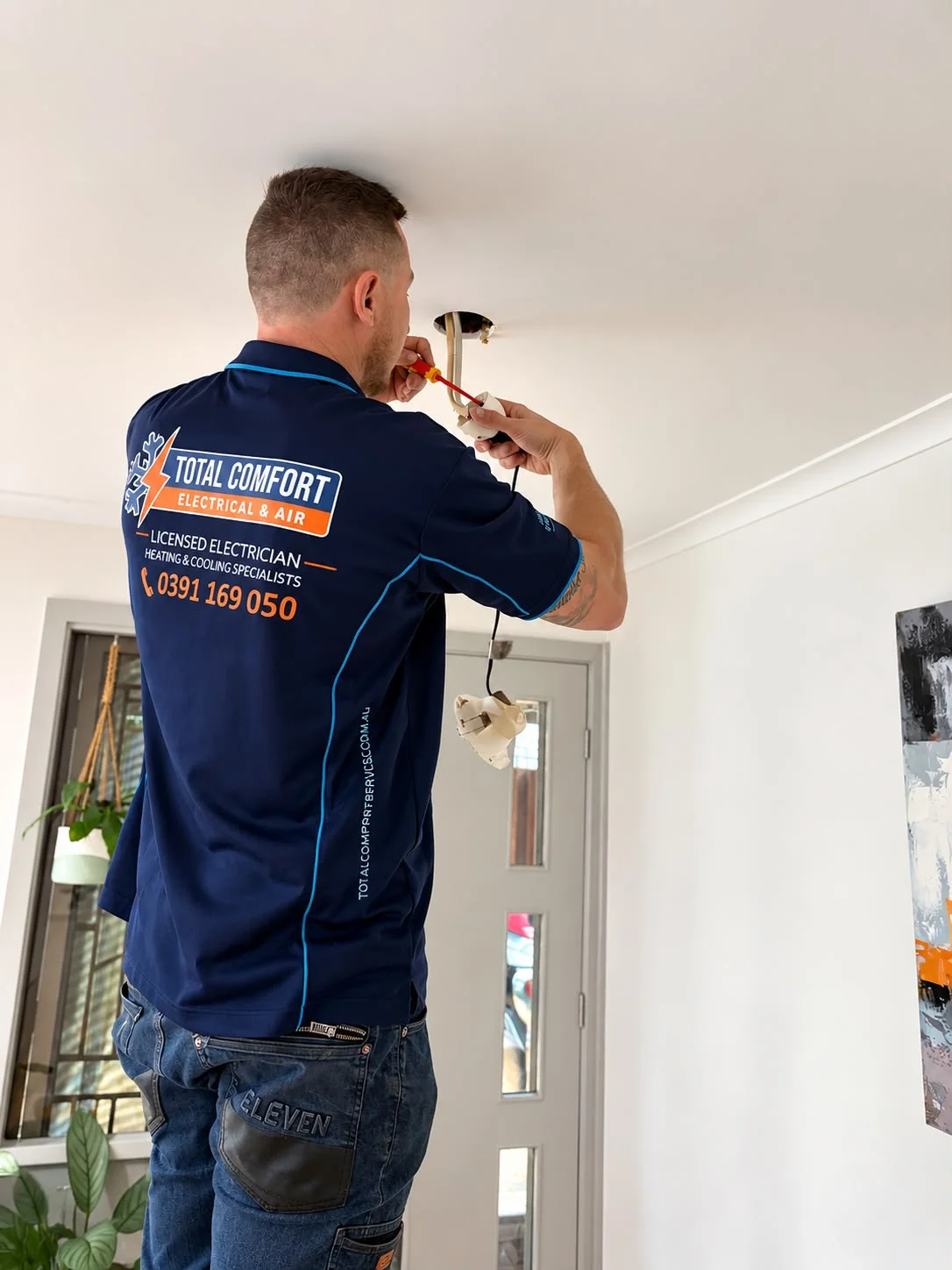
In older homes, changing fittings opens light points that may not have been touched in decades. Energy Safe Victoria lists old switches and flickering lights among the signs of faulty wiring and advises having the wiring checked in houses over 30 years old. Brittle cable found at a light point is best replaced, not reused. Lights are non-prescribed electrical work, and whenever a licensed electrician completes electrical installation work, they must give you a Certificate of Electrical Safety.
Renters can still make a difference: LED globes in plain lampholders and plug-in lamps for task lighting are easy changes, and anything wired in is a conversation with the rental provider.
Common questions
Quick answers
- Why do my lights turn on or off by themselves?Lights that switch on or off by themselves are usually following instructions you've forgotten: a smart switch schedule, a routine in an app, a motion or daylight…
- Why do my LED lights buzz or hum?Most buzzing LEDs come from a mismatch rather than a fault: a dimmer built for old halogen globes, an LED driver that doesn't suit the dimmer, an old transformer left in…
- Why do my light globes keep blowing?Globes that fail early usually have help.
- Why has the ceiling around my light gone brown?A brown ring hugging the edge of a light is usually heat or dust.
Sources for this guide
4 sources, with the date each was checked
- 1.Energy Safe Victoria: Electrical work isn’t a DIY job, even for small jobs such as changing power points or light switches. Accessed 30 September 2026.
- 2.Energy Safe Victoria: Old switchboards, particularly those without a safety switch Old power switches or power points, particularly broken ones Flickering lights Sparks from switchboards, switches or power points. If your house is over 30… Accessed 30 September 2026.
- 3.Energy Safe Victoria: Whenever a licensed electrician completes any electrical installation work, they must provide a Certificate of Electrical Safety (COES). Accessed 30 September 2026.
- 4.Energy Safe Victoria: For electrical installation work performed within your electrical installation including but not limited to lights, power points, air conditioning, hot water service etc. Accessed 30 September 2026.
Planning advice for homeowners. Installation requirements depend on the property and equipment. Where this guide refers to Victorian safety or rental rules, use the linked official guidance for the current requirements.