
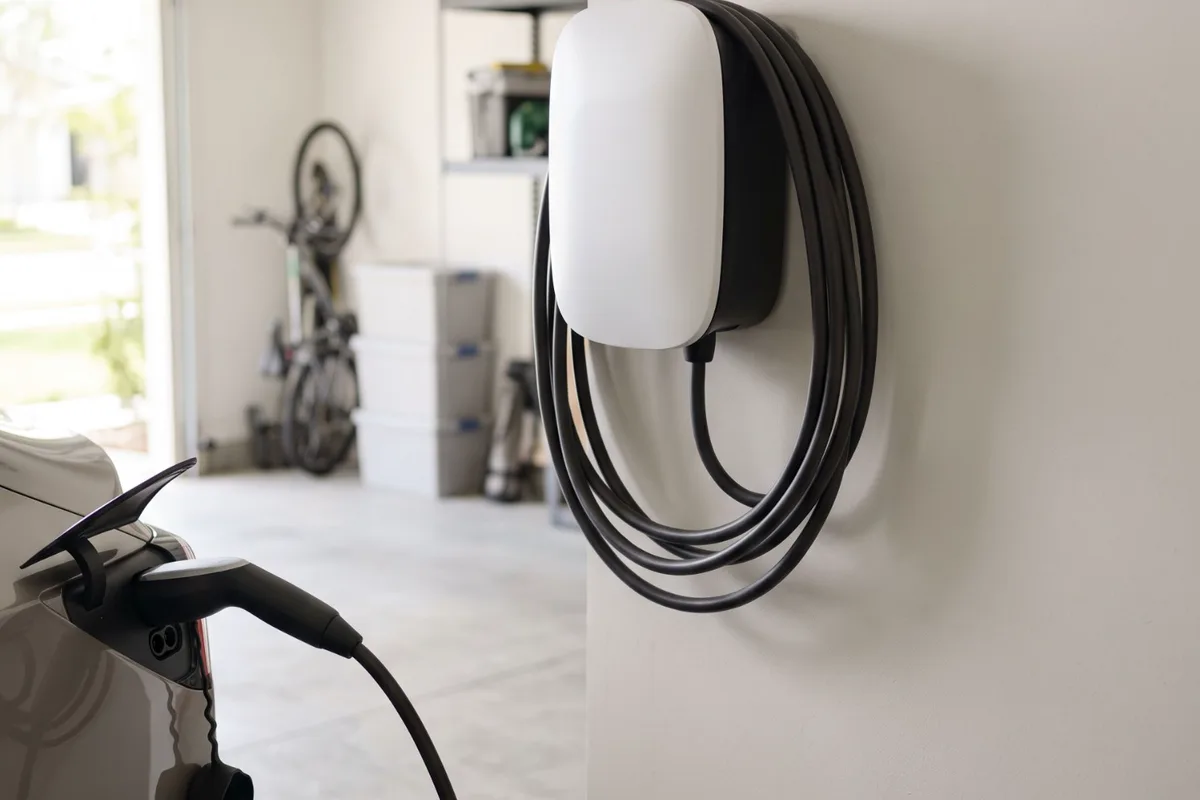
Can my home's power supply charge two electric cars?
- Most homes can charge two EVs. The real question is how quickly each car needs topping up.
- One shared charger works when the cars charge on alternate nights or one car only does short trips.
- Two chargers with load management share a modest supply by slowing charging when the house is busy.
- Three-phase makes sense when both cars cover long distances, charging windows are short, or the home has other big electric loads.
Start with how far both cars go
Two EVs don't mean twice the charging every night. Most cars cover a modest distance on a normal day, and a few hours of charging replaces it. Write down each car's typical daily distance, when it is home and how long it sits there. That simple list decides most of the plan.
A household with one commuter car and one car for local trips has very different needs from two long-distance commuters who both get home at seven and leave at six. The first can often share one charger. The second needs more capacity, more time or both.
Two chargers with load management
Where both cars need regular charging, two chargers make life easier. Load management uses a sensor on the incoming supply to measure what the house is drawing and slows charging when the oven, heating and hot water are all on. Some chargers can also share one circuit's capacity between two units, splitting it when both cars are plugged in.
Load management doesn't add capacity; it shares the supply you already have. It suits loads that can wait, like overnight charging. If the main switch already trips with nothing flexible running, the supply itself needs attention, and that is where a supply upgrade comes in alongside it.
When three-phase makes sense
Three-phase makes sense when the loads are large and overlap. Two cars that both drive long distances and charge in a short overnight window, cars that can use higher three-phase charging rates, or a home that also runs ducted reverse-cycle, induction and a heat pump water heater in the same evening can all push past what one phase comfortably carries.
Your distributor decides whether three-phase is available at your property and on what terms. New consumer mains and main switchboard work are prescribed work, inspected by a Licensed Electrical Inspector. A larger single-phase supply with load management is sometimes enough, so we check that alongside three-phase and lay out both options.
Charging schedules that work
Staggering helps even on a big supply. Set one car to start when the household winds down for the night and the other a few hours later, so they aren't both pulling full power while dinner is cooking. Most cars and chargers can schedule around your electricity plan.
With solar, a car that stays home during the day can soak up surplus power, leaving the night for the commuter car. Our view: plan for both cars now, even if the second is a year away. Circuit routes, charger positions and board space are far easier to set up once than to retrofit.
Every charger circuit needs safety switch protection, and each installation comes with a Certificate of Electrical Safety.
Questions that come next
Sources for this article
3 sources, with the date each was checked
- 1.Energy Safe Victoria: 'Prescribed' certificates are for electrical installation work that requires inspection by a Licensed Electrical inspector. This includes (but is not limited to): Consumer mains cables, main switchboard, meter box and… Accessed 30 September 2026.
- 2.Energy Safe Victoria: Clause 2.6.3.2.2 requires all final sub-circuits in a domestic installation be protected by a residual current device (RCD). A hot water service is included in this requirement Accessed 30 September 2026.
- 3.Energy Safe Victoria: Whenever a licensed electrician completes any electrical installation work, they must provide a Certificate of Electrical Safety (COES). Accessed 30 September 2026.