
Should my home office have its own power circuit?
- A laptop, screens and a router draw little power, so most offices only need more outlets in the right places.
- A heater, laser printer or bar fridge sharing the circuit is what usually tips an office over the edge.
- If the desk goes dead when the kettle or dryer runs elsewhere, the circuit is shared and overloaded.
- A dedicated circuit with its own safety switch keeps a fault elsewhere in the house from dropping your desk.
What an office actually draws
A laptop, two monitors, a router and a desk lamp together draw less than a kettle. Power-wise, a typical work-from-home desk is a light load, and on its own it rarely justifies a new circuit. What it does need is enough outlets where the desk actually sits, so the setup isn't running off a power board tucked behind the bookshelf.
The picture changes when the room carries more. A plug-in heater on a cold July morning, a laser printer warming up, a bar fridge or a gaming PC can push an ordinary power circuit past what its protection allows, especially when the same circuit also feeds the laundry or the kitchen. That's when the breaker trips, usually halfway through a call.
When a dedicated circuit is worth it
We'd put an office on its own circuit when a heater lives in the room through winter, when a printer, server or small fridge runs alongside the computer, or when a dropped connection costs real money: client calls, remote access to a work system, recording or broadcasting. It also makes sense in a converted garage or backyard studio, where a new run from the board is often needed anyway.
A dedicated circuit runs from its own protection on the switchboard to the office, with nothing else on it. Energy Safe Victoria guidance says the Wiring Rules require every final sub-circuit in a home to be protected by a safety switch, and we give an office circuit protection of its own. A fault in the garden lights or an old garage fridge then trips its own circuit and leaves your desk running.
When extra points are enough
If nothing heavy shares the circuit and the only complaint is too few outlets, adding points or swapping singles for doubles is usually the answer. A double at desk height, one behind the screens and one on the far wall for a lamp clears most of the leads. USB power points save a few chargers on the desk, although they don't add any capacity.
Extending an existing circuit is lighter work than running a new one. A regulators' advisory note on the Wiring Rules gives the example that when an existing power-point circuit is extended with an extra outlet, only the altered circuit needs a safety switch fitted, so it rarely means a switchboard overhaul.
Surge protection is a separate question
A dedicated circuit protects the workday from overload trips. It does nothing about a voltage spike from a lightning strike reaching the computer. Energy Safe Victoria explains that surge diverters capture voltage spikes in the wiring that would otherwise pass into equipment, and that they don't protect people from electric shock the way a safety switch does.
For most home offices, a surge diverter at the switchboard covers the whole house, and a good surge-protected power board at the desk adds a second layer for the computer and router.
What to sort out before you book
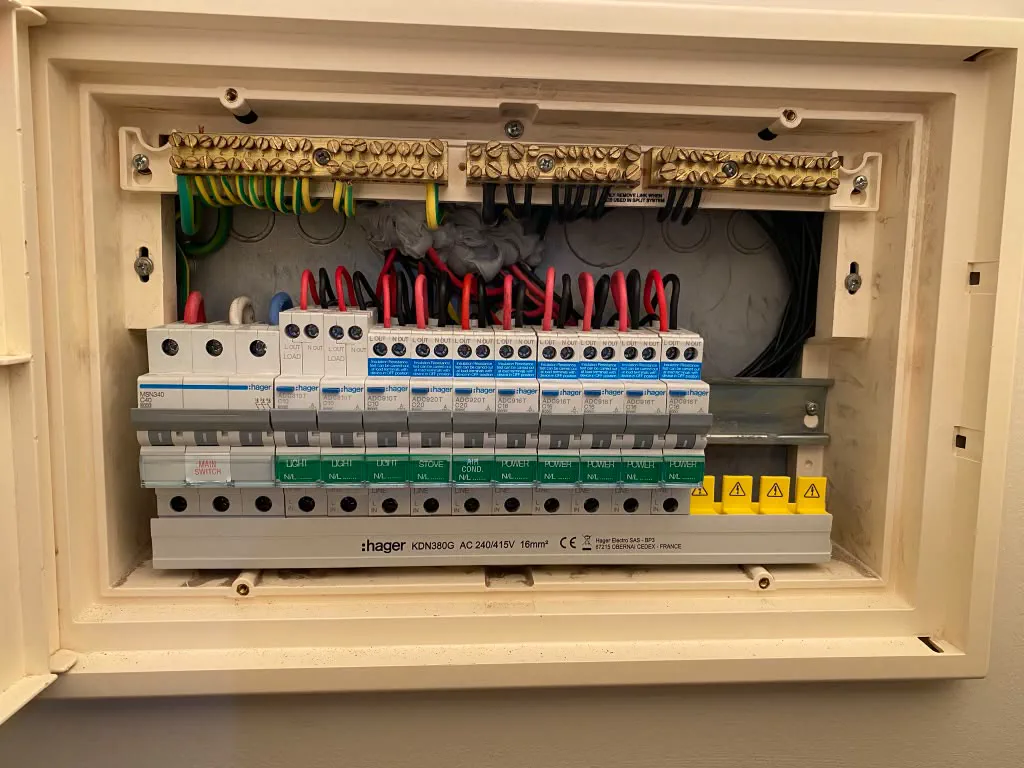
List what the room will run: computer gear, heater, printer, fridge, and anything planned such as a split system. Take a photo of the switchboard and note which breaker kills the office now. That tells us whether the job is a few points, a new circuit, or both, and you'll have the price before any work starts.
A new circuit usually means a short power-off while the switchboard work is done, so pick a day without a deadline. Energy Safe Victoria is clear that electrical work isn't a DIY job, even something as small as changing a power point, and a Certificate of Electrical Safety is issued for the work when it's finished.
Questions that come next
Sources for this article
6 sources, with the date each was checked
- 1.Energy Safe Victoria: Clause 2.6.3.2.2 requires all final sub-circuits in a domestic installation be protected by a residual current device (RCD). A hot water service is included in this requirement Accessed 30 September 2026.
- 2.Electrical Regulatory Authorities Council (ERAC): An existing final sub-circuit for socket outlets is extended and an additional socket outlet is installed. Only that circuit that is altered is required to have a RCD fitted. Accessed 30 September 2026.
- 3.Energy Safe Victoria: Surge diverters protect the property from voltage surges such as those resulting from a lightning strike. The surge diverter captures the voltage spikes in the wiring that would otherwise be transferred into the… Accessed 30 September 2026.
- 4.Energy Safe Victoria: Electrical work isn’t a DIY job, even for small jobs such as changing power points or light switches. Accessed 30 September 2026.
- 5.Energy Safe Victoria: Whenever a licensed electrician completes any electrical installation work, they must provide a Certificate of Electrical Safety (COES). Accessed 30 September 2026.
- 6.Access Canberra Electrical Inspections (ACT Government), Electrical Fact Sheet, updated September 2019: Air-conditioning and heat pump systems incorporating a compressor shall be provided with an isolating switch (lockable) in accordance with Clause 2.3.2.2, installed adjacent to but not on the unit, which isolates all… Accessed 30 September 2026.