
The key points
- Fault finding is a process of elimination: narrow the fault to a circuit, then to a section of cable, a fitting or an appliance.
- Most answers come from tests done with the power off, which is why parts of the house go off in turn during a visit.
- Intermittent faults are the hardest. A short log of when it happens, the weather and what was running often saves a second visit.
- Resetting a safety switch over and over feeds power back into the fault. Reset once, then leave it off.
- A repair is electrical installation work, so it ends with a retest and a Certificate of Electrical Safety.
It starts with your description, not the meter
The first tool is a set of questions. What stopped working, which rooms, what was running, what the weather was doing and whether it has happened before. A safety switch that drops out when it rains points somewhere very different from one that trips when the kettle and oven run together.
Then comes the switchboard. Which device has operated says a lot. A circuit breaker trips on overload or a short circuit. A safety switch trips when current leaks to earth, the kind of fault that can hurt someone, and Energy Safe Victoria says it turns the power off within 0.03 of a second. A board with several circuits behind one safety switch takes more narrowing down than one where each circuit has its own.
Labels help, but in older homes they're often wrong, especially after a few renovations. Part of a fault-finding visit is working out what each breaker actually feeds.
Narrowing it down, one circuit at a time
The core of fault finding is elimination. With everything unplugged on the affected circuit, does the fault still happen? If not, the cause is probably an appliance, and plugging them back in one at a time usually finds it. If it does, the problem is in the fixed wiring: a power point, a light fitting, a junction or the cable itself.
Where one safety switch covers several circuits, the electrician isolates them one by one, switching breakers off until the safety switch holds. That points to the circuit. From there, the circuit is split at points and junctions along its run until the faulty section is found.
This is why the power goes off in parts during a visit. You should be told before anything is switched off, so fridges, freezers, home offices and medical equipment can be planned around.
The tests behind the answer
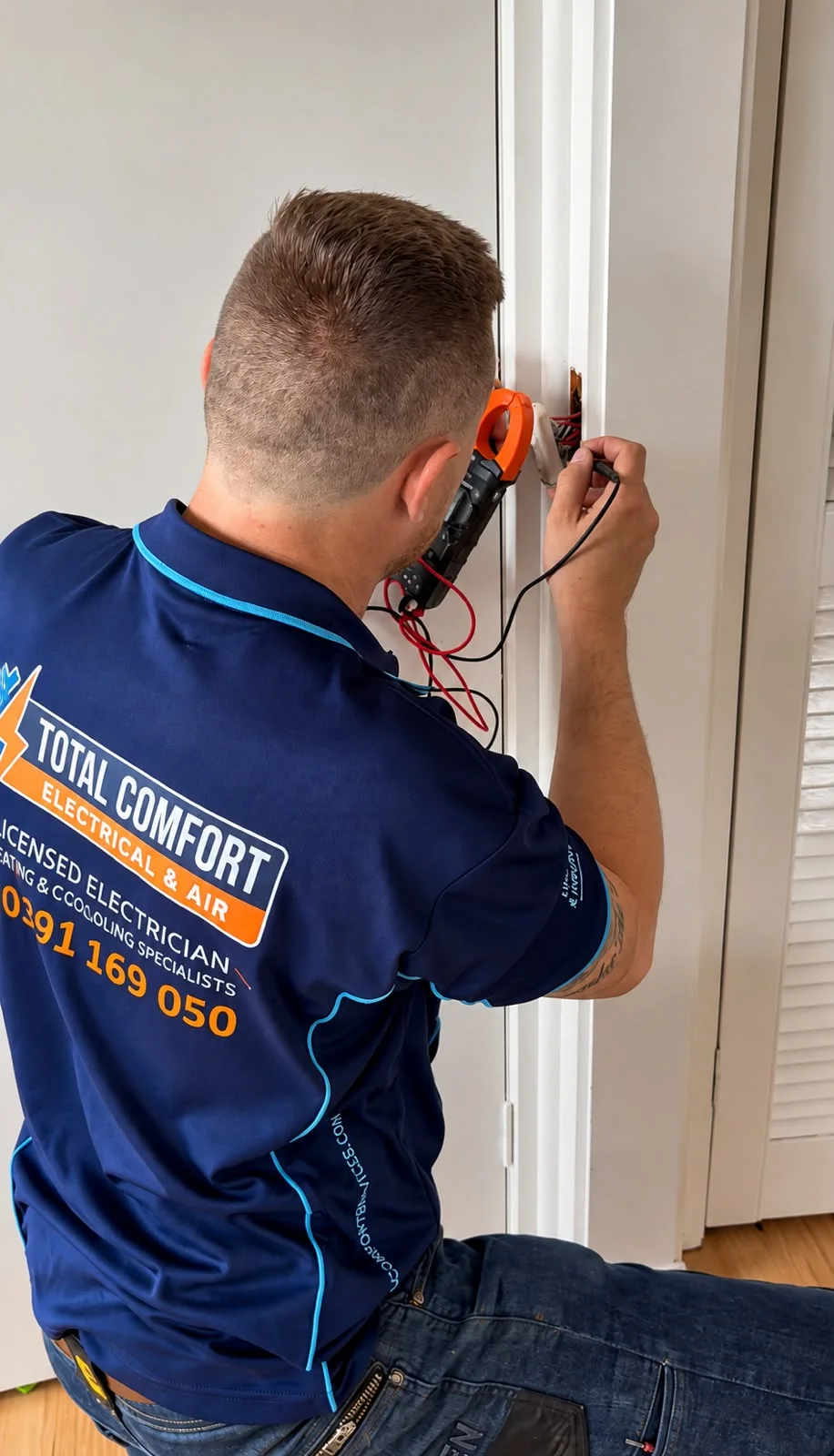
Most of the evidence comes from standard tests done with the power off. An insulation resistance test applies a test voltage between the conductors and earth and measures how well the insulation is holding. Cable that's damp, chewed, crushed or perished shows up as a low reading, often before anything has started tripping.
Continuity tests check that conductors are unbroken end to end and that the earth path is sound. A high reading on a run that should be low points to a loose or corroded joint, the classic cause of a warm power point or lights that flicker.
With power restored, the electrician checks polarity, confirms the safety switch trips as it should and checks the fault has gone. These are measurements, not hunches, and it's reasonable to ask what the readings showed.
- Insulation resistance: is the insulation breaking down anywhere on the circuit?
- Continuity: are the conductors and earth unbroken, with sound joints?
- Polarity: are active and neutral where they should be?
- Safety switch trip test: does it cut the power when it should?
Chasing a fault that won't show itself
Intermittent faults come and go with heat, moisture and load. A circuit can test clean on a dry morning and trip on a wet night, or a joint can hold until it warms up under a heater. In Melbourne's west, outdoor circuits that trip after rain or when the sprinklers run are a common example.
Dead tests often catch the weakness anyway, because degraded insulation reads low even when it isn't actively faulting. Opening junctions and fittings along a suspect run finds connections that look fine until they're touched. Sometimes the fault only appears with one appliance, or one combination of appliances, running.
When it still hides, your notes become the best tool there is. Two or three dated entries can turn a guess into a pattern.
- Date and time it happened.
- Weather: dry, raining, hot or windy.
- What was running at the time.
- Which device tripped, and whether it reset.
How you can help before the visit
Energy Safe Victoria advises householders who lose power to check whether the safety switch has tripped, reset it, and call a licensed electrician if it won't reset. Reset it once. If it drops straight back out, leave it off. Each extra reset sends power back into whatever caused the trip.
Unplug what's easy to reach on the dead circuit, note what was running and photograph the switchboard without removing any covers. Clear a path to the board and the manhole. Mention anything recent: a new appliance, someone drilling into a wall, a storm.
What not to do matters as much. Don't hold or tape a breaker on, don't open the switchboard or remove fittings, and don't run extension leads from another room around a dead circuit. Energy Safe Victoria says electrical work isn't a DIY job, even changing power points or light switches.
The repair, the retest and the paperwork
Once the cause is found, the repair might be a burnt terminal remade, a failed breaker or safety switch replaced, an appliance retired, or a length of damaged cable replaced. The circuit is then retested, because a second weak joint further along the same run is common.
In Victoria, repair counts as electrical installation work, so a licensed electrician must provide a Certificate of Electrical Safety when it's done. For work on things like power points and lights, Energy Safe Victoria says your copy is due within 30 days.
Testing sometimes finds more than the fault you called about, such as ageing insulation across several circuits or a board with no safety switch. That should be explained, made safe if it's dangerous, and priced separately. We give the price before work starts, so anything beyond the original fault is your decision.
Fault finding or a safety check?
Fault finding chases a problem you've noticed until the cause is found. A safety check inspects and tests the whole installation for problems that haven't shown up yet, and ends with a written report. They use many of the same tests but answer different questions.
If the fault turns out to be ageing wiring in an older house, a wider check may be the sensible next step. Energy Safe Victoria advises owners of houses over 30 years old to have their wiring checked by a licensed electrician, and lists old switchboards without a safety switch, flickering lights and sparks from switches or power points as tell-tale signs of faulty wiring.
Common questions
Quick answers
- Why do my lights dim when the air conditioner or fridge starts?A brief dip as a motor starts is common.
- Why does my power point only work some of the time?A power point that comes and goes has a connection that is making and breaking contact.
- How do I describe an electrical fault in my enquiry?Tell us what stopped working, when it started, what was running at the time and what the switchboard shows.
- Why can I hear crackling in my walls or ceiling?Most creaks and ticks in walls and ceilings come from timber, roofing and pipes expanding and contracting, or from animals.
Sources for this guide
7 sources, with the date each was checked
- 1.Energy Safe Victoria: monitors the flow of electricity through a circuit detects a problem that may pose a risk to personal safety turns the power off within 0.03 of a second always has a test button and '30ma' printed on them. Accessed 30 September 2026.
- 2.Energy Safe Victoria: Locate your electricity box outside your home and check whether the safety switch has tripped. If it has tripped, reset the switch. If the switch won’t reset, call a licensed electrician. Accessed 30 September 2026.
- 3.Energy Safe Victoria: Electrical work isn’t a DIY job, even for small jobs such as changing power points or light switches. Accessed 30 September 2026.
- 4.Victorian Legislation (legislation.vic.gov.au) - Electricity Safety Act 1998, authorised version 089 (effective 8 Sep 2026): electrical installation work means installation, alteration, repair or maintenance of an electrical installation; Accessed 30 September 2026.
- 5.Energy Safe Victoria: Whenever a licensed electrician completes any electrical installation work, they must provide a Certificate of Electrical Safety (COES). Accessed 30 September 2026.
- 6.Energy Safe Victoria: The Registered Electrical Contractor or Licensed Electrical Worker will complete the COES and is required to provide you with a copy within 30 days. Accessed 30 September 2026.
- 7.Energy Safe Victoria: Old switchboards, particularly those without a safety switch Old power switches or power points, particularly broken ones Flickering lights Sparks from switchboards, switches or power points. If your house is over 30… Accessed 30 September 2026.
Planning advice for homeowners. Installation requirements depend on the property and equipment. Where this guide refers to Victorian safety or rental rules, use the linked official guidance for the current requirements.