
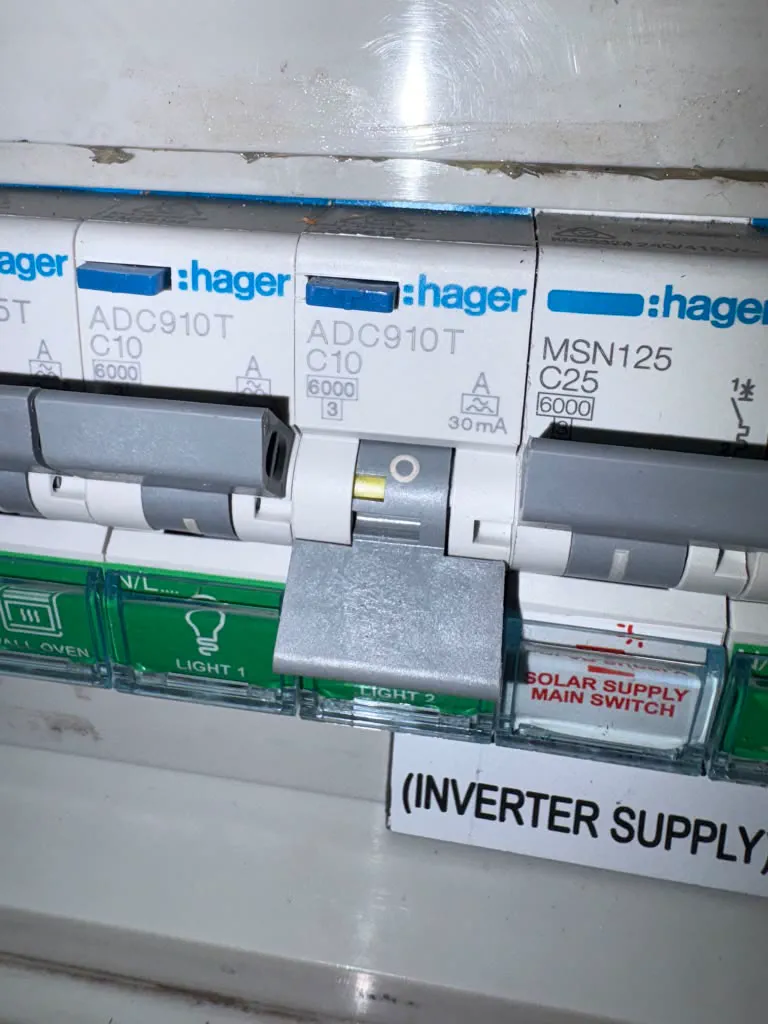
The key points
- An RCBO is a circuit breaker and a safety switch in one device. It protects one circuit against overload, short circuit and current leaking to earth.
- With grouped safety switches, one fault or a build-up of small leaks switches off every circuit in the group. With RCBOs, only the faulty circuit goes off.
- Per-circuit protection makes faults quicker to find, because the device that trips tells you which circuit to look at.
- Grouped safety switches are still a sound layout. RCBOs make most sense when a board is being replaced or rebuilt, or when one trip takes out too much of the house.
What an RCBO combines
A modern switchboard has two kinds of protection doing different jobs. A circuit breaker trips when more current flows than the cable can safely carry, from an overload or a short circuit. It protects the wiring. It does nothing for a person touching something live, because the current through a body is far too small for a breaker to notice.
A safety switch, or RCD, does that second job. Energy Safe Victoria describes it as a device that monitors the flow of electricity through a circuit, detects a problem that may put people at risk and turns the power off within 0.03 of a second. It compares the current going out on the active wire with the current coming back on the neutral. If some is missing, it is leaking to earth, possibly through someone.
An RCBO (a residual current breaker with overcurrent protection) puts both jobs into one device for one circuit. It looks like a breaker, sometimes a slightly wider one, usually with a test button and '30mA' printed on it. It trips for an overload, a short circuit or leakage to earth.
Grouped safety switches and per-circuit RCBOs
There are two common ways to give a board shock protection. In the grouped layout, two or three safety switches each sit in front of a set of ordinary circuit breakers. One might carry the kitchen and laundry power points and some of the lights, another the bedrooms and the rest of the lights. Each safety switch watches its whole group at once.
In the per-circuit layout, every circuit has its own RCBO behind the main switch, so each final circuit stands on its own.
Many older boards in Melbourne's west are neither. A fuse board or early breaker board often had one safety switch added for the power points, while the lights, oven and hot water stayed on breakers or fuses alone. Energy Safe Victoria notes that safety switches may not protect all wiring and appliances, so seeing one on the board doesn't mean everything is covered. That mixed layout is the one most worth fixing, whichever way you go.
Nuisance tripping: why grouping matters
Every appliance leaks a tiny amount of current to earth in normal use. Fridges, washing machines, computers, chargers and the heating elements in kettles and ovens all add a little. On a grouped safety switch those small leaks add together on one device. Most of the time the total sits well under the trip point, but an ageing element or a damp outdoor fitting can push it over.
When that happens, the safety switch drops every circuit in its group: the kitchen, the fridge, the lights in half the house and the modem. The fault might be one tired kettle, but the whole group pays for it. Storms, damp winter mornings and the first week the heaters come out are common times for it.
With RCBOs, each circuit carries only its own leakage, so the build-up doesn't happen, and one fault takes out one circuit. If the fridge and the outdoor points are on different RCBOs, a wet garden light can't switch off the freezer while you're away. For many households that's the strongest practical argument for per-circuit protection.
Fault finding is faster per circuit
When a grouped safety switch trips, the first question is which of its circuits caused it. Answering that means switching breakers off one at a time, resetting and watching what holds, then unplugging appliances one by one. It works, but an intermittent fault that only shows up after rain can take more than one visit to pin down.
With an RCBO on each circuit, the device that trips names the circuit. You can leave it off, keep the rest of the house running and tell the electrician exactly which circuit went and what was on at the time. That narrows the search before anyone opens a cover.
Our guide to a safety switch that keeps tripping covers what to write down when a trip happens. Energy Safe Victoria asks householders to press the test button on each safety switch every three months, and on an RCBO board that means every RCBO, one at a time.
When each layout makes sense
Grouped safety switches are a sound layout. A board where they cover every circuit, in sensible groups that pass their tests and rarely trip, doesn't need ripping out.
RCBOs earn their place in a few situations. The board is being replaced anyway, so per-circuit protection is a small part of a bigger job. One trip regularly takes out too much, such as the fridge, the lights and a home office together. Something needs to stay on, like a freezer, home medical equipment or a security system. Or a few circuits on the board have no safety switch at all and need one.
Energy Safe Victoria notes that the Wiring Rules require additional safety switch protection when an existing installation is altered, and safety switches on all final sub-circuits when a switchboard is replaced. Adding a circuit for an air conditioner or cooktop, or replacing the board, is the natural time to decide on the layout.
- One trip takes out the fridge, lights and modem together: RCBOs are worth a look.
- Some circuits have no safety switch at all: add protection, by RCBO or another safety switch.
- The board is being replaced: per-circuit protection is a small extra on the day.
- Grouped switches that test well and rarely trip: usually fine as they are.
Can your existing board take RCBOs?
Sometimes. RCBOs have to match the board's chassis and busbar, which usually means the same maker's range. A board in good condition, with spare room and a range of devices still made, can often be converted circuit by circuit. A fuse board can't take them at all, some older ranges are discontinued, and in some ranges an RCBO is wider than the breaker it replaces, so a full board may not have room. An electrician checks the make, space and condition of the board before recommending anything.
The device itself matters too. Energy Safe Victoria has made it an offence since 3 July 2019 to supply a consumer in Victoria with a prohibited RCBO, and it says Type AC safety switches must not be installed in Australia, even as like-for-like replacements. A cheap device bought online is not the place to save money. What goes into your board should be chosen and fitted by a licensed electrician.
What changes when RCBOs go in
Converting a board means the power is off while circuits are moved across, and each circuit is tested before it's reconnected. That test matters. A breaker ignores leakage to earth and an RCBO doesn't, so a circuit that ran happily on a plain breaker for years can trip as soon as it has shock protection. A worn oven element, an old outdoor light with water in it or cable insulation breaking down are the usual reasons.
That isn't the RCBO being faulty. It's showing you a problem that was already there. Testing before connection catches most of it, but the odd appliance shows itself in the first few weeks. Reset once. If it trips again, leave it off and note what was running.
When the work is finished, a licensed electrician must give you a Certificate of Electrical Safety. Keep it with a photo of the labelled board, so the next person knows which circuits are protected and how.
Common questions
Quick answers
- Is a safety switch power point the same as a safety switch on the board?No.
- What's the difference between a safety switch and a circuit breaker?A safety switch protects people.
- What do the numbers and letters on my circuit breakers mean?The number is the breaker's rating in amps: the current it can carry continuously without tripping.
- Why does my washing machine or dishwasher trip the safety switch?Water and worn heating elements are the usual causes.
Sources for this guide
8 sources, with the date each was checked
- 1.Energy Safe Victoria: monitors the flow of electricity through a circuit detects a problem that may pose a risk to personal safety turns the power off within 0.03 of a second always has a test button and '30ma' printed on them. Accessed 30 September 2026.
- 2.Energy Safe Victoria: Follow these steps to check your safety switch every three months: Press in the test buttons on each safety switch which will cut the power and trip the switch into the off position. You may hear a clunking sound. If… Accessed 30 September 2026.
- 3.Energy Safe Victoria: Clause 2.6.3.2.5 of the Wiring Rules states: Additional protection by RCDs shall be provided in existing electrical installations where alterations or a switchboard replacement is completed. Accessed 30 September 2026.
- 4.Energy Safe Victoria: If a switchboard is required to be replaced then as per clause 2.6.3.2.5 (Alterations to installations and replacement of switchboards) of AS/NZS 3000: RCD’s are required on all final sub-circuits. Accessed 30 September 2026.
- 5.Energy Safe Victoria: After 3 July 2019, it is an offence for any person to supply a consumer in Victoria with a prohibited RCBO. No, the prohibition is only applicable in Victoria. Accessed 30 September 2026.
- 6.Energy Safe Victoria: Type AC RCDs must not be installed in Australia. This includes like for like replacement. We recommend that electrical contractors advise customers of the new requirements. However, it is not mandatory to replace… Accessed 30 September 2026.
- 7.Energy Safe Victoria: Whenever a licensed electrician completes any electrical installation work, they must provide a Certificate of Electrical Safety (COES). Accessed 30 September 2026.
- 8.Energy Safe Victoria: Gas and electricity are inherently dangerous and it’s illegal and potentially fatal for unlicensed and unqualified people to undertake any electrical or gasfitting work. Homeowners and consumers must always use… Accessed 30 September 2026.
Planning advice for homeowners. Installation requirements depend on the property and equipment. Where this guide refers to Victorian safety or rental rules, use the linked official guidance for the current requirements.