
The key points
- A broken fitting is a repair the rental provider pays for. A new fan, power point or light is a change you're asking permission for.
- Swapping in LED globes that don't need new fittings is one of the changes renters can make without asking.
- Anything that touches fixed wiring needs the rental provider's consent, and it must be done by a licensed electrician.
- Put the request in writing: what, where, why, who does it, who pays and whether it stays when you leave.
- Unless agreed otherwise, renters must restore the property before the agreement ends, so settle what happens to the fan or point up front.
Repair or change: know which you're asking for
Start by sorting your request into the right box, because the rules are different. A light that doesn't work, a cracked power point or an exhaust fan that has died is a repair. Consumer Affairs Victoria says the rental provider must organise and pay for repairs unless the renter caused the problem, with urgent repairs done immediately and others within 14 days of a written request.
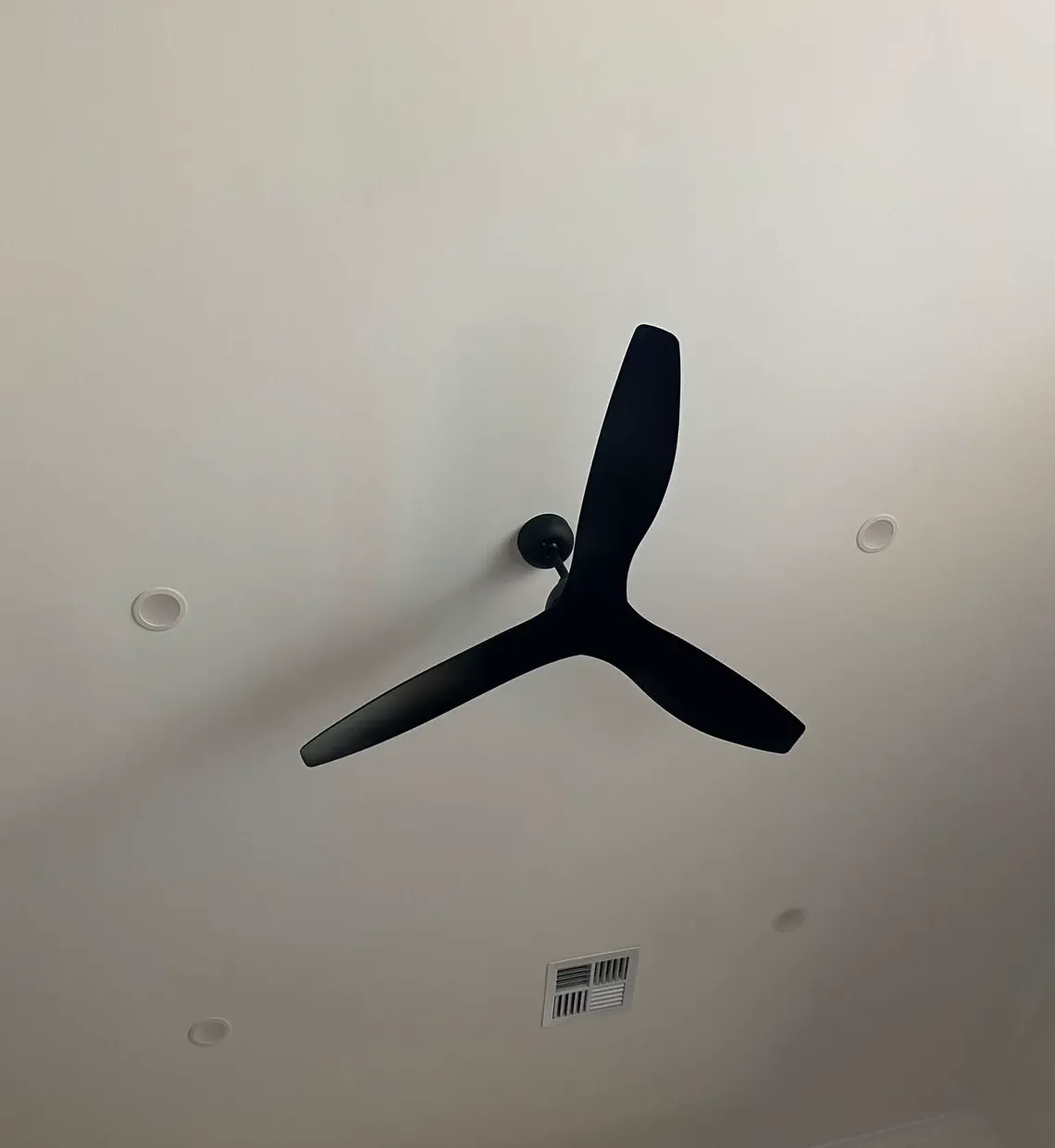
An extra power point behind the desk, a ceiling fan in the bedroom, USB outlets in the kitchen or a sensor light by the back door is a change to the property. That's a request for permission, and the conversation about who pays is a separate one.
Some things sit in between. Rooms and hallways must have enough light to be usable, with artificial light at night, so a bedroom with no working light at all is a minimum standards problem, not a nice-to-have.
What renters can do without asking
CAV lists changes renters can make without the rental provider's permission. Electrically, the useful one is LED light globes that don't need new light fittings. Swapping old halogen or incandescent globes for LEDs in the same fittings is fine.
Anything plugged into a power point is also your own business: lamps, plug-in timers, smart plugs and a fan on a stand. Use a power board with overload protection, keep heaters on a wall outlet, and don't run power boards off other power boards.
That's where it stops. Energy Safe Victoria says electrical work isn't a DIY job, even small jobs like changing power points or light switches, and that unlicensed electrical work is illegal and potentially fatal. Swapping a switch for a smart switch or a power point for a USB one is electrical work.
Changes that need the rental provider's consent
Ceiling fans, new or moved power points, USB power points, new light fittings, dimmers, smart switches, outdoor lights and data points all involve fixed wiring, so they need consent. CAV says that for changes beyond the no-permission list, renters must ask the rental provider's permission.
Some kinds of change can't be refused without a good reason, including some changes made for health and safety, security or access to phone and internet services. Whether a particular request falls into one of those categories depends on the change, so check CAV's current list before you rely on it. If you can't agree, CAV says the renter can apply to VCAT.
CAV also says the rental provider may require that changes be done by a suitably qualified person. For electrical work that's not optional anyway: it must be a licensed electrician.
How to write the request
A clear written request is easier to say yes to. Send it by email so there's a record, and keep it short and specific. Offer to have the electrician quote first so the rental provider can see exactly what's proposed.
Ask for the reply in writing too, and keep it with your lease, together with anything you agree about cost and what happens at the end of the agreement. A verbal yes from a property manager who later moves on is hard to rely on.
- What you want and where, with a photo of the spot
- Why: a home office, a hot bedroom, safety outside at night
- Who will do it: a licensed electrician working for a registered electrical contractor
- Who pays for the work
- Whether it stays when you leave, or is removed and made good
- When the work would happen and how long the power is off
Who pays, and what happens when you move out
Agree who pays before any work starts. Some rental providers will pay for a change that adds value, such as a ceiling fan in a hot upstairs bedroom, and some will split the cost. Others will agree only if the renter pays.
Then agree what happens at the end. CAV says that even with written consent, the renter must restore the property to its condition before the change, or pay for that, unless the rental provider agrees otherwise, it's written in the agreement or a modification bond was paid. Many rental providers would rather keep a well-installed fan or power point than have it removed, but get that in writing so there's no argument when you leave.
Why a licensed electrician is non-negotiable
Energy Safe Victoria says anyone planning electrical installation work must engage a registered electrical contractor, who sends a licensed electrician to do it. Whenever a licensed electrician completes electrical installation work, they must provide a Certificate of Electrical Safety. For non-prescribed work such as lights and power points, you must get a copy within 30 days. Give a copy to the rental provider or agent for their records.
Victorian rentals must already have power and lighting circuits protected by circuit breakers and safety switches. Extending a circuit keeps the new point on that protection, and a good electrician will check the circuit can take what you plan to plug in. A home office with a heater, screens and a printer on one new point may need more than a quick extension.
Common requests and what they involve
A USB power point in place of an existing one is usually a straight swap in the same spot. A new power point means running cable from a nearby circuit through the wall or roof space, which is simple in some walls and awkward in brick. A ceiling fan needs a sound ceiling fixing, usually an existing light point, and a wall control; in a room full of downlights, the electrician will check clearances to insulation.
Smart switches and dimmers need compatible LED globes and fittings, or they flicker and hum. Outdoor sensor lights need weatherproof fittings and a safe cable route. Telling the electrician the reason for the change helps them suggest the simplest version that does the job.
Common questions
Quick answers
- Why does my ceiling fan work but the light doesn't?If the fan runs but its light doesn't, the fault is on the light side: a failed globe or LED module, a light setting on the remote or wall control, or a loose connection…
- Why does my reverse-cycle heat the ceiling and leave my feet cold?Warm air rises, so a high-wall unit blowing gently forward can leave a warm layer at the ceiling and cool air at floor level.
- Can a power point be added to my kitchen island?Usually, yes.
- Do power point covers protect children?They help a little, but they're not the main protection.
Sources for this guide
7 sources, with the date each was checked
- 1.Consumer Affairs Victoria: The rental provider must organise and pay for all repairs if they are not the renter’s fault. Accessed 30 September 2026.
- 2.Consumer Affairs Victoria: Inside rooms, corridors and hallways must have access to light to make the areas functional. During the day, natural light can include light borrowed from an adjoining room. At night, renters should have access to… Accessed 30 September 2026.
- 3.Energy Safe Victoria: Electrical work isn’t a DIY job, even for small jobs such as changing power points or light switches. Accessed 30 September 2026.
- 4.Energy Safe Victoria: Gas and electricity are inherently dangerous and it’s illegal and potentially fatal for unlicensed and unqualified people to undertake any electrical or gasfitting work. Homeowners and consumers must always use… Accessed 30 September 2026.
- 5.Energy Safe Victoria: If you are planning to have electrical installation work done, you must engage a registered electrical contractor (REC). They will send a licensed and qualified electrician to do the work to the required standards. Accessed 30 September 2026.
- 6.Energy Safe Victoria: For electrical installation work performed within your electrical installation including but not limited to lights, power points, air conditioning, hot water service etc. Accessed 30 September 2026.
- 7.Consumer Affairs Victoria: From 29 March 2023 all power outlets and lighting circuits in a rental premises must connect to both a switchboard-type circuit breaker that complies with AS/NZS 3000 and a switchboard-type residual current device that… Accessed 30 September 2026.
Planning advice for homeowners. Installation requirements depend on the property and equipment. Where this guide refers to Victorian safety or rental rules, use the linked official guidance for the current requirements.