
The key points
- Surge protection looks after equipment, not people. It is not a safety switch.
- A switchboard surge diverter covers every circuit, hard-wired appliances included. A surge power board covers only what's plugged into it.
- The two work best as layers, and neither will save equipment from a direct lightning strike.
- A switchboard device is only as good as the earth behind it, so the earth gets tested first.
What a surge actually is
The power in your walls normally sits at a fairly steady voltage. A surge is a brief spike well above it, often over faster than a light can flicker. You rarely see one happen. You find out afterwards, when the modem is dead and the TV won't wake up.
Lightning hitting the network, or striking nearby, is the dramatic cause. Far more often it's the network switching, a fault further down the line, supply coming back after an outage, or big motors and compressors starting and stopping, some of them inside your own house.
What gets hurt is electronics. An old bar heater shrugs off most spikes. Control boards, power supplies and chargers don't, and most homes are now full of them: inverter air conditioners, fridges, garage door motors, solar inverters, TVs and the modem.
Switchboard surge diverters and surge power boards
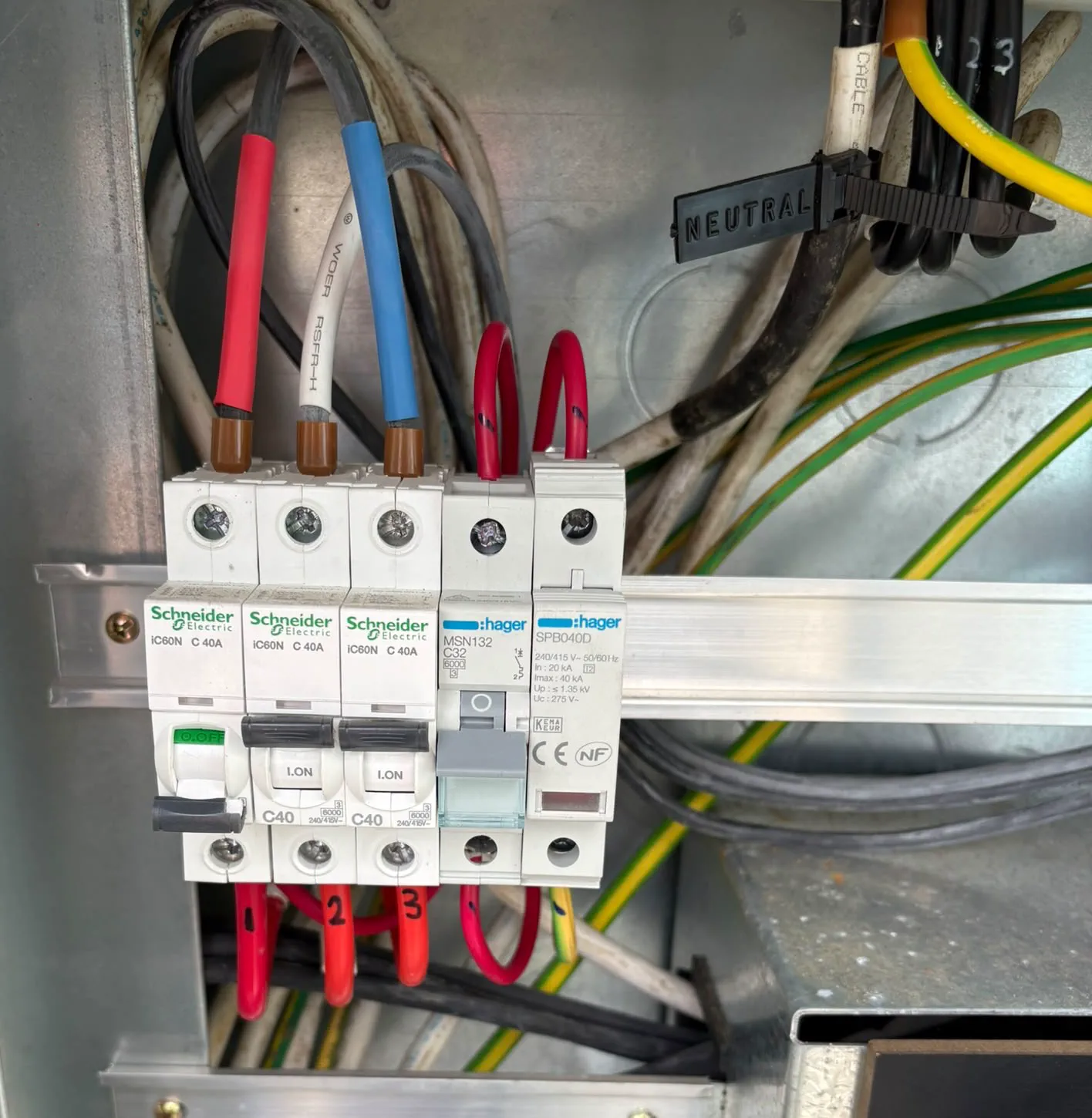
Energy Safe Victoria describes a surge diverter as a device that captures voltage spikes in the wiring that would otherwise be transferred into the equipment in your home. The whole-house version lives in the switchboard, fitted by a licensed electrician close to the main switch, where it sees everything arriving on the power wiring.
Because it sits at the board, it covers every circuit, including the things you can't plug into anything: the outdoor unit of a split system, ducted air conditioning, the oven, a pool pump, the garage door motor. That's its real advantage. No power board can reach hard-wired equipment.
A surge power board works at the other end. It only protects what's plugged into it, but it sits right beside that gear, so it catches what's left of a spike after the switchboard device has taken the brunt, plus smaller spikes made inside the house.
What surge protection won't do
It won't protect people. Energy Safe Victoria says surge diverters and circuit breakers don't act as safety switches for protection against electric shock. A safety switch monitors the flow of electricity through a circuit and turns the power off within 0.03 of a second when it detects a risk to personal safety. You want both.
It won't save equipment from a direct lightning strike on the house; the energy is simply too large. It won't keep the power on in a blackout. And tingles from a tap aren't a surge problem: stop using the tap and have a licensed electrician check the wiring.
Nor will it fix dull or flickering lights. For those, or a brownout, leave the switchboard and anything metal alone, unplug what you easily can and contact your electricity distributor. Around Laverton, Altona Meadows, Point Cook, Tarneit and Werribee that's Powercor. Jemena's area reaches Williamstown and Footscray, and CitiPower supplies parts of Port Melbourne.
Which homes get the most from it
The case gets stronger with the amount of expensive, hard-wired electronics in the house and the cost of going without it. An inverter air conditioner has control boards indoors and out, wired straight into the board. A home office that stops when the modem dies is another.
Solar and batteries raise the stakes. The inverter sits between the panels, the battery and your switchboard, electronics from end to end, so a home with solar or a battery has a lot riding on the board.
Older homes need a different starting point. A post-war weatherboard in Altona or an Edwardian cottage in Yarraville may still have its original board, with little spare room and an earth disturbed by decades of plumbing and paving. Energy Safe Victoria says the wiring should be checked if a house was built more than 30 years ago, and that comes first.
- Inverter split systems or ducted air conditioning.
- Solar panels, a battery or an EV charger.
- A home office that depends on the internet.
- Electronics that have died after past storms.
The earth and the board come first
A switchboard surge device works by giving a spike a short, easy path to earth. If the earth connection is poor, the spike looks for another way through, and your appliances are often it. So the first job is testing the main earth, not opening a box of parts.
Some older boards have no room for the device, and forcing one in helps nobody. That's often where a switchboard upgrade makes more sense. Energy Safe Victoria notes a replacement board needs safety switches on all final sub-circuits under AS/NZS 3000, and power can't go back on to a new main switchboard until a Licensed Electrical Inspector has inspected it. Surge protection is a small extra on that day.
None of this is a homeowner job. Energy Safe Victoria says electrical work isn't DIY, even changing a power point or light switch, and work inside a switchboard is well beyond that. When a licensed electrician finishes electrical installation work, they must give you a Certificate of Electrical Safety.
When a storm knocks the power out
Energy Safe Victoria's advice for a power failure is to turn off and unplug all electrical appliances at the power point, to help prevent equipment damage if there's a surge. The moment supply returns is a common time for a spike, so leave one light switched on and you'll know when the power is back.
If the neighbours still have power, look at your switchboard. Energy Safe Victoria says to check whether the safety switch has tripped, reset it, and call a licensed electrician if it won't reset. Reset it once, don't keep flicking it, and don't take any covers off.
Storms bring bigger risks than a dead modem. Keep well clear of fallen powerlines and anything they're touching, and treat them as live. Afterwards, note anything that didn't come back on. If your board has a surge device, check its status window without removing anything.
Getting more from surge power boards
Buy boards with an indicator that shows the protection still works. If your internet comes in over a copper phone line or the TV runs off a roof antenna, choose one with matching ports so those cables pass through it too. A spike on the antenna lead goes straight past a switchboard device.
A board wears as it absorbs surges, and a big one can use it up in one go. When the indicator goes out, replace it. Don't plug one power board into another, and if the lounge room needs a string of them, what it really needs is more power points.
When it makes sense to get Total Comfort in
Get us in if a storm has taken out more than one appliance, if you're planning switchboard, solar or air conditioning work, or if you don't know what's in your board. We'll test the earth, look at the board and tell you plainly whether a switchboard device is worth it, or whether a couple of decent power boards will do.
Total Comfort is a licensed electrical contractor (REC 38187) with 19 years in the industry, based in Altona Meadows. You get the price before we start, and the work comes with our lifetime workmanship guarantee. One local team handles electrical, heating and cooling, so we can look at the air conditioner that stopped after the storm too.
If the only question is which power board to buy for the TV, you don't need an electrician. Pick one with an indicator and the right ports.
Common questions
Quick answers
- An appliance stopped working after a storm. Was it a surge?It may have been.
- Should I unplug appliances during a thunderstorm?For sensitive and expensive electronics, yes, ideally before the storm arrives.
- Why didn't everything come back on after a power outage?When the power comes back, some things need help to restart.
- My air conditioner won't restart after a power outage. What now?Give it a few minutes first.
Sources for this guide
14 sources, with the date each was checked
- 1.Energy Safe Victoria: Surge diverters protect the property from voltage surges such as those resulting from a lightning strike. The surge diverter captures the voltage spikes in the wiring that would otherwise be transferred into the… Accessed 30 September 2026.
- 2.Powercor Australia, Project Assessment Draft Report: Altona Terminal Station (West) (June 2025): It supplies part of Melbourne’s western growth corridor. This includes the areas of Laverton, Laverton North, Altona Meadows, Werribee, Wyndham Vale, Mount Cottrell, Eynesbury, Tarneit, Hoppers Crossing and Point Cook… Accessed 30 September 2026.
- 3.Jemena Electricity Networks (Vic) Ltd, 2025 Distribution Annual Planning Report (2 December 2025): Figure 1-1 shows the JEN supply area, which ranges from Gisborne South, Clarkefield and Mickleham in the north to Williamstown and Footscray in the south, and from Hillside, Sydenham and Brooklyn in the west to… Accessed 30 September 2026.
- 4.CitiPower, Distribution Annual Planning Report December 2024 (hosted by the Australian Energy Regulator): The zone substation in Fisherman’s Bend (E) is served by two sub-transmission lines from Fisherman Bend Terminal station (FBTS). The zone substation supplies areas of Fisherman’s Bend and Port Melbourne. Accessed 30 September 2026.
- 5.Victorian Heritage Database (Heritage Council Victoria); entry maintained by Maribyrnong City Council: The general character of the Yarraville Residential Precinct is that of small Victorian & Edwardian single-storey detached housing with mainly weatherboard and some brick wall cladding, corrugated iron roofing, front… Accessed 30 September 2026.
- 6.Energy Safe Victoria: Old switchboards, particularly those without a safety switch Old power switches or power points, particularly broken ones Flickering lights Sparks from switchboards, switches or power points. If your house is over 30… Accessed 30 September 2026.
- 7.Energy Safe Victoria: If a switchboard is required to be replaced then as per clause 2.6.3.2.5 (Alterations to installations and replacement of switchboards) of AS/NZS 3000: RCD’s are required on all final sub-circuits. Accessed 30 September 2026.
- 8.Energy Safe Victoria: The electrician has eight business days after the work is completed to have that work inspected by a licensed electrical inspector (LEI). If an electrician replaces a main switchboard at a property, power cannot go back… Accessed 30 September 2026.
- 9.Energy Safe Victoria: Electrical work isn’t a DIY job, even for small jobs such as changing power points or light switches. Accessed 30 September 2026.
- 10.Energy Safe Victoria: Whenever a licensed electrician completes any electrical installation work, they must provide a Certificate of Electrical Safety (COES). Accessed 30 September 2026.
- 11.Energy Safe Victoria: In the event of a power failure turn off and unplug all electrical appliances at the powerpoint. This will help to prevent equipment damage in the event of a power surge. Accessed 30 September 2026.
- 12.Energy Safe Victoria: Locate your electricity box outside your home and check whether the safety switch has tripped. If it has tripped, reset the switch. If the switch won’t reset, call a licensed electrician. Accessed 30 September 2026.
- 13.Energy Safe Victoria: Gas and electricity are inherently dangerous and it’s illegal and potentially fatal for unlicensed and unqualified people to undertake any electrical or gasfitting work. Homeowners and consumers must always use… Accessed 30 September 2026.
- 14.Energy Safe Victoria: The point of supply is the changeover point from the electricity distribution network to the electrical installation, where the property owner becomes responsible for the maintenance and repair of the electrical… Accessed 30 September 2026.
Planning advice for homeowners. Installation requirements depend on the property and equipment. Where this guide refers to Victorian safety or rental rules, use the linked official guidance for the current requirements.