
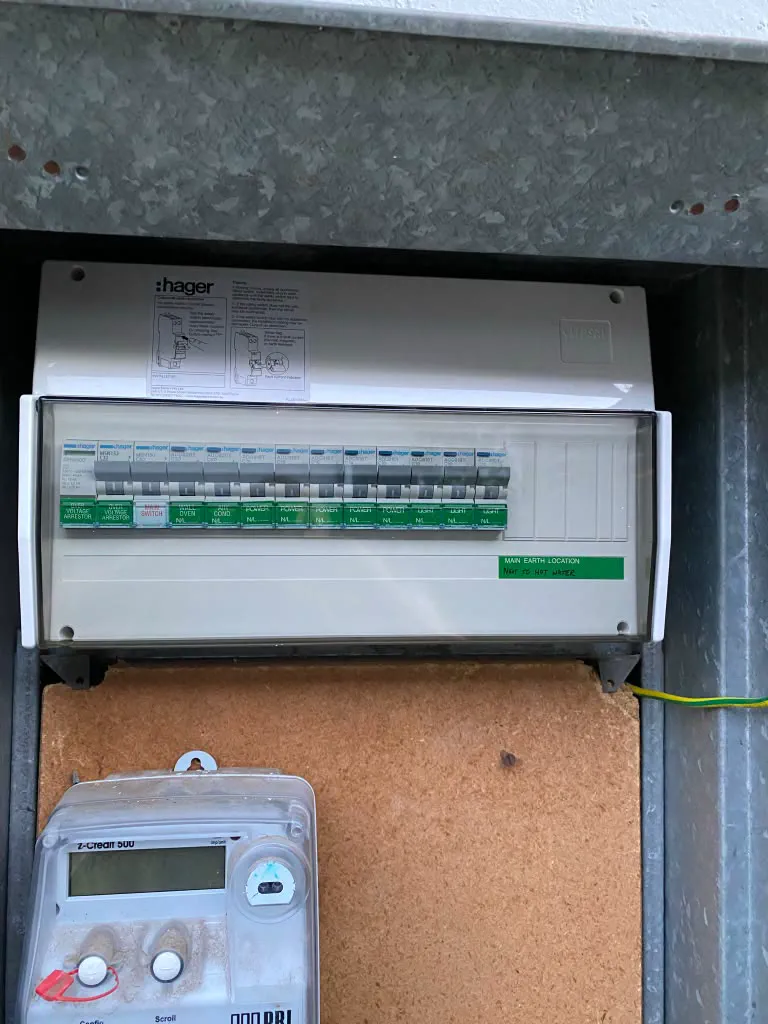
The key points
- The earthing system gives fault current a safe, low-resistance path, so a breaker or safety switch cuts the power quickly if something metal becomes live.
- At the switchboard, a main earthing conductor runs to an earth electrode, usually a stake driven into the ground near the meter box.
- Bonding connects metal such as water pipes to the same earth, so a tap and an appliance can't sit at different voltages during a fault.
- Plumbing changes, paving, landscaping and renovations can disturb the earth or the bonding without anyone noticing.
- The main earthing system is prescribed work in Victoria, and the earth is tested whenever a switchboard or mains is replaced.
What earthing does
Inside every appliance with a metal case, and every metal light fitting, there's a chance a live wire could come loose and touch the metal. Without an earth, that case would sit at mains voltage until someone touched it. With an earth, the fault current has an easy path back through the earth wire, enough current flows to trip the breaker or safety switch, and the power goes off.
That's the job in one sentence: give fault current a low-resistance path so the protection operates quickly. The earth pin on a plug and the green-and-yellow wire in a power point are the visible ends of it. The rest runs back through the cables to the switchboard and out to the main earth.
Earthing and safety switches work together. Energy Safe Victoria describes a safety switch as turning the power off within 0.03 of a second when it detects a problem that may put people at risk. A sound earth means a fault on a metal appliance shows up as leakage the safety switch can see straight away, rather than waiting for a person to complete the circuit.
The main earth at the switchboard
Inside the main switchboard is an earth bar that collects the earth wires from every circuit. From it, a main earthing conductor runs to an earth electrode, usually a metal stake driven into the ground close to the meter box or switchboard. You may see a green or green-and-yellow cable running down the wall into the ground, sometimes to a small cover or a label.
Australian homes use what's called a multiple earthed neutral, or MEN, system. At the main switchboard, the earth and neutral are linked, and the network's neutral is also earthed along the street. So a fault inside the home returns mostly through the wiring rather than through the soil, which is what makes the fault current large enough to trip protection quickly.
Because of that link, the earth also matters when something goes wrong with the neutral, such as a loose or broken neutral in the supply. That's one cause of tingles from taps and metal fittings. If you feel a tingle from a tap or appliance, stop using it, keep others away, let your distributor know and have a licensed electrician check it straight away.
Bonding: keeping metal at the same voltage
Earthing deals with metal that's part of the electrical installation. Bonding deals with other metal that could end up in a fault path, most often metal water pipes. A bonding conductor connects the pipework to the main earth, so the pipes and the earthed parts of the installation sit at the same voltage. If a fault occurs, there's no voltage difference between a tap and a metal appliance for a person to bridge.
In some older homes, the metal water service itself was used as part of the earth. That worked when every pipe was copper or galvanised steel. It works less well now that sections of pipe are often replaced with plastic, which doesn't conduct.
How plumbing and renovations affect it
A plumber replacing a length of copper with plastic, a new water meter, or a burst pipe fixed with a plastic joiner can break the electrical path that bonding or an older earth relied on. Nothing looks different and the taps work as before. The earth simply isn't there any more on part of the system.
Outside, the earth stake is easy to disturb. Concreting a path beside the house, laying pavers, building a deck or moving the meter box can bury, cut or loosen the stake and its connection. If you're landscaping near the meter box, find out where the earth runs and tell whoever is digging.
Inside, a renovation that replaces circuits or moves the switchboard changes the earth path too. That's why electricians test the earth whenever they work on the board, rather than assuming the old connection is still good.
Why the earth is tested during switchboard work
Energy Safe Victoria lists the main earthing system among examples of prescribed electrical work, alongside consumer mains, the main switchboard and the meter box. Prescribed work has to be inspected by a Licensed Electrical Inspector, and power can't go back onto a new main switchboard until that inspection is done.
On a switchboard or mains job, the electrician tests the resistance of the main earth, checks the connection at the electrode, confirms the MEN link and bonding, and tests earth continuity on each circuit. Earths are then checked where they're used: power points, metal light fittings and hard-wired appliances.
Surge protection depends on it too. Energy Safe Victoria explains that a surge diverter captures voltage spikes that would otherwise pass into your equipment, and it does that by giving them a short path to earth. A poor earth leaves the spike looking for another way through, which is why our guide to surge protection puts the earth first.
Signs the earthing may need a look
Most earthing problems are silent. There's no buzzing or smell, and everything works normally until there's a fault. A few situations are worth acting on.
Don't dig around the meter box looking for the stake, and never disconnect or move the earth cable. Energy Safe Victoria says it's illegal, and potentially fatal, for unlicensed people to do electrical work.
- A tingle from a tap, shower, metal sink or appliance.
- Plumbing work that replaced metal pipe with plastic near the house.
- Paving, concreting or landscaping near the meter box or switchboard.
- An older home with no visible earth cable near the meter box.
- A surge diverter or switchboard upgrade being planned.
- Metal light fittings or ceiling fans going onto old lighting circuits.
Common questions
Quick answers
- I felt a tingle from a tap or appliance. What should I do?Treat it as a warning.
- Do I need to be home for a switchboard upgrade?Someone should be there at the start and at the end, and the electrician needs access to the switchboard and to the rooms inside for testing.
- What is a sub-board, and do I have one?A sub-board is a smaller switchboard fed by its own cable from a circuit breaker on your main switchboard.
- Why does a Licensed Electrical Inspector need to check my new switchboard?Because replacing a main switchboard is prescribed work in Victoria.
Sources for this guide
4 sources, with the date each was checked
- 1.Energy Safe Victoria: monitors the flow of electricity through a circuit detects a problem that may pose a risk to personal safety turns the power off within 0.03 of a second always has a test button and '30ma' printed on them. Accessed 30 September 2026.
- 2.Energy Safe Victoria: 'Prescribed' certificates are for electrical installation work that requires inspection by a Licensed Electrical inspector. This includes (but is not limited to): Consumer mains cables, main switchboard, meter box and… Accessed 30 September 2026.
- 3.Energy Safe Victoria: The electrician has eight business days after the work is completed to have that work inspected by a licensed electrical inspector (LEI). If an electrician replaces a main switchboard at a property, power cannot go back… Accessed 30 September 2026.
- 4.Energy Safe Victoria: Gas and electricity are inherently dangerous and it’s illegal and potentially fatal for unlicensed and unqualified people to undertake any electrical or gasfitting work. Homeowners and consumers must always use… Accessed 30 September 2026.
Planning advice for homeowners. Installation requirements depend on the property and equipment. Where this guide refers to Victorian safety or rental rules, use the linked official guidance for the current requirements.