
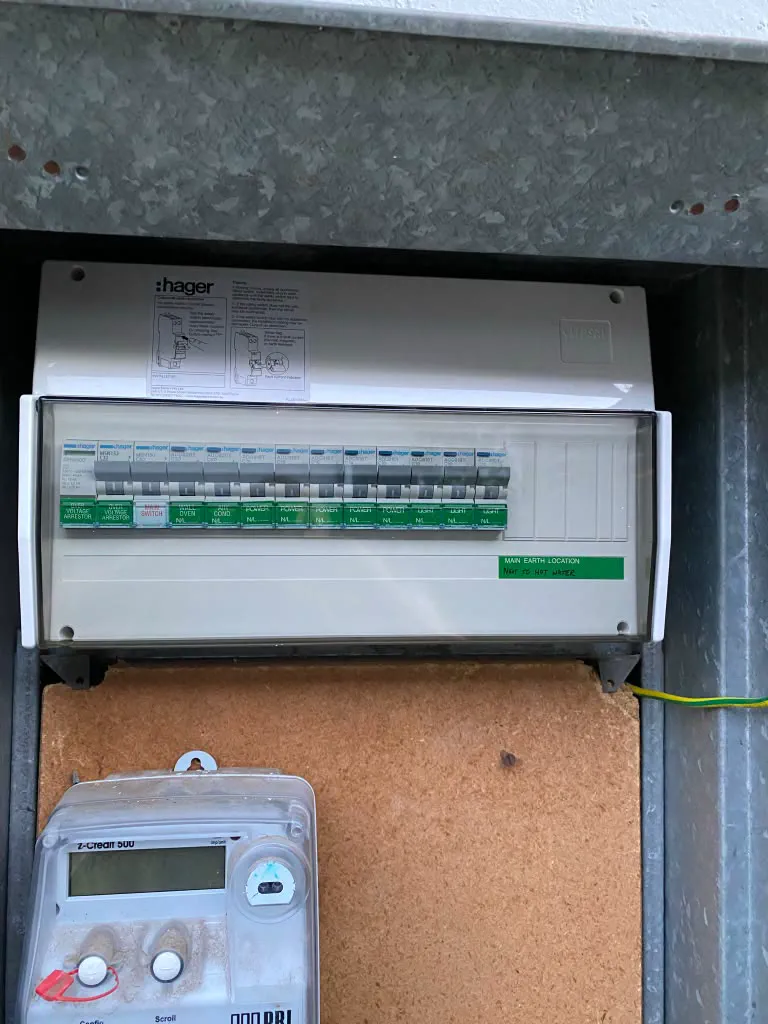
The key points
- Look, don't touch. Open the hinged door and read the fronts of the devices, but never remove a cover or anything held on with screws.
- The main switch turns off the circuits on that board, safety switches have a test button and '30mA' printed on them, and circuit breakers have a single toggle and a rating.
- Labels should tell you what each device covers. Missing or wrong labels are worth fixing before you need them in a hurry.
- Surge diverters, off-peak hot water devices and solar supply switches are common extras, each with its own markings.
- Scorch marks, buzzing, a burning smell or anything wet means close the door, keep people away and get an electrician.
Before you open the door
Most switchboards in Melbourne's west are in one of three places: in or beside the meter box on an outside wall, in the garage, or in a hallway or laundry cupboard. Newer estate homes in Point Cook, Tarneit and Werribee often have the board inside, and apartments and townhouses usually have a small board in the unit. This tour is about modern boards with circuit breakers. If yours has white ceramic fuse carriers instead, our guide to ceramic fuses and old switchboards is the one to read.
This is a reading exercise, not a hands-on one. Energy Safe Victoria says it is illegal, and potentially fatal, for unlicensed people to do electrical work, and that includes taking a cover off for a better look. Open the hinged door, stand back a little and use your eyes and a phone camera.
If you open the door and see scorch marks, melted plastic or water, or hear buzzing or crackling, stop there. Close the door, keep people away and get an electrician to look. If there is smoke, fire or immediate danger, get everyone out.
The main switch
The main switch is usually the largest device on the board, often with a red toggle, and labelled 'Main switch' or 'Main switch (normal supply)'. Switching it off disconnects every circuit on that board. It doesn't make the board itself dead: the cables coming in, the meter and the terminals feeding the main switch stay live.
Energy Safe Victoria describes the wiring up to the switchboard, which can include the line from the street and the meter, as equipment where the electricity can't be switched off. So the main switch is for isolating your circuits, not for making the board safe to work on.
Homes with solar panels usually have a second main switch labelled for the solar or inverter supply, and a sign on the board warning that there is more than one source of supply. Turning off the normal main switch doesn't turn off the solar side.
Safety switches: look for the test button
Energy Safe Victoria says a safety switch always has a test button and '30mA' printed on it, so those two markings are what you're looking for. On a board with grouped protection, you'll see two or three of them, each at the head of a row of breakers. On a newer board, every circuit may have its own RCBO, which looks like a breaker with a test button.
Count them and work out what they cover. A safety switch only protects the circuits wired through it. Some older boards have one for the power points while the lights, oven and hot water sit on plain breakers, and Energy Safe Victoria notes that safety switches may not protect all wiring and appliances. If you can't tell what's covered, an electrician can map it.
Note the type while you're there. Some devices are marked 'Type A' or 'Type AC', or carry a small symbol. Energy Safe Victoria says Type AC safety switches can't be installed any more, but existing ones installed, tested and certified before 1 May 2023 don't have to be replaced. It's useful to know next time the board is worked on.
Circuit breakers and what the markings mean
Circuit breakers are the narrower devices with a single toggle and no test button. Each one protects one circuit's cable from overload and short circuit. A tripped breaker usually sits in the off position, but on some brands it rests partway, so look along the row carefully rather than scanning for one that's fully down.
The marking on the front is usually a letter and a number, such as C16 or C20. The number is the current rating in amps. The letter describes how the breaker responds to a brief surge of current, and household breakers are commonly type C. Lighting circuits usually have lower ratings than power circuits, and an oven, cooktop or air conditioner on its own circuit has its own breaker.
Breakers protect cable, not people. Energy Safe Victoria says surge diverters and circuit breakers don't act as safety switches and don't protect people from electric shock. A row of breakers with no test button anywhere in front of them means those circuits have no shock protection.
Labels, sub-boards and the circuit chart
Each device should have a label: 'Lights bedrooms', 'Power kitchen', 'Oven', 'Hot water', 'A/C'. Many boards also have a circuit chart inside the door. Labels drift out of date after renovations, so check one or two against reality next time something trips by noting what went off.
Accurate labels save time when something trips at night or an electrician needs to isolate a circuit. Ask for them to be updated after any electrical work, and keep a photo of the labelled board with your house records.
You may also see a breaker labelled for a sub-board, such as 'Garage DB' or 'Granny flat'. It feeds a second, smaller switchboard elsewhere on the property, which has its own devices and sometimes its own safety switches. That board is worth reading the same way.
Surge diverters, off-peak devices and other extras
A surge diverter usually sits near the main switch and has a small status window or light. Energy Safe Victoria explains that surge diverters capture voltage spikes in the wiring that would otherwise pass into your equipment. Check the indicator after a big storm. If it shows a fault colour, or you can't tell what it means, ask your electrician; our guide to surge protection explains more.
If your hot water is on an off-peak or controlled load tariff, you may see a contactor, timer or relay labelled 'Off peak' or 'Hot water', sometimes with a small override switch. It decides when the hot water heater gets power, so a timer that has lost its setting is one reason the hot water runs cold. In many homes with a smart meter the switching happens in the meter instead, and there's nothing extra on the board.
Other things you might spot include a doorbell transformer, a time switch for garden lights, or a blank cover where a device used to be. If something is unlabelled and you don't know what it does, leave it alone and add it to your list of questions.
- The whole board from a step back, with the door open.
- Close-ups of each label and marking you can read without touching.
- Every test button, and how many there are.
- The surge diverter indicator, if there is one.
- Anything scorched, cracked, wet or unlabelled.
What's yours to do, and what isn't
Resetting is the one hands-on job that's yours. Energy Safe Victoria advises checking whether a safety switch has tripped when you lose power, resetting it, and calling a licensed electrician if it won't reset. Reset once. If it drops straight back, leave it off, because repeated resets push power back into whatever caused the trip.
Pressing the test buttons every three months is also yours, as Energy Safe Victoria advises. Beyond that, leave the board alone: no removing covers, swapping devices or tightening anything. Energy Safe Victoria's message is that electrical work isn't a DIY job, even small jobs like changing a power point or light switch. A board that's crowded, poorly labelled or has circuits with no safety switch is a good question for the next electrician on site.
Common questions
Quick answers
- How do I tell which switch has tripped on my switchboard?Open the switchboard door and look along the rows of switches.
- Is my meter box the same as my switchboard?Not quite, though they are often in the same place.
- What do the numbers and letters on my circuit breakers mean?The number is the breaker's rating in amps: the current it can carry continuously without tripping.
- What is a sub-board, and do I have one?A sub-board is a smaller switchboard fed by its own cable from a circuit breaker on your main switchboard.
Sources for this guide
7 sources, with the date each was checked
- 1.Energy Safe Victoria: Gas and electricity are inherently dangerous and it’s illegal and potentially fatal for unlicensed and unqualified people to undertake any electrical or gasfitting work. Homeowners and consumers must always use… Accessed 30 September 2026.
- 2.Energy Safe Victoria: Electrical work isn’t a DIY job, even for small jobs such as changing power points or light switches. Accessed 30 September 2026.
- 3.Energy Safe Victoria: A prescribed certificate is for all major electrical wiring work in all types of premises. In a domestic property this covers all work done on wiring and equipment where the electricity cannot be switched off. This… Accessed 30 September 2026.
- 4.Energy Safe Victoria: monitors the flow of electricity through a circuit detects a problem that may pose a risk to personal safety turns the power off within 0.03 of a second always has a test button and '30ma' printed on them. Accessed 30 September 2026.
- 5.Energy Safe Victoria: Type AC RCDs must not be installed in Australia. This includes like for like replacement. We recommend that electrical contractors advise customers of the new requirements. However, it is not mandatory to replace… Accessed 30 September 2026.
- 6.Energy Safe Victoria: Locate your electricity box outside your home and check whether the safety switch has tripped. If it has tripped, reset the switch. If the switch won’t reset, call a licensed electrician. Accessed 30 September 2026.
- 7.Energy Safe Victoria: Follow these steps to check your safety switch every three months: Press in the test buttons on each safety switch which will cut the power and trip the switch into the off position. You may hear a clunking sound. If… Accessed 30 September 2026.
Planning advice for homeowners. Installation requirements depend on the property and equipment. Where this guide refers to Victorian safety or rental rules, use the linked official guidance for the current requirements.