
The key points
- From 1 March 2027, a gas hot water system in an existing home that breaks and can't be repaired must be replaced with an electric alternative.
- A working gas unit doesn't have to come out, a repairable one can be repaired, and gas heating and cooking can stay.
- The regulations list exemptions, including where switching would mean altering the main switchboard or a distribution board.
- Plan while the old unit still works: check the switchboard, the spot and the tank size before you are without hot water.
What the rule actually says
Victoria has finalised the Building and Plumbing Amendment Regulations 2025. From 1 March 2027, gas hot water systems in existing homes must be replaced with electric alternatives when they reach end of life. For an owner-occupier, that means a gas water heater that breaks and can't be repaired is replaced with an electric one, not another gas unit.
That is the whole of it for an existing home you own and live in. You don't have to remove a working gas hot water unit, and you aren't required to switch gas space heating or gas cooking to electric, although the Victorian Government encourages it to cut energy bills.
The rule covers water heaters on reticulated, or mains, gas in existing houses, townhouses and apartment buildings, whether they are storage tanks or continuous-flow units. Rentals have their own version under the rental minimum standards: after 1 March 2027, a failed gas hot water system in a rental can't be replaced with another gas system.
The exemptions, and why they shouldn't be the plan
The regulations list exemptions from the ban. One applies where switching to a non-gas water heater would require altering a main switchboard or distribution board. Others cover insufficient space, centralised gas systems such as those in some apartment buildings, and cases where switching would be unlawful.
The switchboard exemption is easy to misread. It isn't a reason to leave an old board alone indefinitely. Heating and cooking upgrades may lean on the same board later, and many older boards need attention for safety reasons anyway. Whether an exemption applies to your home is something to confirm with your plumber at the time, not assume in advance.
The electric options
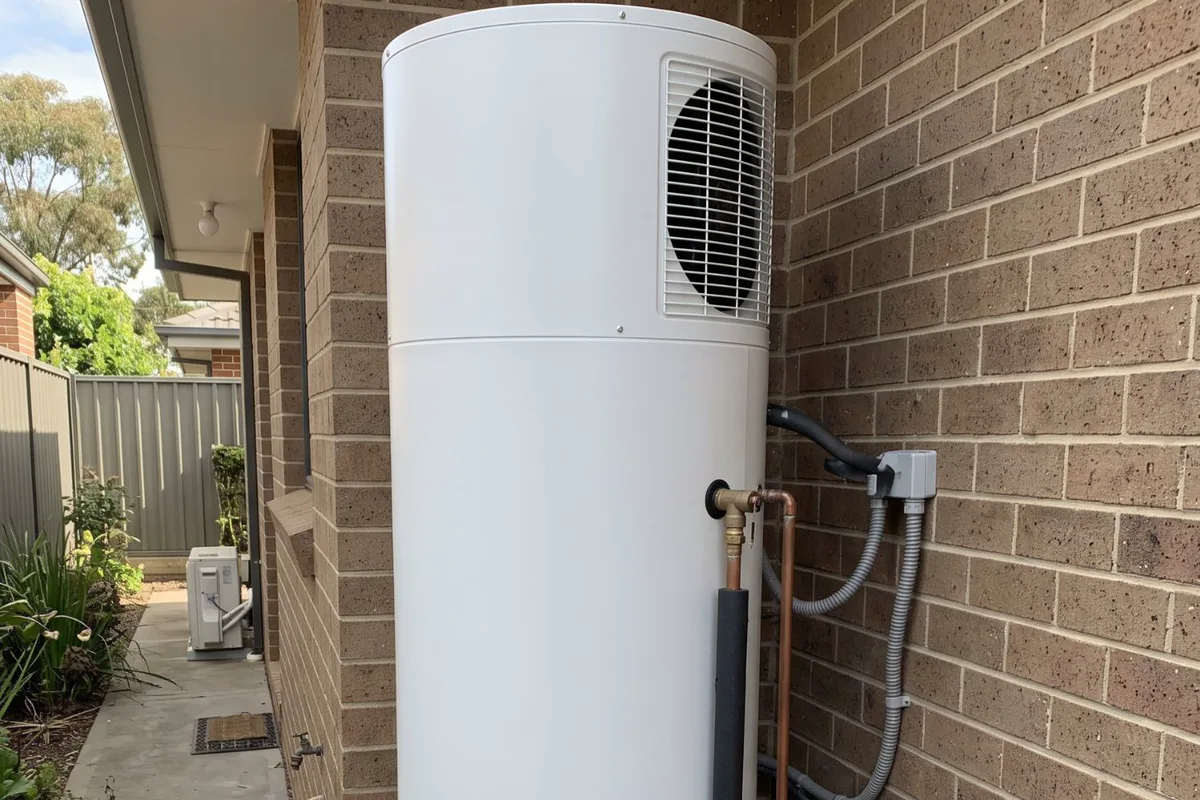
There are three main electric replacements. A heat pump water heater moves heat from the air into a storage tank and uses much less electricity than an element. An electric storage tank heats with an element, often on an off-peak circuit, and is simple to fit but uses far more electricity. An electric continuous-flow unit heats water only as it is used, but draws a very large current.
For most houses replacing gas, a heat pump is the one to look at first. Electric continuous flow suits particular cases, but larger units can need heavy cabling and switchboard or supply work, and some need three-phase power, which is when an upgrade to three-phase makes sense.
A heat pump stores its hot water, so the tank has to cover your busiest hour. Households used to unlimited hot water from a gas continuous-flow unit need the tank sized for their morning or evening rush.
- Integrated heat pump: tank, fan and compressor in one unit; the simplest heat pump install, needs open air and a drain
- Split heat pump: tank in one place, outdoor unit elsewhere; more flexible on tight sites
- Electric storage tank: simple and compact; much higher running cost
- Electric continuous flow: no tank; very high current, often with cabling and switchboard or supply work
The switchboard and circuit check
A gas water heater has no circuit of its own, or only a small supply for its controls. An electric replacement needs a dedicated circuit from the switchboard with RCD protection: Energy Safe Victoria's guidance says the Wiring Rules require it on every final sub-circuit in a home, hot water included, and most units call for an isolating switch nearby.
So the questions are straightforward. Is there a spare position on the board? Does it already have safety switches? Can the supply carry the new load alongside heating, cooking and anything else planned, such as an EV charger? If the main switchboard has to be replaced, power can't go back on until a licensed electrical inspector has inspected the work, which is far easier to arrange as a planned job than on the morning the old unit dies.
In older homes around Altona and Laverton, shaped by post-war growth, the board may be dated and short of space. In growth areas such as Tarneit and Truganina, a newer board often has room, but the supply deserves a look if ducted heating, induction and an EV are also on the plan.
Where the new unit goes
A wall-hung gas continuous-flow unit takes up almost no space. A heat pump needs a level base, open air in and out, a drain for condensation and access for servicing. The old spot may not suit: a narrow side passage, a boxed-in alcove or a wall under a bedroom window.
Noise is part of the decision. EPA Victoria's residential noise rules treat heat pump noise as unreasonable during prohibited times, before 7am or after 10pm on weekdays and before 9am or after 10pm on weekends and public holidays, if it can be heard in a habitable room of another home. A considered spot and a daytime timer usually deal with it.
If an old gas storage unit's flue comes out, the roof or wall needs making good. A licensed gasfitter caps the gas, a licensed plumber connects the water, and an electrician runs the circuit. Energy Safe Victoria says it is illegal and potentially fatal for unlicensed people to do gasfitting or electrical work.
How to plan ahead
Hot water rarely gives notice. A gas unit that fails on a July morning after 1 March 2027 means an electric replacement in a hurry, perhaps with switchboard work squeezed into the same job. Planning while the old unit still works turns it into an ordinary booking.
Signs a gas water heater is nearing the end include rust or water around the base, water that won't stay at temperature and a pilot that keeps going out. Those are for a licensed plumber or gasfitter to assess, but they are a good prompt to get the electrical side sorted.
- Note the brand, type and age of your gas unit from its label
- Photograph the switchboard with the door open and the cover left on
- Work out where a heat pump could go, away from bedroom windows
- List how many people use hot water, and when
- Note whether you have solar, and when it produces
- Have the switchboard and circuit assessed before the old unit fails
Should you replace a working gas unit early?
You don't have to. Some households switch before the old unit fails, especially when it is old, when solar is going in, or when a renovation already has the switchboard open. Others run the gas unit until it can't be repaired. Both are reasonable.
If you are weighing up a new gas unit before the rules start, think about how long it will last. When it eventually fails it will be replaced with electric anyway, and the switchboard and location work will still be waiting.
Common questions
Quick answers
- Can a rental's failed gas hot water be replaced with gas after March 2027?No.
- Should my heat pump hot water run during the day or overnight?If you can choose, run it during the day.
- Why does my hot water smell like rotten eggs?A rotten egg smell that comes only from the hot tap usually starts inside the storage tank.
- What is the off-peak or timer switch on my switchboard?It controls an off-peak circuit, usually for electric storage hot water and sometimes for slab heating or a pool pump.
Sources for this guide
11 sources, with the date each was checked
- 1.Department of Transport and Planning (Victoria): Victoria’s new Building and Plumbing Amendment Regulations 2025 have been finalised, advancing Victoria’s shift toward all-electric buildings. From 1 January 2027, all new homes and most new commercial buildings will be… Accessed 30 September 2026.
- 2.Department of Energy, Environment and Climate Action (Victoria): From 1 March 2027, if a gas hot water appliance breaks and cannot be repaired, it must be replaced with an electric alternative. No requirement to upgrade gas space heating or stovetop gas cooking to electric, however… Accessed 30 September 2026.
- 3.Consumer Affairs Victoria: It cannot be replaced with another gas system after 1 March 2027. Accessed 30 September 2026.
- 4.Chief Parliamentary Counsel Victoria (Victorian Legislation): (3) Subregulations (1) and (2) do not apply to a person if— (a) there is insufficient space available in the building or no suitable outdoor space associated with the building to install or replace the reticulated gas… Accessed 30 September 2026.
- 5.Energy Safe Victoria: Clause 2.6.3.2.2 requires all final sub-circuits in a domestic installation be protected by a residual current device (RCD). A hot water service is included in this requirement Accessed 30 September 2026.
- 6.Energy Safe Victoria: The electrician has eight business days after the work is completed to have that work inspected by a licensed electrical inspector (LEI). If an electrician replaces a main switchboard at a property, power cannot go back… Accessed 30 September 2026.
- 7.Victorian Government, Hobsons Bay Planning Scheme (PDF snapshot, last updated by VC292 on 11/09/2025): The heritage places of Hobsons Bay reflect the key themes that have shaped the development of the city since the establishment of Williamstown in the 1840s as the first port of Melbourne, through the development of… Accessed 30 September 2026.
- 8.Victorian Electoral Commission (2023 electoral structure review fact sheet): New housing developments are planned in residential growth areas including Truganina, Tarneit, Wyndham Vale and Manor Lakes, as well as near activity centres and public transport. Accessed 30 September 2026.
- 9.Energy Safe Victoria: Gas and electricity are inherently dangerous and it’s illegal and potentially fatal for unlicensed and unqualified people to undertake any gasfitting or electrical work. Accessed 30 September 2026.
- 10.Consumer Affairs Victoria: Anything on this list is legally defined as an urgent repair: burst water service blocked or broken toilet system serious roof leak gas leak dangerous electrical fault flooding or serious flood damage serious… Accessed 30 September 2026.
- 11.Consumer Affairs Victoria: From 1 March 2027, when an existing hot water system permanently fails and can't be repaired, rental providers must replace it with an energy-efficient electric hot water system. Accessed 30 September 2026.
Planning advice for homeowners. Installation requirements depend on the property and equipment. Where this guide refers to Victorian safety or rental rules, use the linked official guidance for the current requirements.