
The key points
- Learn the controls first. Mode, set temperature, fan speed and timers make more difference than anything else you can change.
- Washing the filters is light care that needs no tools. Anything behind a cover, on the roof or at the outdoor isolator is for the rental provider to arrange.
- Report changes in writing early. A small drip or a new noise is easier to fix in spring than in the middle of a hot spell.
- A cooling appliance supplied by the rental provider that stops working is on the legal list of urgent repairs.
Work out what you've got
Most rentals in Melbourne's west have one of three set-ups: a wall-mounted split system in the living area, sometimes with more in the bedrooms; a ducted reverse-cycle system with ceiling outlets and a wall controller; or gas ducted heating with an evaporative cooler on the roof. Each is run differently, so it pays to know which you have.
Find the model number. On a split it is on a sticker on the side of the indoor unit; on a ducted system it is usually inside the controller cover or on the unit in the roof. Most makers put manuals online. Ask the agent for any manual left at the property and when the system was last serviced.
A reverse-cycle split or ducted system is a heat pump, so it heats as well as cools. Plenty of renters use the split only in summer and run portable heaters in winter. Reverse-cycle units move three to five units of heat for each unit of electricity they use, where a standard electric heater produces about one.
Running it well day to day
The Victorian Government suggests 18 to 20 °C for heating and 24 to 26 °C for cooling living areas, and says each degree beyond that adds around 10% to running costs. Setting 18 °C on a hot afternoon doesn't cool the room faster. It just keeps the unit running harder for longer.
Use auto or a moderate fan speed, angle the louvres up for cooling and down for heating, and close doors to rooms you aren't using. On a ducted system, shut the zones you don't need rather than closing individual outlets, which can upset the airflow the system was set up for.
Timers help more than most people expect. Starting the cooling before a hot northerly afternoon peaks, or warming the lounge half an hour before you get up on a July morning, is easier on the system and on the bill than starting from a very hot or very cold room.
Simple care that's reasonable for a renter
The Victorian Government suggests cleaning the dust filters on a reverse-cycle air conditioner about twice a year, or more often with heavy use. On a split it takes a few minutes: switch the unit off, lift the front panel, slide out the mesh filters, vacuum and rinse them, let them dry in the shade and refit. Dirty filters significantly cut airflow and efficiency, so clean ones show up on your own power bill.
On a ducted system the filter sits behind the return-air grille, often in a hallway ceiling. If the grille is easy to reach from a stable step and the filter is washable, the job is similar. If it isn't, or the filter is a replaceable pad, ask the agent. If your lease says anything specific about air conditioner care, follow it, and if you're unsure whether something is your job, ask in writing first.
- Wash split system filters a couple of times a year, more often in dusty or pet-heavy homes
- Keep furniture and curtains clear of the indoor unit and the wall controller
- Keep bikes, bins, pot plants and stored boxes away from the outdoor unit
- Wipe the outside of the indoor unit with a dry cloth
- Note any change in noise, smell or performance, and report it
What to leave alone
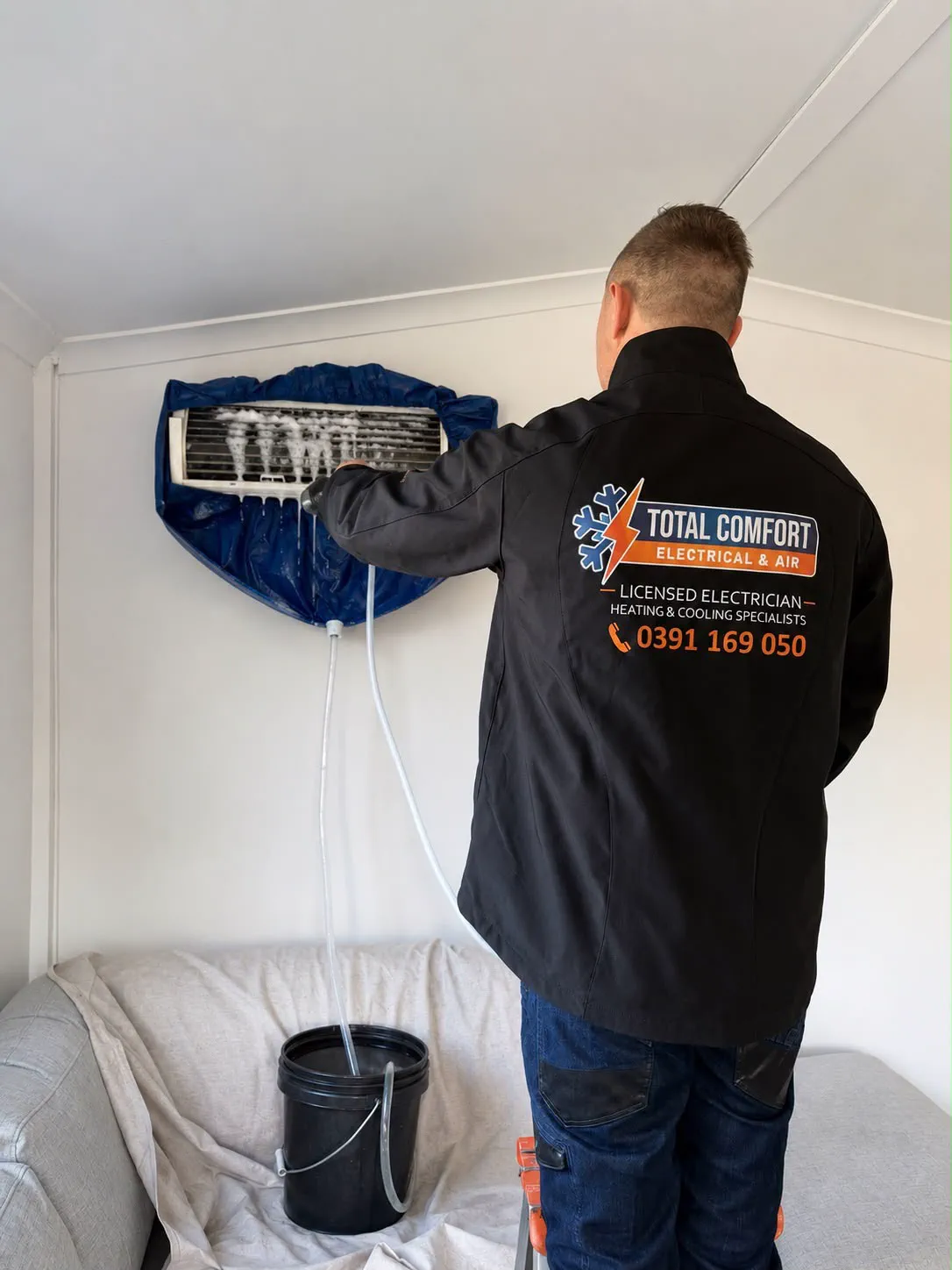
Don't take covers off, spray cleaning products into the unit, or climb onto the roof to look at an evaporative cooler. The coil, fan, drain and wiring sit behind the covers, and Energy Safe Victoria says electrical work isn't a DIY job, even for small jobs.
The switch on the wall beside the outdoor unit is an isolator. Air conditioners with a compressor need a lockable isolating switch next to the unit so a technician can work on it safely. Leave it on unless the agent or a technician asks you to switch it off.
Refrigerant is licensed work. Anyone who installs, services or maintains air conditioning equipment needs a Refrigerant Handling Licence, so a gas top-up is never a renter or handyman job. Ask the rental provider in writing before adding anything to the system, such as a Wi-Fi adapter.
What to report, and how
Report anything that changes: water dripping from the indoor unit, ice on the pipes, a burning or musty smell that doesn't clear, a new rattle or grinding, the unit switching itself off, or a room that no longer reaches the set temperature. Small faults found early are simpler to fix, and the rental provider has time to organise it before the weather turns.
Put it in writing, by email or through the agent's portal, even if you've also phoned. Describe what you see and when it happens, and include the brand and model from the sticker, any error code on the display, and a short video if the noise is the problem. It helps the right technician arrive with the right parts.
Rental providers must do urgent repairs immediately and non-urgent repairs within 14 days of a written request, and they pay unless the renter caused the problem. Consumer Affairs Victoria's urgent repairs list includes a cooling appliance supplied by the rental provider that isn't working, and a failed heating appliance.
Getting ready for a hot spell
Laverton averages 27 days a year at or above 30 °C, mostly from December to February. Victoria's health department advises checking before extreme heat that your fan and air conditioner work and that filters and vents are clean. Run the cooling for half an hour on a mild spring day. If it struggles then, report it then.
On a hot day, close the blinds on sunny windows early, keep doors shut to the cooled rooms and leave the set point in the mid-20s. The health department advises using air conditioning or a fan during extreme heat, and says people with limited ways to keep cool are among those most at risk. If the system fails, plan where you could go, such as a friend's place or a cool public building.
What's changing for rental cooling
From 1 March 2027, rental providers must install energy-efficient fixed cooling with an outlet in the main living area when a new rental agreement starts, and from 1 July 2030 all rentals must have cooling, whatever their lease status. One reverse-cycle air conditioner can meet both the heating and cooling standards.
If your rental has no fixed cooling now, ask the agent how the standard applies to your agreement. Until then, a plug-in fan and good blind habits go a long way on most summer days.
Common questions
Quick answers
- Who is responsible for servicing the air conditioner in a rental?The rental provider, for an air conditioner they supplied.
- How do I clean my split system filters?Turn the unit off, lift the front panel, slide the filters out and vacuum off the dust.
- Why is my air conditioner blowing out black specks?Black specks are almost always mould and grime from inside the unit.
- How do I prepare for an air conditioning service or installation?Clear a working space around the indoor unit and the outdoor unit, make sure the roof manhole is easy to reach if you have a ducted system, and secure pets.
Sources for this guide
13 sources, with the date each was checked
- 1.YourHome (Australian Government): A reverse cycle air-conditioner is a type of heat pump that uses electricity to warm your home in winter and cool it in summer (refer to Heat pumps below). In heating mode, the system absorbs heat from the outside air… Accessed 30 September 2026.
- 2.Energy Rating (GEMS Regulator / DCCEEW): Reverse cycle air conditioners are much more efficient at heating than standard electric heaters (bar heaters, convection, or radiant heaters). ... During the normal operating range in Australia for every unit of… Accessed 30 September 2026.
- 3.Solar Victoria (updated 20 November 2025): To heat a room, try setting the temperature between 18°C to 20°C. Every 1°C higher will add around 10% to your heating bill. Set your air conditioner thermostat for cooling between 24°C and 26°C for living areas – every… Accessed 30 September 2026.
- 4.Energy Safe Victoria: Electrical work isn’t a DIY job, even for small jobs such as changing power points or light switches. Accessed 30 September 2026.
- 5.Access Canberra Electrical Inspections (ACT Government), Electrical Fact Sheet, updated September 2019: Air-conditioning and heat pump systems incorporating a compressor shall be provided with an isolating switch (lockable) in accordance with Clause 2.3.2.2, installed adjacent to but not on the unit, which isolates all… Accessed 30 September 2026.
- 6.Australian Refrigeration Council (ARC): A Refrigerant Handling Licence must be held by any person who carries out work in relation to refrigeration and air conditioning (RAC) equipment. Carrying out work in relation to RAC equipment means to do anything with… Accessed 30 September 2026.
- 7.Australian Refrigeration Council (ARC): NO. If the refrigerant is contained in equipment, such as a split system air conditioner, a Refrigerant Trading Authorisation is not required. However a refrigerant handling licence is required to install this type of… Accessed 30 September 2026.
- 8.Consumer Affairs Victoria: Repairs are either ‘urgent’ or ‘non-urgent’. Rental providers must make urgent repairs immediately. Rental providers must make non-urgent repairs within 14 days of getting a written request. Accessed 30 September 2026.
- 9.Bureau of Meteorology: Mean number of days ≥ 30 °C 6.9 6.0 4.5 0.7 0.0 0.0 0.0 0.0 0.1 0.9 2.8 5.1 27.0 82 1943 2026 Mean number of days ≥ 35 °C 3.6 2.4 0.9 0.0 0.0 0.0 0.0 0.0 0.0 0.1 0.5 1.9 9.4 Accessed 30 September 2026.
- 10.Better Health Channel (Department of Health, Victoria): Check that your fan and air-conditioner works well. Have your air-conditioner serviced if needed. Ensure the filters, pads and air vents are clean. Accessed 30 September 2026.
- 11.Department of Health, Victoria (updated 3 February 2026): Use air conditioning or a fan, wear light and loose-fitting clothing, keep your skin wet (for example, with a spray bottle or damp sponge), and take cool showers or foot baths. ... People most at risk include those over… Accessed 30 September 2026.
- 12.Consumer Affairs Victoria: From 1 March 2027, rental providers must install an energy-efficient, fixed cooling system with an outlet in the main living area. This applies at the start of a new rental agreement. All rental properties must have… Accessed 30 September 2026.
- 13.Consumer Affairs Victoria: Tip: A reverse-cycle air conditioner can satisfy both the heating and cooling standards. Accessed 30 September 2026.
Planning advice for homeowners. Installation requirements depend on the property and equipment. Where this guide refers to Victorian safety or rental rules, use the linked official guidance for the current requirements.