
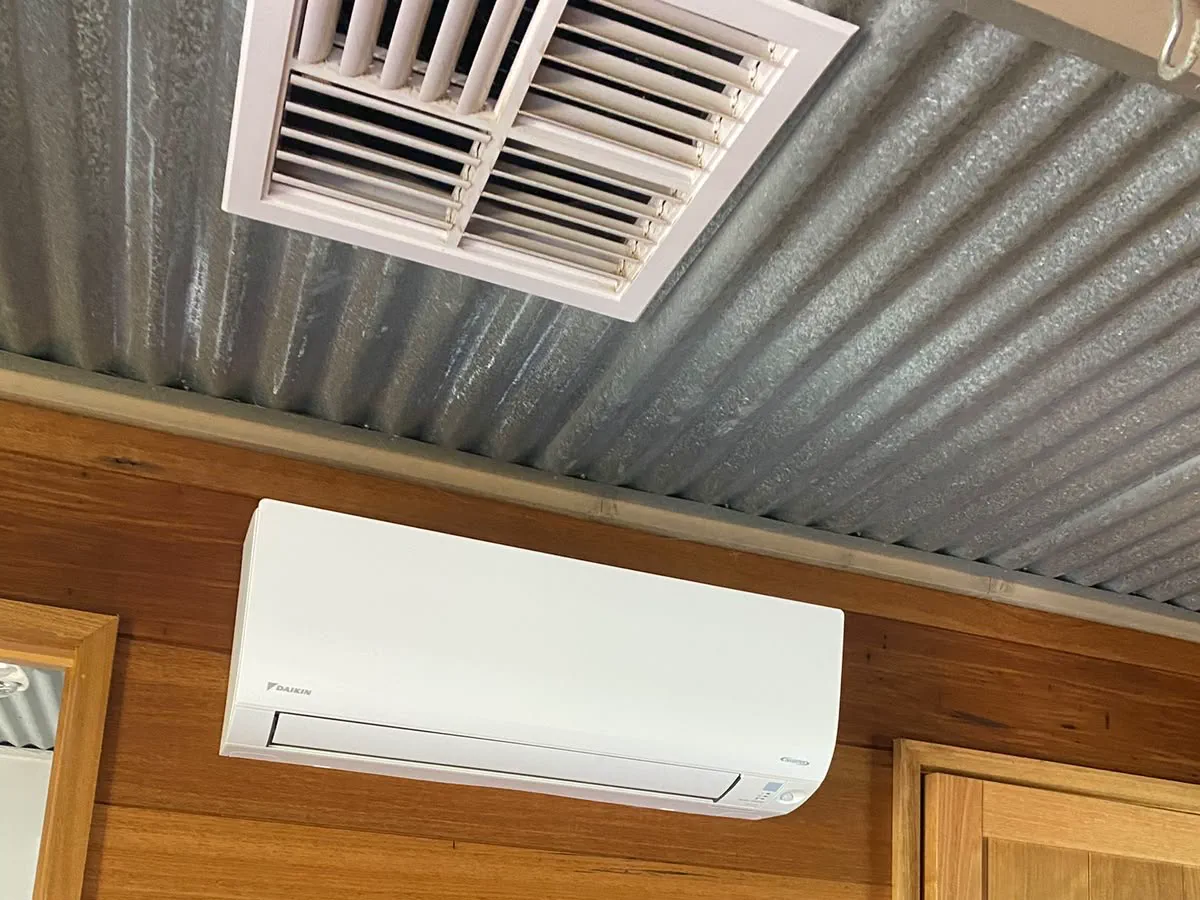
Should landlords install air conditioning now or wait until the cooling standard applies?
- From 1 March 2027, fixed cooling is required in the main living area when a new agreement starts. From 1 July 2030, every rental needs it.
- Installing during a quiet spell or before summer beats squeezing the work in between tenants.
- A reverse-cycle split covers the cooling and heating standards in one job.
- Once you supply cooling, a breakdown is an urgent repair, so plan for servicing.
The two deadlines
Under Victoria's minimum energy efficiency standards, rental providers must install energy-efficient fixed cooling with an outlet in the main living area when a new rental agreement starts on or after 1 March 2027. From 1 July 2030, all rentals must have it, whatever their lease status. Existing evaporative cooling meets the standard at the start of a new lease.
Efficient means a non-ducted electric air conditioner or heat pump with a GEMS cooling rating of 3 stars or more, or a ducted electric system with a Total Cooling Seasonal Performance Factor of 3.8 or more, for the property's climate area. A reverse-cycle split in the living area is the usual answer, and one reverse-cycle unit can meet the heating and cooling standards together.
The case for installing now
Our view: if a property is likely to turn over in the next year or two, install before the lease ends rather than at it. The gap between tenants is short, and the cooling has to be in place when the new agreement starts. Doing it now, with the renter's agreement on access, takes that pressure out of the vacancy.
Then there's summer. Laverton averages 27 days a year at or above 30 °C, mostly between December and February, and set a January record of 45.6 °C on 27 January 2026. Victoria's health department says people without a way to keep cool are among those most at risk in extreme heat. A renter with cooling this summer is more comfortable, safer and more likely to stay.
Demand is also likely to bunch up. Every landlord facing a new agreement after March 2027, and every remaining rental before July 2030, will be after the same work. Installing ahead of that lets you choose the system, the spot and the date.
When waiting is reasonable
If you have a good long-term renter on a fixed term that runs well past 2027, and the property already has decent heating, there's less urgency. You still face the 2030 deadline, so waiting delays the job rather than avoiding it.
Remember what comes with it. Once you supply a cooling appliance, Consumer Affairs Victoria treats one that isn't working as an urgent repair. That isn't a reason to avoid cooling, but it is a reason to choose a reliable system, place it well and book regular servicing.
Sort the switchboard while you can
A new air conditioner needs its own circuit, and an older rental's board may have no room or still use old fuses. If the main switchboard has to be replaced, power can't go back on until a Licensed Electrical Inspector has inspected it, so that work is much easier with the property empty or with a renter who has agreed the outage in advance.
Under the cooling standard, the cost of electrical work needed for the installation and of upgrading a switchboard for the extra load don't count when judging whether fixed cooling is unreasonable to install. An old board isn't a way out of the standard, so it's better found now than in the week before a new lease.
A simple plan for each property
List each property's next likely agreement date, the heating and cooling it has, and the switchboard type. Properties with no cooling and a turnover coming soon go first. Where the gas heater is also old, a reverse-cycle split solves both problems at once.
Book the work for spring or autumn where you can. Mild weather leaves time to test the new system before the season it's needed, and it keeps the job clear of the first heatwave.
- Next agreement or likely vacancy date
- Existing cooling, if any, and whether it meets the standard
- Heater type, age and service history
- Switchboard type and spare space
- Best outdoor unit position for the living area
Questions that come next
Sources for this article
9 sources, with the date each was checked
- 1.Consumer Affairs Victoria: From 1 March 2027, rental providers must install an energy-efficient, fixed cooling system with an outlet in the main living area. This applies at the start of a new rental agreement. All rental properties must have… Accessed 30 September 2026.
- 2.Department of Energy, Environment and Climate Action (energy.vic.gov.au), page last updated 05/08/26: From 1 March 2027, at the start of a new lease, rental homes must include: energy-efficient cooling in the living area (noting that if evaporative cooling is already installed, it meets the standard) ... By 1 July 2030… Accessed 30 September 2026.
- 3.Consumer Affairs Victoria: Definition: From 1 March 2027, energy efficient fixed cooling means: (a) a non-portable, non-ducted electric air conditioner or heat pump capable of cooling, with a GEMS 3-star or above cooling rating (for the climate… Accessed 30 September 2026.
- 4.Consumer Affairs Victoria: Tip: A reverse-cycle air conditioner can satisfy both the heating and cooling standards. Accessed 30 September 2026.
- 5.Bureau of Meteorology: Mean number of days ≥ 30 °C 6.9 6.0 4.5 0.7 0.0 0.0 0.0 0.0 0.1 0.9 2.8 5.1 27.0 82 1943 2026 Mean number of days ≥ 35 °C 3.6 2.4 0.9 0.0 0.0 0.0 0.0 0.0 0.0 0.1 0.5 1.9 9.4 Accessed 30 September 2026.
- 6.Department of Health, Victoria (updated 3 February 2026): Use air conditioning or a fan, wear light and loose-fitting clothing, keep your skin wet (for example, with a spray bottle or damp sponge), and take cool showers or foot baths. ... People most at risk include those over… Accessed 30 September 2026.
- 7.Consumer Affairs Victoria: a cooling appliance or service provided by the rental provider is not working the property does not meet minimum standards a safety-related device, such as a smoke alarm or pool fence, is not working Accessed 30 September 2026.
- 8.Energy Safe Victoria: The electrician has eight business days after the work is completed to have that work inspected by a licensed electrical inspector (LEI). If an electrician replaces a main switchboard at a property, power cannot go back… Accessed 30 September 2026.
- 9.Victorian Legislation (Chief Parliamentary Counsel): (6) For the purposes of subclauses (4)(a) and (5)(a), the following is not part of the cost of installation— (a) the cost of electrical work required for the installation; (b) the cost of upgrading an electrical… Accessed 30 September 2026.