
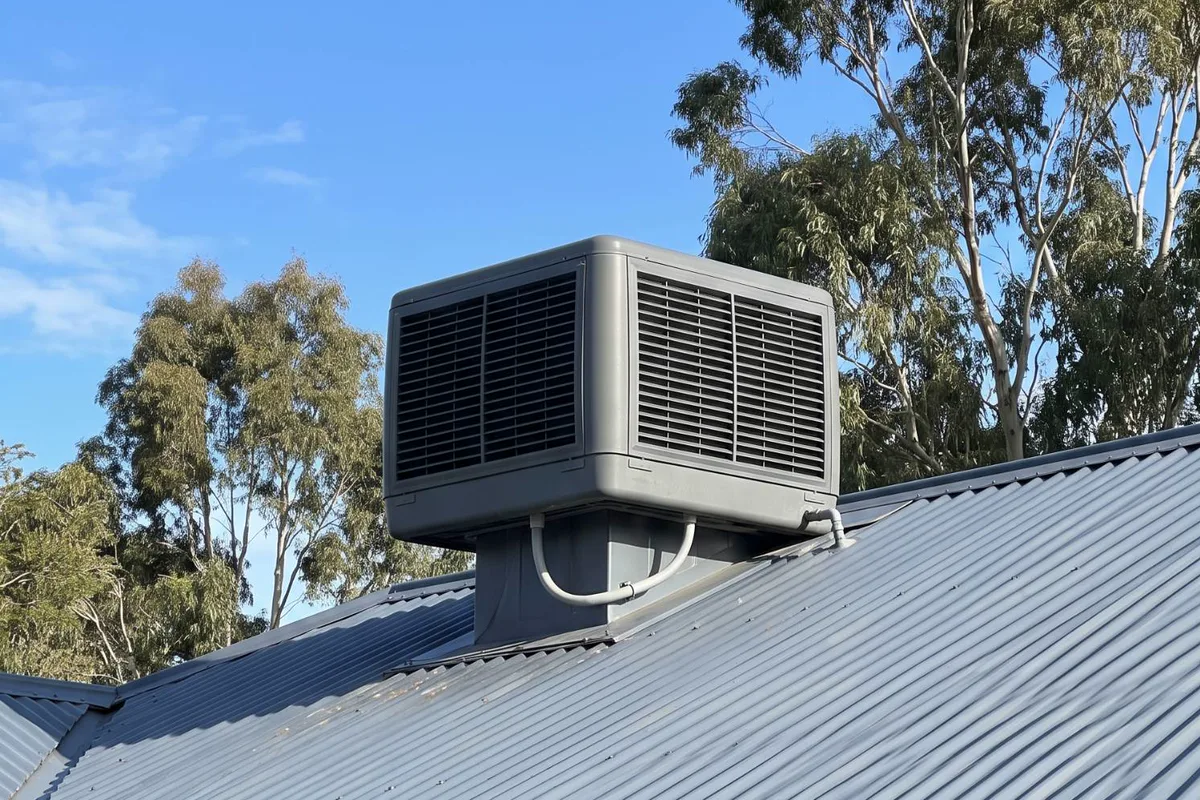
Should landlords keep an evaporative cooler or replace it with reverse-cycle?
- The government's summary of the 2027 rules says existing evaporative cooling meets the new-lease cooling standard, so nothing forces a working cooler out.
- Evaporative cooling does well on hot, dry days and struggles on humid ones. It needs open windows and doesn't heat.
- One reverse-cycle air conditioner can meet both the heating and cooling standards, which matters if the rental's heater is old.
- A sound, serviced cooler beside a newer heater is a reasonable keep. A tired cooler beside an ageing heater makes a strong case for reverse-cycle.
What the 2027 standard says about evaporative
From 1 March 2027, rental providers must have energy-efficient fixed cooling in the main living area when a new rental agreement starts, and from 1 July 2030 all rentals must have cooling whatever their lease status. The Victorian Government's summary of the change notes that if evaporative cooling is already installed, it meets the standard.
So keeping a working cooler is a legitimate choice, not a loophole. The summary is explicit about the new-lease requirement, so check Consumer Affairs Victoria's current guidance on how an existing cooler is treated for the 2030 deadline. Either way, a supplied cooling appliance that stops working is on CAV's urgent repairs list, so whatever is there has to keep working.
The case for keeping it
An evaporative cooler blows outside air over wet pads and pushes it through the house and out through open windows and doors. On a hot, dry northerly day that works well and runs cheaply: ducted evaporative coolers use less than half the electricity of an air conditioner of similar capacity. Laverton averages about 27 days a year at or above 30 °C, most of them between December and February.
If the pads, pump, float valve and motor are in good order and the cooler is serviced before each summer, keeping it costs little up front and meets the standard. Some renters also prefer the fresh-air feel of evaporative cooling to a closed-up house.
Where it falls short for renters
Evaporative cooling loses ground when the air is already humid, because evaporation slows. A muggy evening or a sticky February night is when renters contact the agent to say the cooling isn't working, even though the unit is doing all it can. It also needs windows or doors open, which is awkward for renters on a busy road or in a ground-floor unit worried about security.
There's upkeep too. Central systems can use 25 litres of water or more an hour on hot, dry days, and the ducts should be closed off and the roof unit covered in winter if it has no automatic seals. And it does nothing for heating, which is where Victorians usually use the most energy.
The case for reverse-cycle
Consumer Affairs Victoria's guide for rental providers says one reverse-cycle air conditioner can meet both the heating and cooling standards. That matters most when the heater is old. From 1 March 2027, a fixed heater that fails and can't be repaired must be replaced with an energy-efficient fixed electric heater with an outlet in the main living area. A gas heater near the end of its life is a good reason to plan the change now rather than in a rush mid-winter.
Reverse-cycle also copes with humid days, works with the house shut and gives renters one system to learn. The trade-offs are the cost up front, higher summer running costs than evaporative, and electrical work: a new system usually needs its own circuit, and we check the switchboard before anything goes in.
Middle paths worth considering
It doesn't have to be all or nothing. A common approach is to keep a sound cooler for the dry summer heat and add a reverse-cycle split system in the main living area. The split covers heating and the muggy nights, the cooler keeps the rest of the house comfortable on scorching days, and nothing is ripped out.
A full conversion to ducted reverse-cycle is the bigger step. Evaporative ducts are built to push outside air one way and are usually lightly insulated, so they rarely carry over; refrigerated ducts should be insulated to at least R1.5 with sealed joints. Plan on new ductwork, and time the work between tenancies or in autumn or spring so renters aren't left without cooling in the heat.
How to decide for your property
Have the cooler serviced and inspected first, so you know whether you're keeping a sound unit or nursing a tired one. Then look at the heater's type, age and condition. A good cooler with a newer efficient heater is a reasonable keep. A worn cooler beside an old gas heater points towards reverse-cycle.
Have the cooler, the heater and the switchboard looked at together, so the comparison is based on the actual house and each option is priced before any work starts.
- Condition of the cooler's pads, pump, motor and roof seals
- Age and type of the current heater
- Switchboard space for a new reverse-cycle circuit
- Renter feedback about humid nights and winter comfort
Questions that come next
Sources for this article
8 sources, with the date each was checked
- 1.Department of Energy, Environment and Climate Action (energy.vic.gov.au), page last updated 05/08/26: From 1 March 2027, at the start of a new lease, rental homes must include: energy-efficient cooling in the living area (noting that if evaporative cooling is already installed, it meets the standard) ... By 1 July 2030… Accessed 30 September 2026.
- 2.Consumer Affairs Victoria: From 1 March 2027, rental providers must install an energy-efficient, fixed cooling system with an outlet in the main living area. This applies at the start of a new rental agreement. All rental properties must have… Accessed 30 September 2026.
- 3.Consumer Affairs Victoria: a cooling appliance or service provided by the rental provider is not working the property does not meet minimum standards a safety-related device, such as a smoke alarm or pool fence, is not working Accessed 30 September 2026.
- 4.energy.gov.au (Australian Government, DCCEEW): Evaporative coolers work by blowing air over a film of water on a filter or sponge, cooling the sponge and the air through the process of evaporation. Outside air is drawn through the evaporative unit (generally on the… Accessed 30 September 2026.
- 5.Bureau of Meteorology: Mean number of days ≥ 30 °C 6.9 6.0 4.5 0.7 0.0 0.0 0.0 0.0 0.1 0.9 2.8 5.1 27.0 82 1943 2026 Mean number of days ≥ 35 °C 3.6 2.4 0.9 0.0 0.0 0.0 0.0 0.0 0.0 0.1 0.5 1.9 9.4 Accessed 30 September 2026.
- 6.YourHome (Australian Government): Evaporative coolers cool outside air and blow it into the house; some windows or doors will need to be left open when the cooler is in use to allow indoor air to exit. ... For central systems, water use can be 25 L or… Accessed 30 September 2026.
- 7.Department of Energy, Environment and Climate Action (energy.vic.gov.au), page last updated 14/04/25: Victorians typically use more energy for heating than cooling, so look for a unit with a higher heating efficiency. Accessed 30 September 2026.
- 8.Consumer Affairs Victoria: Tip: A reverse-cycle air conditioner can satisfy both the heating and cooling standards. Accessed 30 September 2026.