
The key points
- Compare coolers on the airflow they deliver to your house, not cabinet size. More air only helps if the ducts can carry it and open windows let it out.
- Rigid honeycomb pads generally hold their shape and wet more evenly than loose-fibre pads, but the cooler has to be designed for them.
- How the cooler keeps minerals down, by bleed, timed drain or water sensor, affects pad life, water use and how much ends up down the drain.
- A wall controller with a thermostat mode, timers and an automatic drain cycle makes a cooler easier to live with than fan-speed buttons alone.
- In a rental, an existing ducted evaporative cooler that fails beyond repair from 1 March 2027 can be replaced with another ducted evaporative cooler or an efficient fixed cooler.
Start with the house, not the brochure
This guide assumes you've already decided evaporative cooling suits you. If you're still choosing between evaporative and refrigerated, settle that first. Federal energy advice says evaporative coolers work best in low-humidity areas, so the answer depends on how the household copes on muggy days and whether you want one system to heat as well.
An evaporative cooler blows outside air over wet pads to cool it, then pushes that air through the house and out through open windows and doors. Its job is to replace the hot air in the house with cooler air quickly, so the volume of the house matters more than its floor area alone. A single-storey brick veneer in Altona North with standard ceilings and a new double storey in Point Cook with a high entry void are very different jobs.
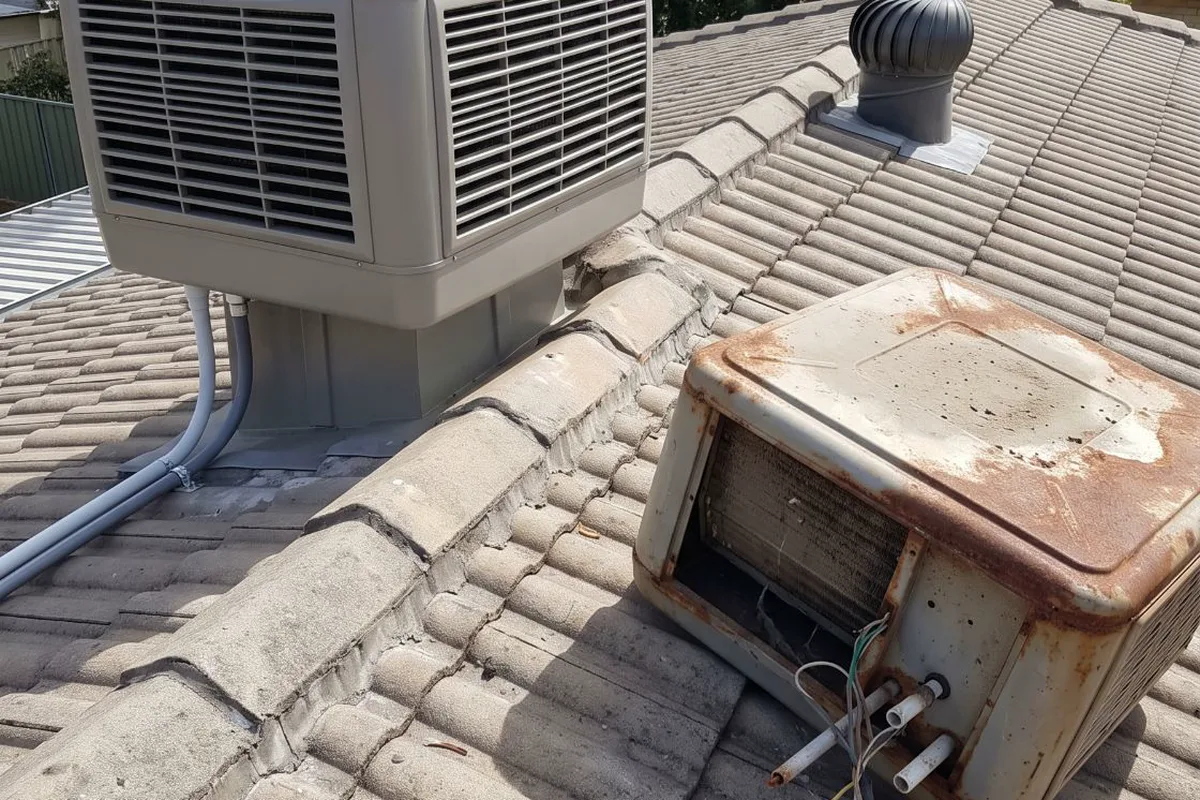
Note what's already there: where the roof unit and outlets sit, how many outlets there are, which rooms have none, and whether the house has been extended since the old cooler went in.
Airflow, outlets and ducts
Coolers are compared on airflow, the volume of air they can push through the system, rather than a kilowatt figure. Suppliers size them on the volume of the house and how many times an hour the air needs replacing to feel cool on a hot day. Ask each supplier to show how they arrived at their recommendation.
Airflow is only useful if it arrives. Evaporative ducts are larger than refrigerated ones because they move a lot of air, and a bigger cooler on undersized or damaged ducts mostly makes noise. If you're replacing a cooler, have every duct run checked in the roof space. If rooms never cooled, the fix may be an extra outlet or a better duct run rather than a bigger unit.
The air also needs somewhere to go. Every room with an outlet needs a window or door open somewhere downstream, and a house with nowhere for the air to leave simply feels humid.
- The airflow figure and how the supplier sized it for your home
- Which ducts are reused, repaired or replaced
- Outlets for any rooms that never cooled
- How the air will leave the house in each zone of use
Fan, motor and noise
Coolers use different fan designs, and the practical questions are the same for all of them: how loud is it at the speeds you'll actually use, and how does it behave at low speed overnight? Variable-speed motors let a cooler run gently on a warm evening instead of jumping between fixed steps, which usually means less noise and less power at the lower settings.
Ask where the fan and motor sit and how they're accessed for servicing. A cooler that's easy to work on gets serviced properly; one that isn't tends to get skipped.
Pads: loose-fibre or rigid
Loose-fibre pads, made from wood wool or synthetic fibre, hold plenty of water but thin and sag with age, leaving gaps where warm air slips through. Rigid honeycomb-style pads generally keep their shape longer and let air through more evenly. A cooler is designed around one type or the other, so pad type is part of choosing the unit, not something to change later on a whim.
Pad life depends less on the calendar than on your water, how much the cooler runs and whether its water management works. Ask what replacement pads cost and how easy they are to get for the model, because you'll be buying them again.
Water use and water management
Evaporating water leaves its minerals behind on the pads, tank and pump. Coolers deal with this in different ways: a small continuous bleed to waste, a drain valve that empties the tank on a cycle, or a sensor that measures how salty the water has become and drains only when needed. The last two usually waste less water and suit a cooler that sits idle between hot spells, because the tank can empty instead of going stale.
Water use is real. YourHome puts a central evaporative system's use at 25 L or more an hour on hot, dry days, which can matter during water restrictions. Ask how much a model drains to waste as well as what it evaporates, and where the drain water will go on your roof.
Many modern units seal themselves when switched off. Older ones need the ducts closed and the roof unit covered for winter to stop heat escaping up through the outlets, so automatic seals are worth having on any new cooler.
Controls you'll use every day
A basic controller sets fan speed and turns the pump on or off. Better ones add a thermostat mode that adjusts the fan to hold a temperature, timers, a fan-only setting for ventilating on mild days, and control over the drain cycle. App control is useful if you want to start the cooler on the way home before a hot northerly afternoon peaks.
Laverton averages 27 days a year at or above 30 °C, mostly between December and February. Those are the days a good controller earns its place, starting the cooler early and easing it back as the evening change arrives.
The roof, the power and rentals
The new cabinet needs a sound base and a good seal to the roof opening. A different footprint may need an adaptor or new flashing, and two-storey or steep roofs make the lift harder. The cable and isolating switch on the roof have usually baked in the sun for years and should be checked; if the wiring is altered, Energy Safe Victoria notes the Wiring Rules require additional RCD protection. Whenever a licensed electrician completes electrical installation work, they must provide a Certificate of Electrical Safety.
For rental providers, the Victorian Government says existing evaporative cooling meets the rental cooling standard that applies to new agreements from 1 March 2027. Consumer Affairs Victoria's cooling standard says that when a ducted evaporative cooler fails and can't be repaired, it can be replaced with another ducted evaporative cooler with an outlet in the main living area, or upgraded to an energy-efficient fixed cooler. A room evaporative cooler that fails has to be upgraded to an efficient fixed cooler.
Common questions
Sources for this guide
8 sources, with the date each was checked
- 1.energy.gov.au (Australian Government, DCCEEW): Evaporative coolers work by blowing air over a film of water on a filter or sponge, cooling the sponge and the air through the process of evaporation. Outside air is drawn through the evaporative unit (generally on the… Accessed 30 September 2026.
- 2.YourHome (Australian Government): Evaporative coolers cool outside air and blow it into the house; some windows or doors will need to be left open when the cooler is in use to allow indoor air to exit. ... For central systems, water use can be 25 L or… Accessed 30 September 2026.
- 3.Bureau of Meteorology: Mean number of days ≥ 30 °C 6.9 6.0 4.5 0.7 0.0 0.0 0.0 0.0 0.1 0.9 2.8 5.1 27.0 82 1943 2026 Mean number of days ≥ 35 °C 3.6 2.4 0.9 0.0 0.0 0.0 0.0 0.0 0.0 0.1 0.5 1.9 9.4 Accessed 30 September 2026.
- 4.Bureau of Meteorology (article issued 3 August 2026): To the north lies Australia's hot, dry interior, while to the south stretches the cold Southern Ocean. ... Warm northerly winds arrive first, bringing higher temperatures and clear skies. Then, as a cold front moves in… Accessed 30 September 2026.
- 5.Energy Safe Victoria: Clause 2.6.3.2.5 of the Wiring Rules states: Additional protection by RCDs shall be provided in existing electrical installations where alterations or a switchboard replacement is completed. Accessed 30 September 2026.
- 6.Energy Safe Victoria: Whenever a licensed electrician completes any electrical installation work, they must provide a Certificate of Electrical Safety (COES). Accessed 30 September 2026.
- 7.Department of Energy, Environment and Climate Action (energy.vic.gov.au), page last updated 05/08/26: From 1 March 2027, at the start of a new lease, rental homes must include: energy-efficient cooling in the living area (noting that if evaporative cooling is already installed, it meets the standard) ... By 1 July 2030… Accessed 30 September 2026.
- 8.Consumer Affairs Victoria: From 1 March 2027, rental providers must install an energy-efficient, fixed cooling system with an outlet in the main living area. This applies at the start of a new rental agreement. All rental properties must have… Accessed 30 September 2026.
Planning advice for homeowners. Installation requirements depend on the property and equipment. Where this guide refers to Victorian safety or rental rules, use the linked official guidance for the current requirements.