
The key points
- Light the ground you walk on and a few features you want to see. Lighting everything flattens the garden.
- 12 volt systems run from a transformer and are easy to extend; 240 volt fittings suit longer runs and brighter fixtures.
- Split the garden into zones with their own switches or timers: paths and steps, features and the alfresco.
- Most of the work is underground. Lay conduit before paving and planting, and keep joints above ground in sealed enclosures.
- Anything connected to the home's wiring, including a hardwired transformer, is licensed electrical work.
Decide what you want to see
Stand at the back door after dark and ask what you need to see and what you'd like to see. Needs come first: the path to the gate, the steps, the clothesline and the bins. Then a few features, such as a tree, a feature wall or a water feature. Two or three lit features look far better than a dozen lights scattered across the garden.
Leave some dark. Contrast is what makes a lit tree look good, and darker areas let your eyes adjust so lower light levels are enough. It also keeps light out of the neighbours' windows and the night sky.
Draw the plan with plants at their mature size, not as they look the week they go in. A light that suits a young shrub will be buried in a couple of years.
Techniques for paths, steps, trees and walls
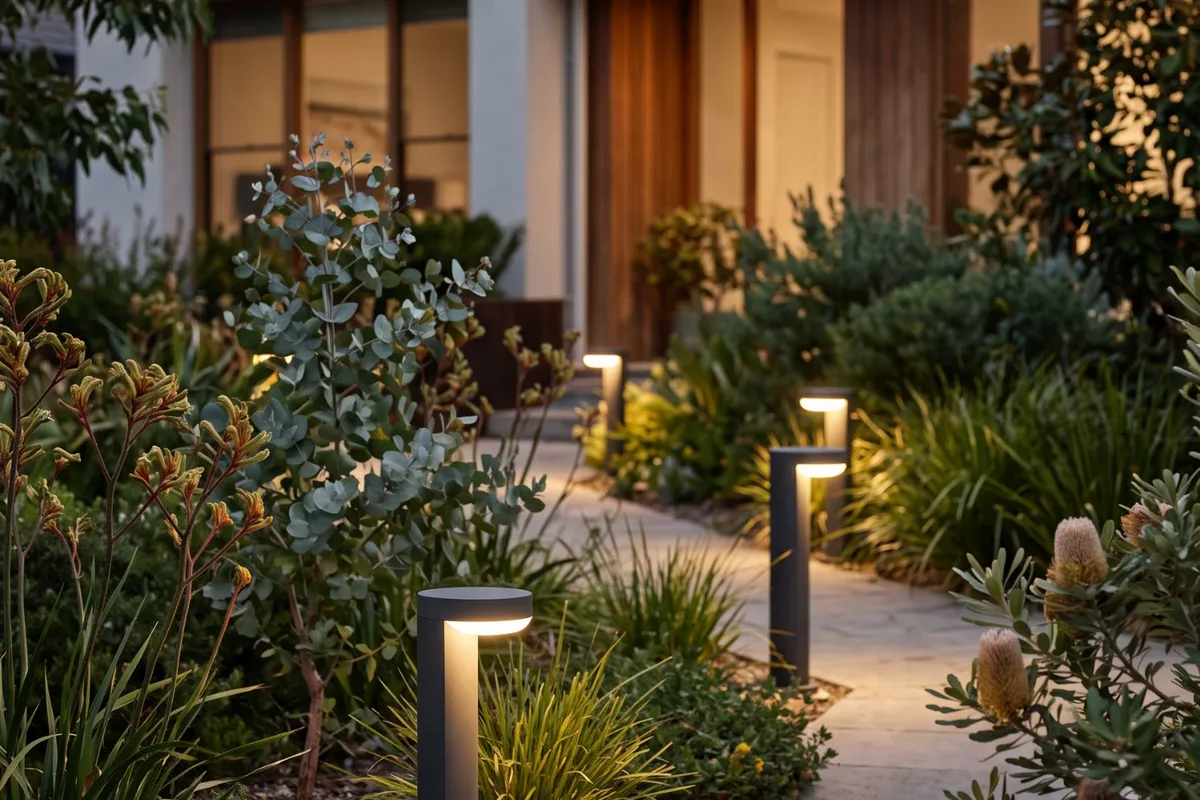
Paths are best lit low. Bollards or spike lights with shielded heads throw light onto the ground without glare, spaced so the pools of light just meet. Steps need a light on each tread or riser, recessed into the side wall or under the nosing, so you can see where each tread ends.
Trees come alive with uplighting: a fitting at the base angled into the canopy, with two from different sides for a big tree. Grazing a wall means placing fittings close to its base so light skims up and shows the texture of brick, stone or render. Washing a wall uses wider beams further back for even light.
Downlighting from a pergola, eave or tree mimics moonlight and suits entertaining areas. Silhouetting puts a light behind a plant against a wall so its shape shows dark against the glow. Most good schemes use two or three of these techniques, not all of them.
- Paths: low, shielded light onto the ground.
- Steps: a light on each tread or riser.
- Trees: uplights at the base, angled into the canopy.
- Walls: grazing for texture, washing for even light.
Low voltage or mains?
Garden lights run either at 240 volts straight from the home's wiring, or at 12 volts from a transformer that converts mains power. 12 volt fittings are smaller and easier to move and add to, and they're common for path, step and feature lights. Their limit is distance and load: long runs with many fittings lose voltage, so lights at the far end can be dimmer unless the cable and transformer are sized for the run.
240 volt fittings suit longer runs, brighter fixtures and wall lights on the house or fence. The cable needs more protection in the ground, with a proper route and depth, and every fitting and joint has to suit its exposure.
The licensing line is the home's wiring. A plug-in kit with its own plug-in transformer plugs into an outdoor outlet like an appliance. A hardwired transformer, a new outdoor circuit or any 240 volt garden light is electrical installation work for a licensed electrician, and Energy Safe Victoria says even small electrical jobs aren't DIY.
Transformers and drivers
The transformer is the heart of a 12 volt system and the part most likely to need attention, so it belongs somewhere dry, ventilated and reachable: an outdoor-rated enclosure on a wall, inside the garage or under the eaves, never buried in a garden bed. Size it with spare capacity, so a few extra lights later won't overload it.
In a big garden, several smaller transformers, each feeding one area, can work better than one large one. Shorter runs mean less voltage drop, and a fault in one zone doesn't take out the whole garden.
LED fittings and transformers have to suit each other. An old halogen transformer won't necessarily run new LED lamps properly, and a mismatched pair can flicker, buzz or fail early.
Zones, timers and sensors
Split the garden into zones that are used differently. Path and step lights might run from dusk to a set time, feature lights only when you're entertaining, and entry lights on motion sensors. Each zone gets its own switch, timer or channel.
Controls can be a switch inside the back door, a timer at the transformer, a dusk-to-dawn sensor, motion sensors, or a smart controller and app. Astronomical timers follow sunset through the year, so lights come on at dusk in July and later in December without resetting.
Keep at least one manual switch inside. Timers and apps are convenient, but when guests are leaving late, a switch by the door is quicker.
Cabling, conduit and joints
Most of the work in garden lighting is underground. Cable runs in conduit along paths, fences and bed edges, where a spade is less likely to find it. Lay spare conduit under paths and driveways before they're poured or paved; it saves lifting pavers later.
Joints are the weak point. Water gets into poorly sealed connections and trips the safety switch after rain or when the sprinklers run. Keeping joints above ground in sealed enclosures, and using fittings rated for in-ground use where they sit in wet soil, prevents most of the trouble.
Outdoor circuits need safety switch protection. Energy Safe Victoria says a safety switch turns the power off within 0.03 of a second when it detects a problem, and outdoor fittings live with exactly the wet conditions it protects against.
Planning with the landscaper
The best results come when lighting is planned with the landscaping, not added afterwards. Give the landscaper and electrician the same plan, with fittings, transformers, conduit routes and switch positions marked. Conduit and cable go in after earthworks and before paving, turf and mulch.
Leave a loop of cable at each feature light so it can move as plants grow, and set the final aim at night with the lights on before the job is signed off. The work comes with a Certificate of Electrical Safety.
- Garden plan with mature plant sizes.
- Fittings, transformers and switches marked.
- Conduit under paths before paving.
- Night-time aiming before sign-off.
Common questions
Quick answers
- Why is there water inside my outdoor light?Water gets into outdoor lights through perished seals, cracked lenses, unsealed cable entries or a fitting that isn't rated for where it's mounted.
- Why does my sensor light stay on or keep turning on all night?A sensor light that stays on or keeps triggering all night is usually seeing something: swaying plants, pets, possums, insects drawn to the light, or warm air from an…
- Why do my lights turn on or off by themselves?Lights that switch on or off by themselves are usually following instructions you've forgotten: a smart switch schedule, a routine in an app, a motion or daylight…
Sources for this guide
3 sources, with the date each was checked
- 1.Energy Safe Victoria: Electrical work isn’t a DIY job, even for small jobs such as changing power points or light switches. Accessed 30 September 2026.
- 2.Energy Safe Victoria: monitors the flow of electricity through a circuit detects a problem that may pose a risk to personal safety turns the power off within 0.03 of a second always has a test button and '30ma' printed on them. Accessed 30 September 2026.
- 3.Energy Safe Victoria: Whenever a licensed electrician completes any electrical installation work, they must provide a Certificate of Electrical Safety (COES). Accessed 30 September 2026.
Planning advice for homeowners. Installation requirements depend on the property and equipment. Where this guide refers to Victorian safety or rental rules, use the linked official guidance for the current requirements.