
The key points
- Your registered electrical contractor runs the job: assessment, the request to the distributor, the new mains and panel, and booking the inspection.
- The distributor owns the network connection and usually the meter, so it removes and refits the meter on its own schedule.
- Consumer mains, meter box and main switchboard work is prescribed, so a Licensed Electrical Inspector checks it before the power goes back on.
- Plan for a full outage on changeover day, and mention fridges, medical equipment, home offices and alarms early.
What's being upgraded
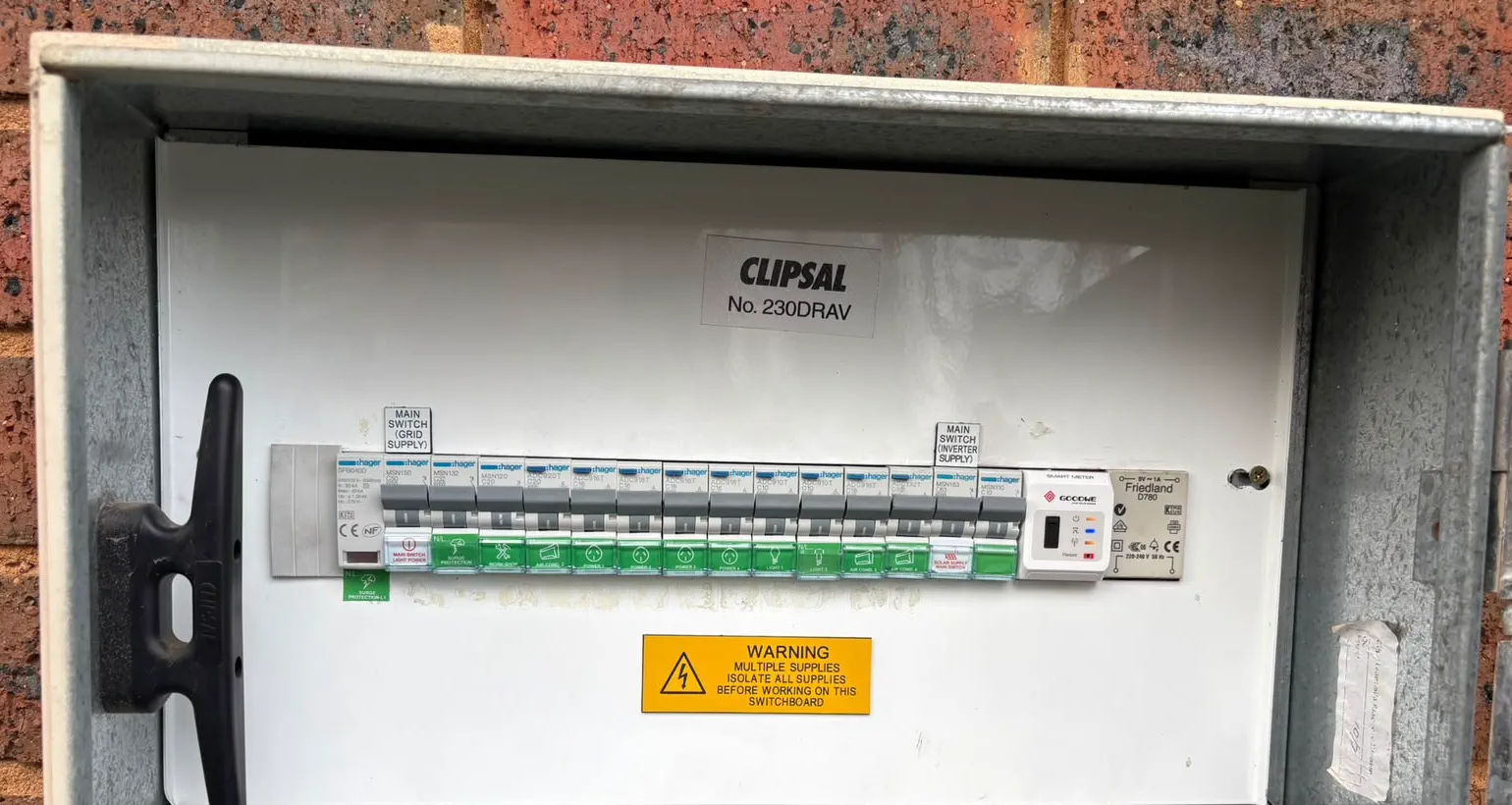
Three things get called 'the mains'. The service line is the network's cable from the pole or pit to your property. The consumer mains is your cable, from the point of supply to the main switchboard. The meter panel, inside the meter box, carries the network's meter and service fuse, and in many older homes the main switch and circuit fuses too.
From the point of supply in, the property owner is responsible for maintaining and repairing the installation, including private lines on the property. Powercor lists customer installation defects, such as an insecure or missing service hook, a defective fused mains box or a defective meter box, as the customer's to fix.
Upgrades usually happen for one of three reasons: the house needs more capacity for new loads, the old cable or panel has deteriorated, or the distributor has issued a defect notice. In an older home in Altona, Laverton or Newport it can be all three.
Who does what
Your registered electrical contractor (REC) is the one you deal with. It assesses the job, prepares the new mains, meter box and panel, and lodges the request with the distributor. In Powercor's area, alteration requests, including upgrading meters or meter panels and changing the supply setup, can only be submitted by an REC.
The distributor owns the poles, wires and network connection, and usually the meter. It approves changes to the supply, may set conditions, and sends its own crew, or someone it authorises, to remove and refit the meter.
The retailer, the company that bills you, doesn't do the physical work, but a meter change can involve a service order through it, and Powercor lists retailer service orders among the third-party steps that can affect timing. If the supply type changes, ask your retailer whether your tariff changes too.
- Electrician (REC): assessment, request, installation, inspection booking and certificate.
- Distributor: approval, the network connection, and meter removal and refit.
- Retailer: billing, and any service order the meter change needs.
- Licensed Electrical Inspector: inspects the prescribed work before it goes live.
The process, step by step
First comes the assessment: the existing mains, meter box, panel and switchboard, what you plan to run, and whether the board should be replaced in the same job. Then the request goes to the distributor, which confirms what it will allow at your property. Nothing should be ordered for a bigger supply until that answer comes back.
Next is preparation. The new box, panel and cable route are planned, and if the old panel may contain asbestos, its removal is planned too. Then dates: the changeover is lined up with the distributor's booking and the inspector, so the house is off for no longer than it needs to be.
On changeover day the power goes off, the old panel and cable come out, the new ones go in, the meter is refitted, and the work is inspected before switch-on. The paperwork follows: the inspector's certificate of inspection, then your Certificate of Electrical Safety.
- Assessment of mains, meter box, panel and switchboard.
- Request lodged with the distributor and approval received.
- Asbestos and access planned for the old panel.
- Changeover date aligned with the distributor and inspector.
- Changeover, inspection and switch-on.
- Certificate of Electrical Safety issued.
Why it's inspected before the power returns
Mains and meter box work is on wiring you can't switch off from inside the house. Energy Safe Victoria describes prescribed work in a home as generally work on wiring and equipment that can't be switched off, usually the wires up to the switchboard, and lists consumer mains, the main switchboard, the meter box and the main earthing system among its examples.
Because a fault there sits ahead of your main switch, it gets a second check by someone who didn't do the work. Prescribed work can't be switched on, or left on, until it has been inspected, and Energy Safe Victoria says the inspection should be completed within 8 business days of the work being finished.
The certificate follows the inspection. The Electricity Safety Act sets the time to give you the Certificate of Electrical Safety for prescribed work at 4 business days after the inspector's certificate of inspection is given.
Old panels and asbestos
Many meter panels in post-war homes are dark, fibrous boards that may contain asbestos. WorkSafe Victoria lists switchboards and their backing boards as a typical location for asbestos-containing materials in buildings built or renovated before the late 1980s, and names pitch-based boards such as Zelemite among its examples.
You can't tell by looking, so the panel shouldn't be drilled, cut, sanded or cleaned. WorkSafe Victoria's compliance code says a licensed asbestos removalist may be needed if a mounting board has deteriorated or asbestos dust is present, and that an asbestos-containing panel that's removed must be replaced with non-asbestos material. That planning belongs at the quote, not on the day.
Planning around the outage
The house is off for the changeover, and the new work can't go live until it's inspected. Ask for the expected window once dates are set, and plan as if it might run long: keep the fridge and freezer shut, and freeze ice bricks the night before.
If anyone at home relies on powered medical equipment, say so at the start so the day can be planned around them. Home offices, aquariums, alarms and automatic gates are worth mentioning too. Leave the meter box clear, pets secured and gates unlocked for the distributor's crew and the inspector.
Afterwards, plug things back in gradually, reset clocks and timers, and check that the hot water, any off-peak circuit and a solar inverter have come back as expected.
- A fridge and freezer plan for the day.
- Medical equipment and home office covered.
- Meter box clear, pets secured, gates unlocked.
- Solar, hot water and timers checked afterwards.
How long it takes, and combining jobs
The site work is usually the quick part. The overall timeline depends on the distributor's approval and booking, and on the inspection. Powercor's own guidance says alterations take between 3 and 8 weeks to complete depending on complexity, and that third parties, including retailer service orders, can affect that.
Because each step involves the distributor and an inspector, combine work where you can. If the switchboard is old, has fuses or lacks safety switches, replacing it with the meter panel means one shutdown and one inspection instead of two. If a larger supply or three-phase is likely in the next few years, decide now.
Common questions
Quick answers
- My meter box door is broken or won't close. Who fixes it?The property owner.
- A power line to my house is down or sagging. What should I do?Stay well away and keep everyone else clear.
- Who trims trees near the power line to my house?It depends whose tree and whose line.
- Why do my lights flicker on windy days?If your lights flicker when the wind blows, the overhead line to your house is the first suspect.
Sources for this guide
8 sources, with the date each was checked
- 1.Energy Safe Victoria: The point of supply is the changeover point from the electricity distribution network to the electrical installation, where the property owner becomes responsible for the maintenance and repair of the electrical… Accessed 30 September 2026.
- 2.CitiPower & Powercor: Customer installation defects fall under customer responsibility and require prompt rectifications to ensure either the safety of the electrical installation, unhindered access to our assets by our employees or that our… Accessed 30 September 2026.
- 3.Energy Safe Victoria: Registered Electrical Contractor (REC) – in Victoria an electrician must work for a Registered Electrical Contractor to perform work for a customer. A Registered Electrical Contractor must be registered with Energy Safe… Accessed 30 September 2026.
- 4.Energy Safe Victoria: A prescribed certificate is for all major electrical wiring work in all types of premises. In a domestic property this covers all work done on wiring and equipment where the electricity cannot be switched off. This… Accessed 30 September 2026.
- 5.Energy Safe Victoria: The electrician has eight business days after the work is completed to have that work inspected by a licensed electrical inspector (LEI). If an electrician replaces a main switchboard at a property, power cannot go back… Accessed 30 September 2026.
- 6.Victorian Legislation (legislation.vic.gov.au) - Electricity Safety Act 1998, authorised version 089 (effective 8 Sep 2026): (a) in the case of prescribed electrical installation work, is 4 business days after the certificate of inspection of that work is given under section 45(3); and Accessed 30 September 2026.
- 7.WorkSafe Victoria: A person who has management or control of a workplace, and employers or self-employed persons and employees should be aware of the typical uses and applications of ACMs, particularly in buildings constructed or… Accessed 30 September 2026.
- 8.WorkSafe Victoria: If the condition of electrical mounting boards has deteriorated or ACD is present an asbestos removal licence holder may be required to undertake asbestos removal work For example, if an ACM electrical mounting panel… Accessed 30 September 2026.
Planning advice for homeowners. Installation requirements depend on the property and equipment. Where this guide refers to Victorian safety or rental rules, use the linked official guidance for the current requirements.