
The key points
- Start with how someone would approach the house: front door, driveway, side gates, back door and garage.
- Sensor lights work best aimed across the path people walk, with the detection zone stopping at your boundary.
- Two moderate lights from different angles usually leave fewer dark corners than one very bright floodlight.
- Floodlight cameras need constant power and a steady Wi-Fi signal at the eave, not just in the lounge.
- Aim lights down and inside your boundary, and use warm white where they face neighbours.
Walk the approach after dark
Security lighting works when it covers the places someone would actually go. Walk around the house at night and note each way in: the front door, the driveway and garage, side gates and paths, the back door, sliding doors and the shed. Note anywhere you can't see your own feet.
Then think about the job at each one. At the front door, light helps visitors find the lock and lets you see who's there. On the driveway it lights the car and the path to the door. In a side path it makes the space less inviting to anyone who shouldn't be there. Different jobs suit different fittings.
In newer estates around Tarneit, Truganina and Werribee, side paths are often narrow and close to the neighbour's windows, so spill matters more. In parts of Altona, where the planning scheme aims to keep post-war homes with generous side setbacks, a driveway often runs down the side to a garage at the back, so distance from the house matters.
- Front door and entry path.
- Driveway, garage and carport.
- Side gates and side paths.
- Back door, sliding doors and the shed.
Sensor lights: placement is everything
Most security lights are motion-sensing. Passive infrared sensors detect movement best across their field of view, so mount them where people walk past the sensor rather than straight at it. Too high and the zone takes in the street and passing cars; too low and the range shrinks.
Angle the head until the zone stops at your boundary. Set the run time long enough to get from the car to the door, and the daylight setting so the light doesn't run in the afternoon. Shrubs moving in the wind are the usual cause of lights switching on by themselves, so keep them out of the zone.
Fittings that glow low from dusk and brighten on movement suit entries and shared driveways: enough light to see by all night, with a jump in brightness when someone approaches.
Floodlights without glare or dark corners
A very bright floodlight is the instinctive choice and often the wrong one. It throws hard black shadows beside its beam, dazzles anyone looking towards it and washes out a camera pointed back at it. Two moderate fittings lighting the driveway from different angles usually leave fewer dark corners.
Mount floodlights high and to one side, aimed down and across the area, not out towards the street. Adjustable heads or shields cut the beam off before it reaches a neighbour's bedroom window. Swapping an old halogen flood for LED also cuts heat on the eave and running costs.
Colour matters. Cool white looks crisper on camera but is harsh over a garden and in a neighbour's window; warm white is easier on everyone. Many homes use cool white at the driveway and warm white at the back and sides.
Floodlight cameras
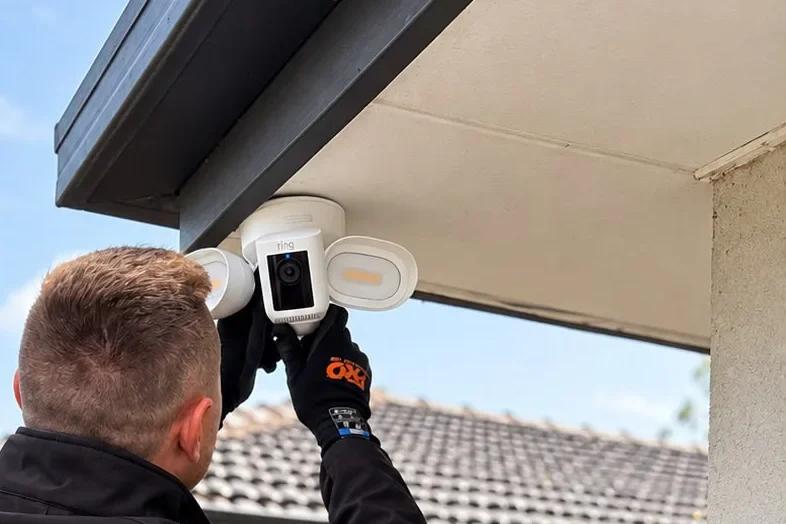
A floodlight camera puts a camera in the same fitting as the light. It needs power that's always on, so the wall switch is either rewired or left on permanently, with the light controlled from the app. It also needs a steady Wi-Fi signal where it's mounted.
Test the signal at the eave, not the lounge. Brick veneer, foil insulation and metal roofing all cut Wi-Fi, so full bars in the kitchen can mean dropouts outside. A video call made from the exact spot is a quick test; if it breaks up, a cabled access point or a wired camera is the fix.
Light and camera want different positions. A light works best high and to the side, while a camera works best lower and facing the approach, so it sees faces rather than the tops of heads. A combined unit suits most front doors and garages, but on a long drive a separate light and camera usually do better.
Neighbours, privacy and the street
Light crossing the fence causes most complaints about security lighting. Aim everything down and inside your boundary, use shielded fittings where spill is a problem, and keep sensor zones away from the street and neighbouring yards, so passing cars and the neighbour's cat don't set lights off all night.
Cameras need the same thought. Keep them pointed at your own property and use the privacy zones most apps offer to blank out a neighbour's windows or yard. The account and recordings sit with the camera's maker, so set them up in your name and check what a subscription covers before relying on stored footage.
Power, circuits and controls
Hardwired security lights run from a lighting circuit, and a camera needs a supply the wall switch doesn't cut. When a light is moved or added, the cable route through the roof or wall is planned with it, and the old point is finished neatly rather than left as a dead fitting.
Outdoor fittings need weather ratings to suit their exposure, and the circuit needs safety switch protection. Energy Safe Victoria says a safety switch turns the power off within 0.03 of a second when it detects a problem. A light that trips the safety switch after rain usually has water inside it.
Keep a manual override. Most sensor lights can be forced on for the evening by flicking the wall switch off and on, though it varies by model, and a switch inside that turns a floodlight on regardless of the sensor is handy when you hear something outside.
Blackouts and backup
Hardwired lights and cameras go off with the house, and so does the modem, so a camera that records to the cloud stops recording too. Some cameras keep clips on a memory card or carry a small backup battery; check the specifications if that matters to you.
Solar sensor lights don't need mains power, but they rely on sun and a battery, both weakest in winter. They suit a shed or back corner; for the front door and driveway, hardwired is more dependable. Every hardwired light is electrical installation work and comes with a Certificate of Electrical Safety.
- Each entry and path marked on a plan.
- Sensor zones that stop at the boundary.
- Wi-Fi tested at camera positions.
- Warm white where light faces neighbours.
Common questions
Quick answers
- Why does my sensor light stay on or keep turning on all night?A sensor light that stays on or keeps triggering all night is usually seeing something: swaying plants, pets, possums, insects drawn to the light, or warm air from an…
- Why is there water inside my outdoor light?Water gets into outdoor lights through perished seals, cracked lenses, unsealed cable entries or a fitting that isn't rated for where it's mounted.
- Why do my lights turn on or off by themselves?Lights that switch on or off by themselves are usually following instructions you've forgotten: a smart switch schedule, a routine in an app, a motion or daylight…
Sources for this guide
3 sources, with the date each was checked
- 1.Victorian Government, Hobsons Bay Planning Scheme (PDF snapshot, last updated by VC292 on 11/09/2025): SPECIAL CHARACTER AREAS, ALTONA 1.0 24/02/2022 C131hbay Neighbourhood character objectives To preserve the characteristics of the neighbourhood, comprising intact post-war brick and weatherboard dwellings with… Accessed 30 September 2026.
- 2.Energy Safe Victoria: monitors the flow of electricity through a circuit detects a problem that may pose a risk to personal safety turns the power off within 0.03 of a second always has a test button and '30ma' printed on them. Accessed 30 September 2026.
- 3.Energy Safe Victoria: Whenever a licensed electrician completes any electrical installation work, they must provide a Certificate of Electrical Safety (COES). Accessed 30 September 2026.
Planning advice for homeowners. Installation requirements depend on the property and equipment. Where this guide refers to Victorian safety or rental rules, use the linked official guidance for the current requirements.