
The key points
- List every tool with its nameplate rating and note which ones run together. That list decides the circuits, not the size of the shed.
- A light and a couple of power points can run on one circuit from the house. Tools, a compressor, a welder or heating usually point to a sub-board in the shed.
- Distance matters as much as load: a long run to the back fence needs heavier cable so motors start cleanly and lights don't dim.
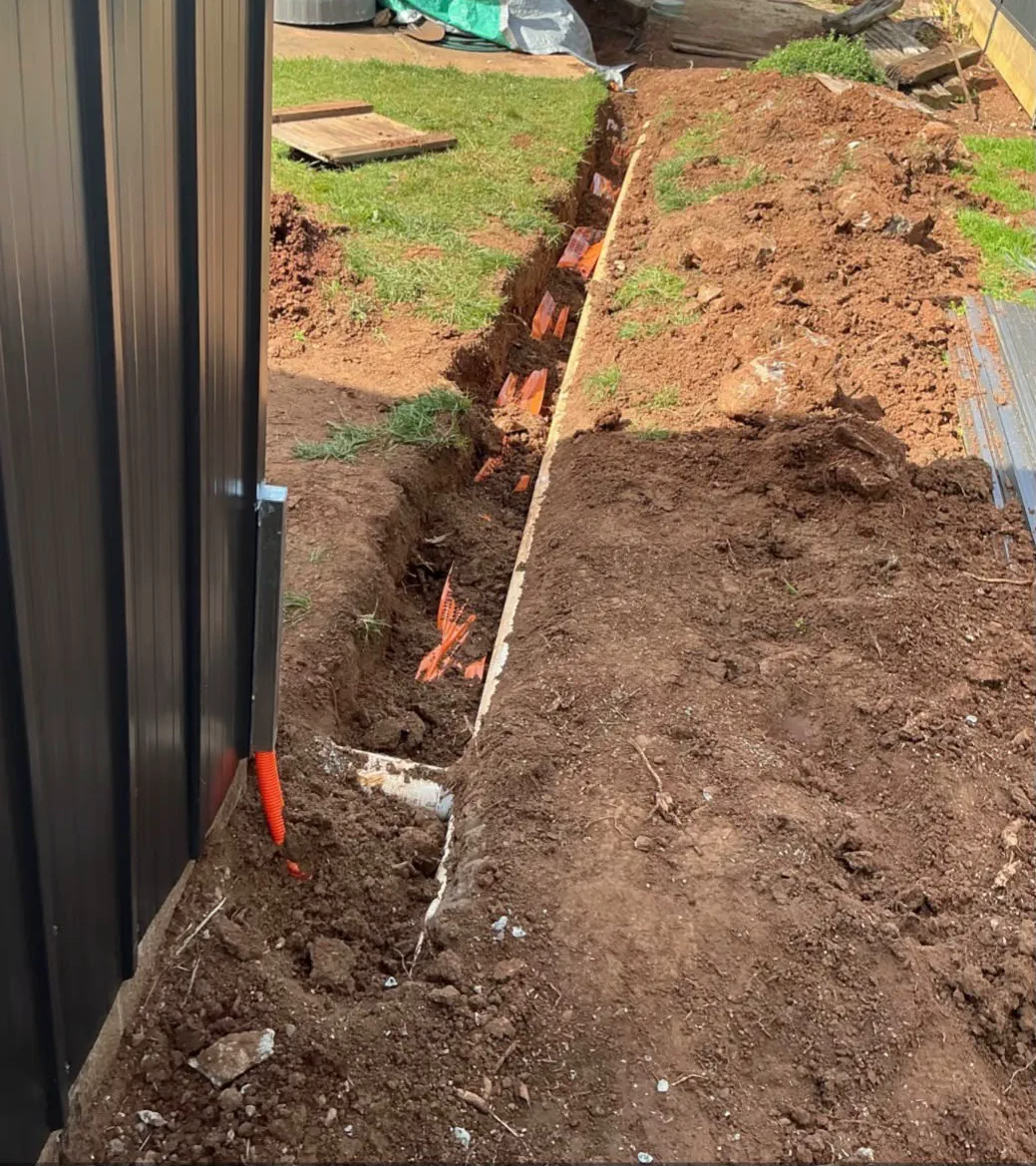
- Lay conduit before concrete, paving or garden beds go in, and keep a photo record of the route.
- Three-phase makes sense for machines built for it or loads too big for one phase. Plenty of workshops run well on single-phase.
Start with a list of what you'll run
Most shed jobs are planned from one piece of paper: a list of what you'll plug in. Write down every tool and appliance, then find the rating on its nameplate or in the manual. It's usually given in amps or watts. Photos of the plates are just as good.
Then mark which ones run at the same time. A drop saw and a shop vac often run together. A compressor cycles on by itself while you're using an air tool. A heater or a split system runs underneath everything else in winter. It's the overlap, not the total, that sets the size of the supply to the shed.
Think a few years ahead as well. If you might add a welder, a second fridge, a kiln or an EV charger in the garage, put it on the list now. Spare capacity in the cable to the shed is easy to allow for at the start and hard to add once the trench is filled.
- Everyday loads: lights, battery chargers, a radio, a drill
- Bench machines: drop saw, table saw, drill press, grinder
- Motors that start under strain: compressor, dust extractor, pressure washer
- Welders: the input rating on the plate and the plug it came with
- Comfort: a heater, a fan or a split system for a workshop used year round
- Future loads: EV charging, a beer fridge, a kiln, a pool or spa pump nearby
Compressors, welders and other heavy loads
Motors draw a burst of current as they start, well above their running figure. A compressor kicking in while a saw is running on the same circuit is the classic cause of a breaker tripping mid-cut. Larger compressors and dust extractors are often happier on a circuit of their own.
Welders vary more than most tools. Smaller inverter welders may plug into an ordinary outlet, while bigger machines come with a higher-rated plug that needs a matching outlet and circuit. Never swap the plug to suit the wall. Bring the model number and we'll work out the outlet, circuit and protection it actually needs.
Heating and cooling in a workshop usually gets its own circuit too. A metal shed is hard to work in on a hot northerly afternoon or a cold July morning, and a split system is a common addition once the power is there. Energy Safe Victoria guidance says that where an air conditioner manufacturer specifies a dedicated circuit or a safety switch, that must be followed.
One circuit from the house, or a sub-board in the shed
A garden shed with a light, a power point for the mower charger and maybe a radio usually runs on one circuit from the house switchboard. It's the smaller job, and the circuit is protected by a safety switch at the house board.
Once the shed has tools, heating or more than a couple of outlets, a sub-board makes more sense. A submain cable runs from the house to a small board in the shed, and each shed circuit gets its own breaker and safety switch there. A tripped circuit can be reset without walking back to the house, and adding a circuit later doesn't mean another trench.
Energy Safe Victoria guidance says the Wiring Rules require safety switch protection on every final sub-circuit in a home, and additional protection when an existing installation is altered. In a shed, with concrete floors, metal tools and leads that get run over, that protection earns its keep.
Getting the cable to a detached shed
Distance is the part people underestimate. Voltage drops along a cable, and the further the shed sits from the switchboard, the heavier the cable has to be for motors to start cleanly and lights to stay steady. A shed at the back of a long block can need a noticeably bigger submain than one beside the house.
Underground cable runs in conduit at the depth and with the protection the Wiring Rules set for that cable, so the route needs planning around garden beds, paths, pipes and anywhere you might dig later. Where a fence line, carport or roof gives a protected path, that can be the better route, particularly where side passages are narrow.
Timing matters. If concrete, paving or synthetic turf is going down, lay the conduit first, even if the cable comes later. Take photos with a tape measure in shot and keep a sketch of the route.
Lighting a shed you can actually work in
A single batten in the middle of the ceiling lights the floor and leaves the bench in your own shadow. Put lights over the bench, slightly in front of where you stand, and light the car or machine area separately. LED battens give even light with little heat, which helps in an uninsulated shed under a metal roof.
Switch the lights in groups, with a switch at the door so you're not crossing a dark shed to find it. A sensor light outside the door helps when you're carrying things in after dark, and an outdoor power point beside the shed is handy for the pressure washer or hedge trimmer.
Power points where the work happens
Put double power points along the back of the bench at working height, spaced so a lead never has to stretch across the cutting area. A point at each end of a long bench and one near the door covers most layouts.
Power boards and long extension leads aren't a fix for too few outlets. They load up a single outlet and get damaged on a shed floor. If you're reaching for them every Saturday, the shed needs more points or another circuit.
When three-phase makes sense for a workshop
Three-phase makes sense when you run machines built for it, such as some larger compressors, lathes or dust extraction, or when the shed's loads are too large to share one phase comfortably with the house. If the house already has a three-phase supply, a three-phase submain can run to a sub-board in the shed.
If the house is single-phase, the upgrade involves your distributor, new consumer mains and a new main switchboard. That is prescribed work, inspected by a Licensed Electrical Inspector before it can be switched on. Weigh it against the alternatives: plenty of hobby and trade tools run on single-phase, and a heavier single-phase supply or a different machine can be the simpler answer.
What to have ready before you book
A quick sketch of the block with the house, switchboard and shed marked, and the rough distance between them, saves a lot of back and forth. Add the tool list, the nameplate photos and a photo of the switchboard.
A licensed electrician must provide a Certificate of Electrical Safety for electrical installation work, and that covers circuits, power points and lights in a shed or garage. Keep it with your route photos. Together they're the record of what was done if you sell or add to the shed later.
Common questions
Quick answers
- Why is there no power to my shed or garage?Start at the switchboards.
- What is a sub-board, and do I have one?A sub-board is a smaller switchboard fed by its own cable from a circuit breaker on your main switchboard.
- What is the switch next to my outdoor unit for?It's an isolating switch that cuts all power to the air conditioner, so a technician can work on the system safely without relying on the switchboard.
- Why does my electric heater trip the safety switch?A safety switch trips when it detects electricity leaking to earth, and portable heaters are a common cause.
Sources for this guide
5 sources, with the date each was checked
- 1.Energy Safe Victoria: This means that if the manufacturer’s specifications require an air conditioner to be installed on a dedicated circuit or protected by a residual current device then they must be adhered to. Accessed 30 September 2026.
- 2.Energy Safe Victoria: Clause 2.6.3.2.2 requires all final sub-circuits in a domestic installation be protected by a residual current device (RCD). A hot water service is included in this requirement Accessed 30 September 2026.
- 3.Energy Safe Victoria: Clause 2.6.3.2.5 of the Wiring Rules states: Additional protection by RCDs shall be provided in existing electrical installations where alterations or a switchboard replacement is completed. Accessed 30 September 2026.
- 4.Energy Safe Victoria: 'Prescribed' certificates are for electrical installation work that requires inspection by a Licensed Electrical inspector. This includes (but is not limited to): Consumer mains cables, main switchboard, meter box and… Accessed 30 September 2026.
- 5.Energy Safe Victoria: Whenever a licensed electrician completes any electrical installation work, they must provide a Certificate of Electrical Safety (COES). Accessed 30 September 2026.
Planning advice for homeowners. Installation requirements depend on the property and equipment. Where this guide refers to Victorian safety or rental rules, use the linked official guidance for the current requirements.