
The key points
- Start with the plan of subdivision. It shows which parts are your lot and which are common property, and that decides who pays and who approves.
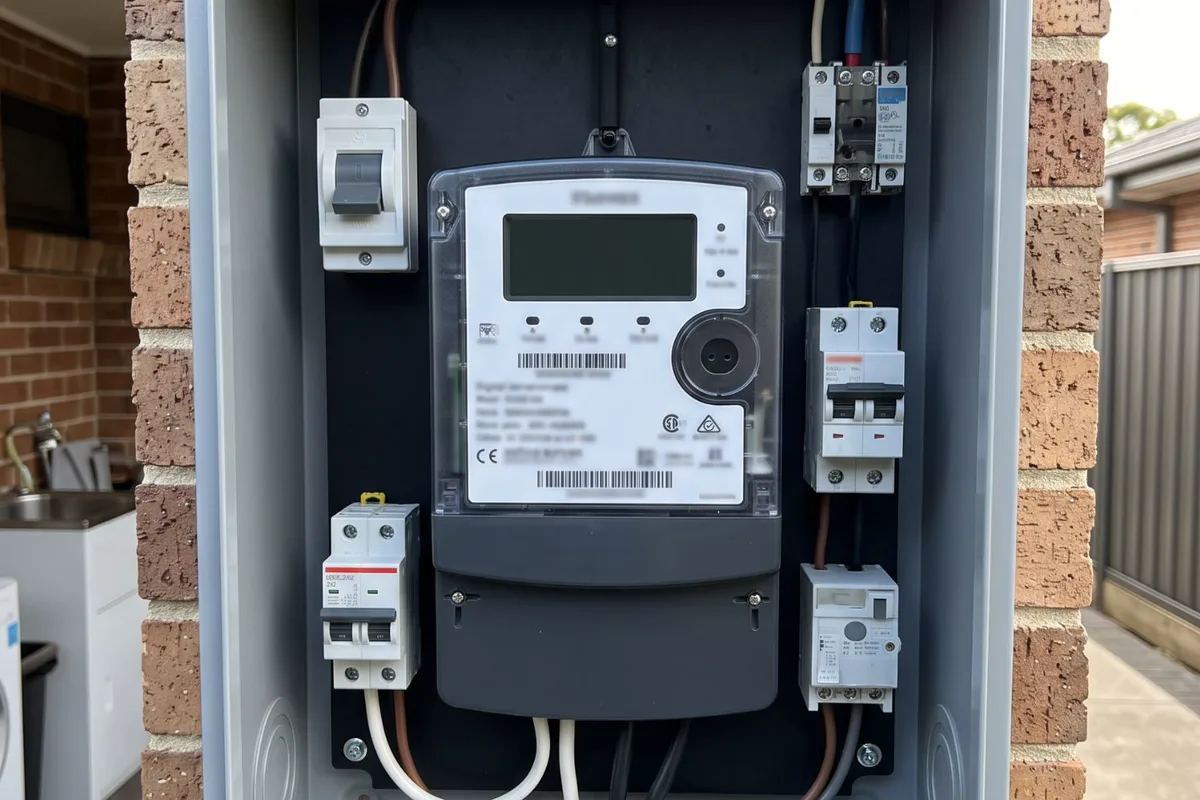
- Wiring and fittings that serve only your home are usually yours. Shared meter panels, mains and common lighting usually sit with the owners corporation.
- Work that touches common property or the building's exterior, such as an outdoor unit on an external wall, usually needs owners corporation approval first.
- EV charging in a shared car park raises supply, cabling and metering questions that need the owners corporation involved early.
- Get approvals in writing before booking the work.
Lot or common property: start with the plan
Units and townhouses are usually subdivided, with each owner holding a lot and the owners corporation responsible for common property. Exactly where one ends and the other begins is set by the plan of subdivision, not by habit or by what the previous owner did. The owners corporation manager, or the plan itself, is where to check.
In many townhouse developments, each lot includes its own building and yard, and common property is little more than the driveway and letterboxes. In older blocks of flats, common property often includes the external walls, roof, stairwells and meter room. The same job can need approval in one and not the other.
Williamstown shows how common this is. At the 2021 Census, 56.2% of its occupied private dwellings were separate houses, well below the Victorian figure of 73.4%. Much of the rest is units, townhouses and flats, each with its own mix of lot and common property.
What's usually yours
Inside your lot, the circuits, power points, lights, switches and a switchboard that serves only your home are generally yours to maintain and upgrade. Adding power points, changing downlights or replacing your own board usually needs no approval, as long as the work stays inside the lot.
Your consumer mains, the cable from the point of supply to your board, may run through common property. Energy Safe Victoria says the property owner is responsible for the electrical installation from the point of supply. In a subdivided building, which owner is responsible for which length of cable depends on the plan and the owners corporation, so find out before work on mains starts.
Air conditioning: where the outdoor unit goes
For most unit owners, the outdoor unit is the sticking point. A unit on an external wall, a roof or a balcony visible from the street may sit on or affect common property, and many owners corporations have rules on placement, noise and appearance. Ask for the rules and apply for approval with a sketch and photos before you buy the system.
Good spots are close to the indoor unit, with space around them for airflow and servicing, and away from neighbours' bedroom windows. A balcony unit needs room to breathe and a drain that doesn't drip onto the balcony below. Air conditioners with a compressor also need a lockable isolating switch next to the outdoor unit.
The pipe and cable route matters too. A route through a shared wall, a common roof space or down an external wall usually needs approval; one that stays inside your lot usually doesn't.
EV charging in shared car parks
An EV charger in a townhouse garage on your own lot is often straightforward, if your supply and board have room. In a shared car park, it raises questions the owners corporation has to answer: whose supply the charger runs from, how the power is metered and billed, where cable can run, and whether the building's supply can carry chargers for several owners.
Some owners corporations plan for this as a whole, with a shared supply, load management and a way of billing each user. That's often better than each owner running cable from their own meter across common property. Raising it at a general meeting gets everyone working from one plan.
Load management matters more in a building than in a house. A sensor on the supply lets several chargers share what's available, rather than every car charging at full rate at once.
Getting owners corporation approval
Write to the manager or committee with what you want done, where, and how it will look. Include a sketch, photos and the product details, and ask for the rules that apply. Wait for written approval before booking work that touches common property.
Some jobs inside a lot can still affect others, such as a new circuit that needs work in a shared meter room, or a job that needs the block's power off for a while. Tell the manager early so neighbours can be warned.
- Check the plan of subdivision for your lot boundaries
- Ask the manager for the owners corporation rules
- Describe the work with a sketch, photos and product details
- Note any work on common property, shared walls or the meter room
- Get approval in writing before booking
- Keep the Certificate of Electrical Safety, and share a copy if the manager asks
If the unit is rented
For an investment unit, the rental rules sit on top of the strata ones. Since 29 March 2023, Victorian rental properties have had to have modern switchboards with circuit breakers and safety switches, and the rental provider is responsible for engaging an electrician to meet that standard. Where the board is in a shared meter room, involve the owners corporation early.
A renter who wants an air conditioner or a charger needs the rental provider's consent, and the rental provider may need owners corporation approval as well. Get both in writing before anything is booked.
Common questions
Quick answers
- Is my meter box the same as my switchboard?Not quite, though they are often in the same place.
- My meter box door is broken or won't close. Who fixes it?The property owner.
- Will my fridge and freezer be OK during a switchboard upgrade?Usually, with some planning.
- Do I need to be home for a switchboard upgrade?Someone should be there at the start and at the end, and the electrician needs access to the switchboard and to the rooms inside for testing.
Sources for this guide
5 sources, with the date each was checked
- 1.Australian Bureau of Statistics, 2021 Census QuickStats: Separate house 3,070 56.2 1,755,423 73.4 Accessed 30 September 2026.
- 2.Energy Safe Victoria: The point of supply is the changeover point from the electricity distribution network to the electrical installation, where the property owner becomes responsible for the maintenance and repair of the electrical… Accessed 30 September 2026.
- 3.Energy Safe Victoria: 'Prescribed' certificates are for electrical installation work that requires inspection by a Licensed Electrical inspector. This includes (but is not limited to): Consumer mains cables, main switchboard, meter box and… Accessed 30 September 2026.
- 4.Access Canberra Electrical Inspections (ACT Government), Electrical Fact Sheet, updated September 2019: Air-conditioning and heat pump systems incorporating a compressor shall be provided with an isolating switch (lockable) in accordance with Clause 2.3.2.2, installed adjacent to but not on the unit, which isolates all… Accessed 30 September 2026.
- 5.Consumer Affairs Victoria: The electrical safety rental minimum standard commenced on 29 March 2023. Rental properties must have modern switchboards, with circuit breakers and electrical safety switches installed. Electrical safety switches are… Accessed 30 September 2026.
Planning advice for homeowners. Installation requirements depend on the property and equipment. Where this guide refers to Victorian safety or rental rules, use the linked official guidance for the current requirements.