
Should I leave the air conditioning on for my pets on hot days?
- A closed house can heat up fast on a hot day. If a pet stays inside, running the air conditioning at a moderate setting is a sensible choice.
- Cool one room to around 24 to 26 °C, close it off, and aim the airflow across the room rather than at the pet's bed.
- Set a timer on the unit as well as in the app, so the cooling still runs if the Wi-Fi drops out.
- Plan for the cooling stopping: shade, plenty of water, a cool floor and someone who can check in.
- Keep pets away from the outdoor unit and power leads, and don't rely on a fan alone to cool them.
Why a closed house gets risky on hot days
Laverton's weather records average about 27 days a year at or above 30 °C and around nine at 35 °C or more, mostly between December and February. On those days a shut house with the blinds open can end up hotter inside than the shade outside by mid-afternoon, especially upstairs rooms, rooms with west-facing glass and estate homes in Point Cook, Tarneit and Werribee with big windows and narrow eaves.
Dogs and cats cool themselves mainly by panting and through their paw pads rather than by sweating, so they rely on the air around them being cooler than they are. Short-nosed breeds, older animals, overweight pets and those with heart or breathing problems struggle soonest, and rabbits, guinea pigs and birds are very sensitive to heat. Your vet is the right person to ask about your own animal's limits.
Victoria's health department advises using air conditioning or a fan during extreme heat, and the same thinking applies to pets: on the hottest days, a cooled room is the most reliable way to keep their space at a safe temperature.
Settings that keep a pet comfortable without wasting power
You don't need to chill the house. The Victorian Government suggests 24 to 26 °C for cooling living areas, and each degree lower adds around 10% to running costs. A room held in that range is far more comfortable for a pet than one that has crept into the mid-30s. Choose cool mode so the unit holds to cooling, and leave the fan on auto.
Cool one area well rather than the whole house poorly. Pick the room with the split system or a ducted zone, close its doors, draw the blinds on sunny windows and put the pet's bed, water and litter tray in there. Aim the louvres across the room rather than down onto the bed, so the animal can lie in the cool air or move out of it.
Timers, apps and what happens when the Wi-Fi drops
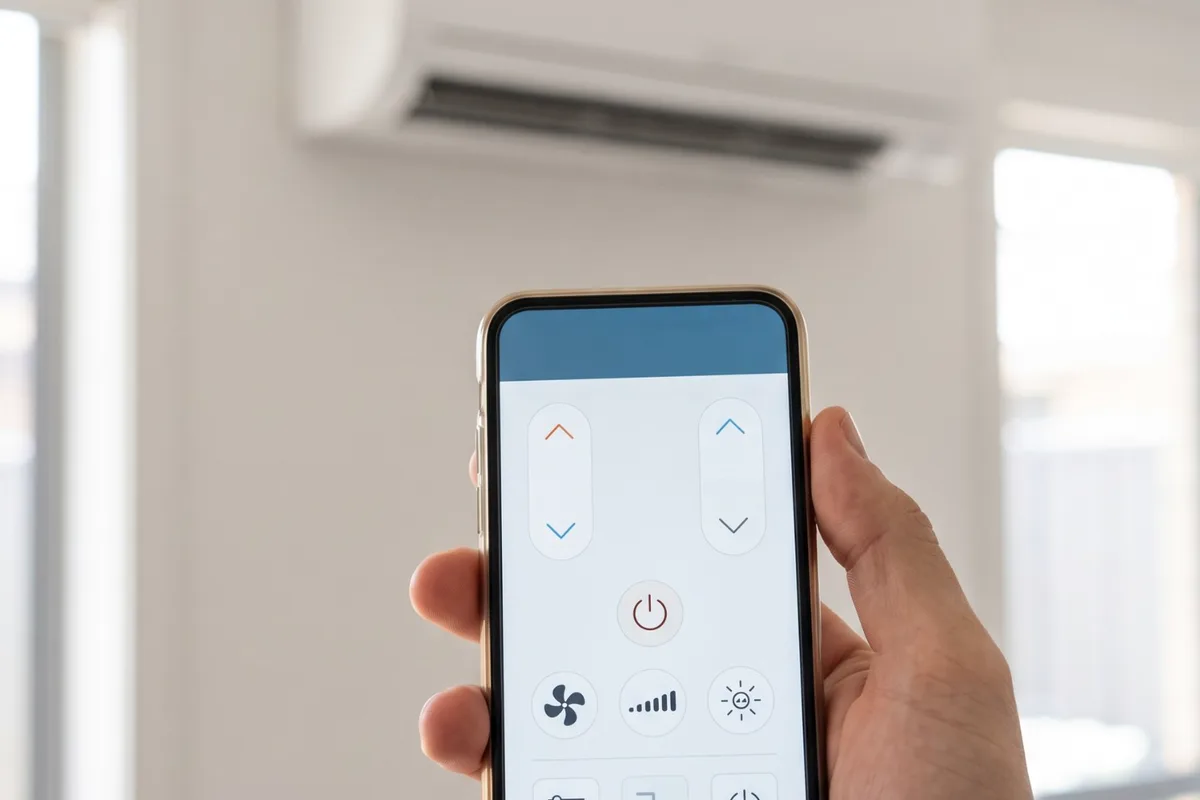
A Wi-Fi adapter or smart controller lets you check the room from work, start cooling early when a hot northerly is forecast and switch it off on your way home. Many split, multi-head and ducted systems connect through the maker's own adapter.
Don't let the app be the only plan. Home internet drops out and phones go flat. Set a schedule on the unit or its wall controller too, and find out what your unit does after a short power interruption. Many units wait a few minutes before restarting, and some need a press of the remote, which an app can't do if the unit is offline.
If a smart plug switches a portable fan, check its rating suits the appliance and plug it straight into a wall point. A fixed split system is wired on its own circuit, so it should never be switched by a smart plug.
A backup plan for when the cooling stops
Power fails during heatwaves and units trip, so plan for it. Leave fresh water in heavy bowls in more than one spot, and give the pet a tiled or concrete floor, a damp towel or a cooling mat that stays cooler than carpet.
Ask a neighbour or friend to check in on the hottest days, and give them a key and simple instructions for the air conditioner. Victoria's health department suggests checking that fans and air conditioners work before extreme heat arrives, getting the air conditioner serviced if needed, and keeping filters and vents clean.
Keeping pets and equipment safely apart
On cooling days the outdoor unit blows out hot air, and it has a fan and electrical connections inside. Keep dogs from digging around it, chewing the pipe insulation or lying against the coil, and from treating the isolator beside it as a scratching post. A low fence or garden bed around the unit, with clear space left for airflow, solves most of this.
Inside, leads from portable fans and chargers are tempting to chew, so run them behind furniture and unplug anything you aren't using. A ceiling fan is safer than a pedestal fan around animals, but a fan moves air without cooling it, and pets get far less benefit from moving air than people do.
Questions that come next
Sources for this article
4 sources, with the date each was checked
- 1.Bureau of Meteorology: Mean number of days ≥ 30 °C 6.9 6.0 4.5 0.7 0.0 0.0 0.0 0.0 0.1 0.9 2.8 5.1 27.0 82 1943 2026 Mean number of days ≥ 35 °C 3.6 2.4 0.9 0.0 0.0 0.0 0.0 0.0 0.0 0.1 0.5 1.9 9.4 Accessed 30 September 2026.
- 2.Department of Health, Victoria (updated 3 February 2026): Use air conditioning or a fan, wear light and loose-fitting clothing, keep your skin wet (for example, with a spray bottle or damp sponge), and take cool showers or foot baths. ... People most at risk include those over… Accessed 30 September 2026.
- 3.Solar Victoria (updated 20 November 2025): To heat a room, try setting the temperature between 18°C to 20°C. Every 1°C higher will add around 10% to your heating bill. Set your air conditioner thermostat for cooling between 24°C and 26°C for living areas – every… Accessed 30 September 2026.
- 4.Better Health Channel (Department of Health, Victoria): Check that your fan and air-conditioner works well. Have your air-conditioner serviced if needed. Ensure the filters, pads and air vents are clean. Accessed 30 September 2026.