
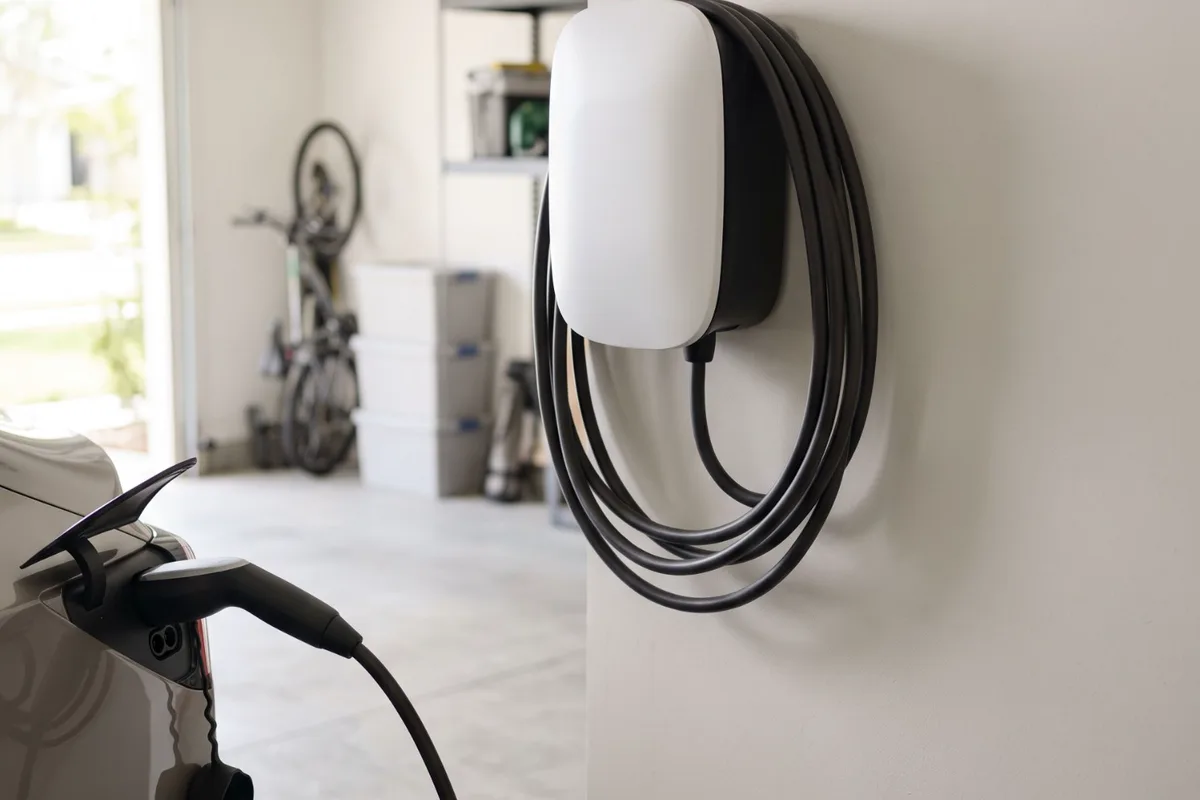
What affects the cost of installing a home EV charger?
- The distance from the switchboard to where the car parks is usually the biggest single variable.
- Board space and supply capacity are separate questions, and either can add work.
- Load management can sometimes avoid a supply upgrade on a modest connection.
- Compare quotes on route, protection, switchboard work, mounting, making good and commissioning.
Why two quotes can be far apart
Two quotes for an EV charger can describe very different jobs. One may assume a short run on the garage wall beside a modern switchboard. Another may include a new circuit through a double-storey home, a load management sensor and switchboard work. Neither is necessarily wrong; they're pricing different assumptions about your house.
The useful move is to make every quote describe the same job. The variables below are the ones that move the scope, roughly in the order they tend to matter.
Distance from the board to the parking spot
The cable has to get from the switchboard to wherever the car parks. In many Point Cook, Tarneit and Werribee homes the board is on the garage wall, so the run is short. In older homes in Altona, Newport or Footscray, the board might be on the front of the house while the car lives in a carport down the side or a garage at the back of the yard.
A longer run needs heavier cable to keep the voltage up at the charger, more time in the roof or subfloor, and sometimes trenching under paths or a driveway. Ask each quote to state where the cable will run, how it's protected and who reinstates any paving or garden.
The switchboard and what the supply can carry
A charger is one of the largest loads in a home, and it runs for hours. The board needs a spare position and the protection the charger's manual asks for. Energy Safe Victoria guidance says the Wiring Rules require every final sub-circuit in a home to have safety switch protection, and Type AC safety switches can no longer be installed, even like for like. An old fuse board or a full panel may need work first.
Separate from board space is the supply itself: how much current the whole house can draw at once. If heating, cooking, hot water and charging could all run together on a winter evening, the supply may be tight, and that's where load management, a mains upgrade or three-phase come in.
Single-phase, three-phase and load management
Many home chargers run well on single-phase power when the board and supply have room. Three-phase makes sense for a higher-capacity charger, two EVs that both need a full charge overnight, or a home already running large loads together. It's a bigger project: consumer mains and the main switchboard are prescribed work, inspected by a Licensed Electrical Inspector before the power goes back on.
Load management sits between the two. A sensor on the incoming supply tells the charger to slow down when the house is busy and pick up again when it's quiet. It adds a sensor, some cabling and set-up time, and on a modest connection it can avoid a supply upgrade. Ask whether each quote includes it, and why or why not.
The unit, its mounting and the extras
The charger itself is only part of the job. Each item below can add parts, time or both, and quotes often differ on which they assume.
Bring the make and model of the charger, the car and any solar inverter to the quote. A charger chosen before the site visit sometimes needs a different circuit or mounting from the one first assumed.
- Supplying the charger, or installing one you've already bought
- A tethered cable or a socket outlet
- Wall mounting, or a pedestal on a driveway or carport
- Outdoor rating and shelter from afternoon sun, mowers and car doors
- Wi-Fi reach, or a data cable for app control and schedules
- Solar-following set-up, which can need extra metering depending on the inverter
Comparing quotes like for like
Lay the quotes side by side and check they cover the same things: cable route and length, the circuit and its protection, any switchboard work, load management, mounting, trenching and making good, testing with your car, and the paperwork. A quote that looks much lower often leaves one of those out, to be added on the day.
Ask what happens if something unexpected turns up, such as a board that can't take another circuit. A clear quote names that uncertainty rather than hiding it. Whoever installs it, a Certificate of Electrical Safety must be issued for the work.
Questions that come next
Sources for this article
4 sources, with the date each was checked
- 1.Energy Safe Victoria: Clause 2.6.3.2.2 requires all final sub-circuits in a domestic installation be protected by a residual current device (RCD). A hot water service is included in this requirement Accessed 30 September 2026.
- 2.Energy Safe Victoria: Type AC RCDs must not be installed in Australia. This includes like for like replacement. We recommend that electrical contractors advise customers of the new requirements. However, it is not mandatory to replace… Accessed 30 September 2026.
- 3.Energy Safe Victoria: 'Prescribed' certificates are for electrical installation work that requires inspection by a Licensed Electrical inspector. This includes (but is not limited to): Consumer mains cables, main switchboard, meter box and… Accessed 30 September 2026.
- 4.Energy Safe Victoria: Whenever a licensed electrician completes any electrical installation work, they must provide a Certificate of Electrical Safety (COES). Accessed 30 September 2026.