
The key points
- Book the start-up service in spring, before the first hot northerly, not on the first scorching day.
- Open windows or doors while it runs. Without a way out, the house turns damp and stuffy.
- On humid days, switch to fan only or use another form of cooling; the cooler can't do much in muggy air.
- At the end of summer, drain the tank, and close the ducts and cover the unit if it has no automatic seals.
- Anything on the roof, inside the cabinet or involving the wiring is a job for a technician.
What you're looking after
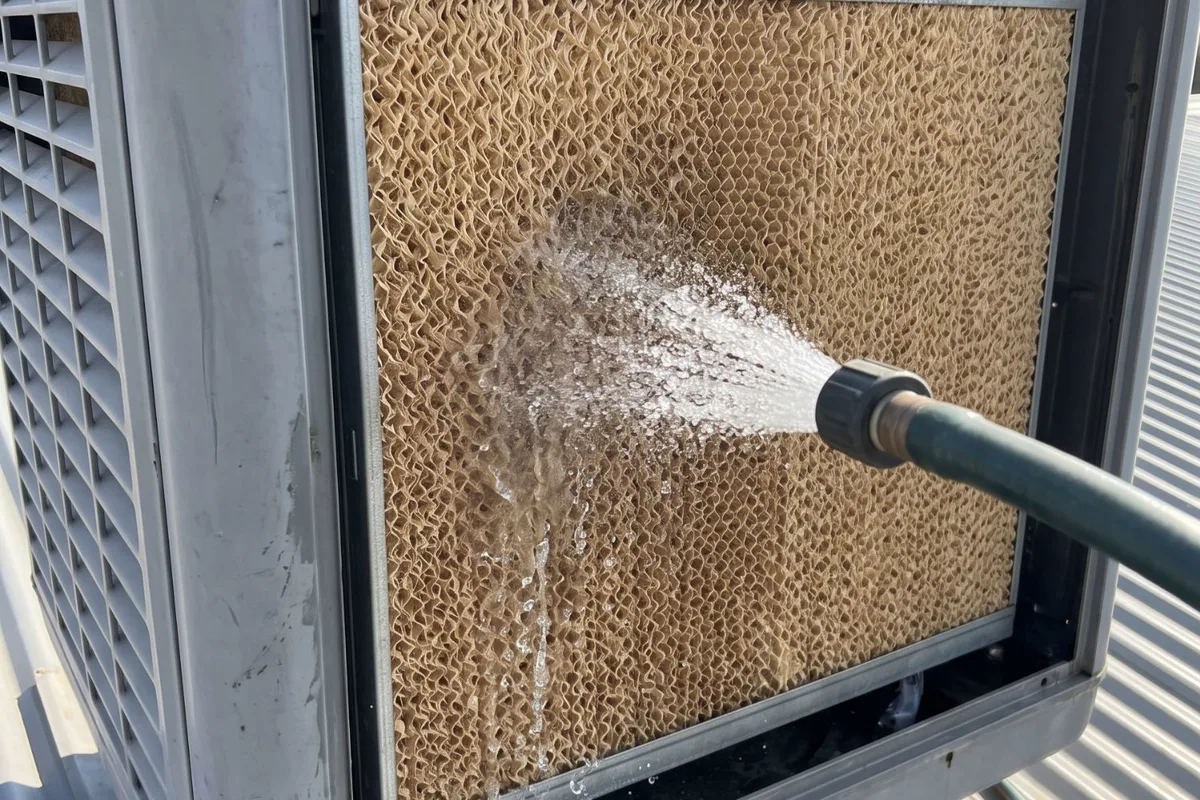
An evaporative cooler blows outside air over wet pads to cool it, then pushes that air through the house and out through open windows and doors. A pump lifts water from the tank to the top of the pads, a distributor spreads it evenly, a float valve tops the tank up from the mains, and a drain or bleed valve dumps some water so minerals don't build up. A large fan does the moving.
Most of that sits on your roof in sun, wind and dust all year. Pads scale up with minerals, the tank collects grime, seals perish, and the pump and fan motor wear. A little care each season keeps it cooling and stops small problems becoming a dead unit in a heatwave.
Spring: start-up before the first hot spell
Laverton averages 27 days a year at or above 30 °C, mostly between December and February, but the first hot northerly can turn up well before that. Book the start-up service in spring, when there's time to fix whatever it finds.
A start-up service is a roof job. The technician uncovers the unit if it was covered, turns the water back on, cleans the tank, checks the float valve, drain valve and pump, inspects the pads, checks the fan, motor and belt, tests the power and roof isolator, and opens any winter seals. Then it runs while they watch the pads wet evenly.
From the ground, you can try the wall controller, open every outlet and note any smell or noise on the first run. A damp-shed smell that doesn't clear after a few minutes usually means stale water or algae.
- Tank drained, cleaned and refilled
- Pads checked for scale, sagging and dry streaks
- Pump, water distributor and float valve working
- Drain or bleed valve cycling correctly
- Fan, motor, bearings and belt checked
- Power, roof isolator and wall controller tested
- Winter seals or covers removed and outlets open
Summer: running it well
An evaporative cooler needs somewhere for the air to go. Open windows or doors in the rooms you want cooled, on the side away from the wind, enough to let the air flow out. With the house shut, the cooler just raises the humidity and the rooms turn stuffy. Your manual or installer can tell you how much opening your system needs.
It works best on hot, dry days and loses ground in humid weather. On a muggy day, or a warm, still night after a change, run it on fan only, or cool the bedroom with a split system instead. Pre-cooling the house on a dry morning before a hot afternoon helps too.
Water use climbs with the heat: central systems can use 25 litres or more an hour on hot, dry days. A tank that overflows, a drain that runs all the time or a ceiling stain near an outlet is worth reporting early.
On days of smoke haze or dust, the cooler pulls outside air straight in. Switch it off and close up until the air clears.
Autumn and winter: shutting it down
Once the hot weather is over, water left in the tank sits stagnant until spring. Most coolers have a drain function or drain automatically after use, so make sure the tank is empty for winter.
Then keep winter out of the house. Some systems have automatic seals that close the ducts when the cooler is off. If yours doesn't, the ducts should be closed off and the roof unit covered for winter, or cold air drops through the outlets and warmth escapes up them. Ceiling outlets with closable vanes or winter covers help too.
Covering a cooler means getting onto the roof. If you aren't set up to work at height safely, have the cover fitted at an end-of-season visit.
The jobs that are yours
Plenty of care happens from the ground: opening the right windows, choosing fan only on humid days, wiping outlet grilles, and noting anything odd, such as a smell, a noise, a slow start or water where it shouldn't be.
Keep trees trimmed back from the cooler. Overhanging branches drop leaves into the pads and give possums a way onto it.
The jobs for a technician
Anything on the roof, inside the cabinet or involving the wiring needs a technician. Roofs are unforgiving, the cabinet holds a fan that can start without warning and a mains-powered pump sitting in water, and Energy Safe Victoria says electrical work isn't a DIY job, even small jobs.
Pads need replacing when they're scaled, thin, sagging or crumbling, because a scaled pad holds less water and lets less air through. Pumps, float valves, drain valves, belts and bearings wear on their own schedules. Work on the water connection is for a licensed plumber.
In time, a tired cooler raises a bigger question: keep it, replace it, or move to refrigerated air that also heats. Victoria's health department advises checking your cooling works before extreme heat and getting it serviced if needed, and that decision is easier on a mild spring day than in the middle of a heatwave.
Common questions
Quick answers
- My evaporative cooler won't start. What can I check?Start with the wall controller and the power: check the controller's display, the circuit breaker and safety switch at the switchboard, and any winter or off-season…
- Why is my evaporative cooler noisy?Most cooler noise comes from wear and loose parts: fan bearings that grind or squeal, a worn or slipping belt, panels and pad frames rattling in the wind, a pump humming…
Sources for this guide
6 sources, with the date each was checked
- 1.energy.gov.au (Australian Government, DCCEEW): Evaporative coolers work by blowing air over a film of water on a filter or sponge, cooling the sponge and the air through the process of evaporation. Outside air is drawn through the evaporative unit (generally on the… Accessed 30 September 2026.
- 2.YourHome (Australian Government): Evaporative coolers cool outside air and blow it into the house; some windows or doors will need to be left open when the cooler is in use to allow indoor air to exit. ... For central systems, water use can be 25 L or… Accessed 30 September 2026.
- 3.Bureau of Meteorology: Mean number of days ≥ 30 °C 6.9 6.0 4.5 0.7 0.0 0.0 0.0 0.0 0.1 0.9 2.8 5.1 27.0 82 1943 2026 Mean number of days ≥ 35 °C 3.6 2.4 0.9 0.0 0.0 0.0 0.0 0.0 0.0 0.1 0.5 1.9 9.4 Accessed 30 September 2026.
- 4.Bureau of Meteorology (article issued 3 August 2026): To the north lies Australia's hot, dry interior, while to the south stretches the cold Southern Ocean. ... Warm northerly winds arrive first, bringing higher temperatures and clear skies. Then, as a cold front moves in… Accessed 30 September 2026.
- 5.Better Health Channel (Department of Health, Victoria): Check that your fan and air-conditioner works well. Have your air-conditioner serviced if needed. Ensure the filters, pads and air vents are clean. Accessed 30 September 2026.
- 6.Energy Safe Victoria: Electrical work isn’t a DIY job, even for small jobs such as changing power points or light switches. Accessed 30 September 2026.
Planning advice for homeowners. Installation requirements depend on the property and equipment. Where this guide refers to Victorian safety or rental rules, use the linked official guidance for the current requirements.