
The key points
- Test every heater on a mild autumn day, when a fault is an inconvenience rather than a cold night.
- Energy Safe Victoria recommends servicing gas heaters at least every two years, with a carbon monoxide test at every outlet of a ducted heater.
- A reverse-cycle unit that pauses on frosty mornings is usually defrosting. Weak or cold air on a mild day is not normal.
- Clean filters, clear vents and a tested safety switch and smoke alarms are the owner's part of getting ready.
- Anything that trips the power, smells hot, or changes how a gas flame looks needs a licensed tradesperson before you rely on it.
Why the test belongs in autumn
Heating sits idle for months, and the first cold snap is when everyone switches on at once. Laverton's coldest month is July, with a mean minimum of 5.2 °C, and June and August are barely warmer. Find a fault on the first really cold night and you'll wait in a queue with everyone else whose heater also didn't start.
Victorians typically use more energy for heating than cooling, so the heater is the system that matters most to comfort and bills in Melbourne's west. Pick a mild day in March or April, set aside an hour, and work through each heater in the house.
Gas ducted heating: the test run
Set the thermostat a few degrees above room temperature and listen. A ducted gas heater normally runs a short start-up sequence: a small fan clears the flue, the burner lights, and after a minute or two the main fan starts blowing warm air. Walk every room and check each outlet, and try each zone from the controller if you have them.
A dusty smell for the first few minutes of the season is common as the burner warms. A smell that lasts, a bang at start-up, or a heater that runs cold air or cuts out after a few minutes are reasons to switch it off and get it checked. A heater that overheats and shuts down is often starved of air by a clogged return filter, closed outlets or a crushed duct.
The return-air filter behind the hallway grille is yours to clean, following the manual. Make sure floor vents aren't under rugs or furniture and ceiling outlets aren't blocked.
- Warm air from every outlet within a few minutes
- Every zone responding to the controller
- No lingering smell, bangs or repeated restarts
- Return filter cleaned and vents unobstructed
- The date of the last service, if you can find it
Book the gas service if it's due
Energy Safe Victoria recommends that all gas heaters be serviced at least every two years by a qualified gasfitter, including a test for carbon monoxide leakage. For ducted heaters it recommends a carbon monoxide test at the heating outlets in every room. A full service includes a visual inspection of the appliance and flue, a negative pressure and spillage test, internal cleaning, any repairs, and running the heater to confirm it works safely.
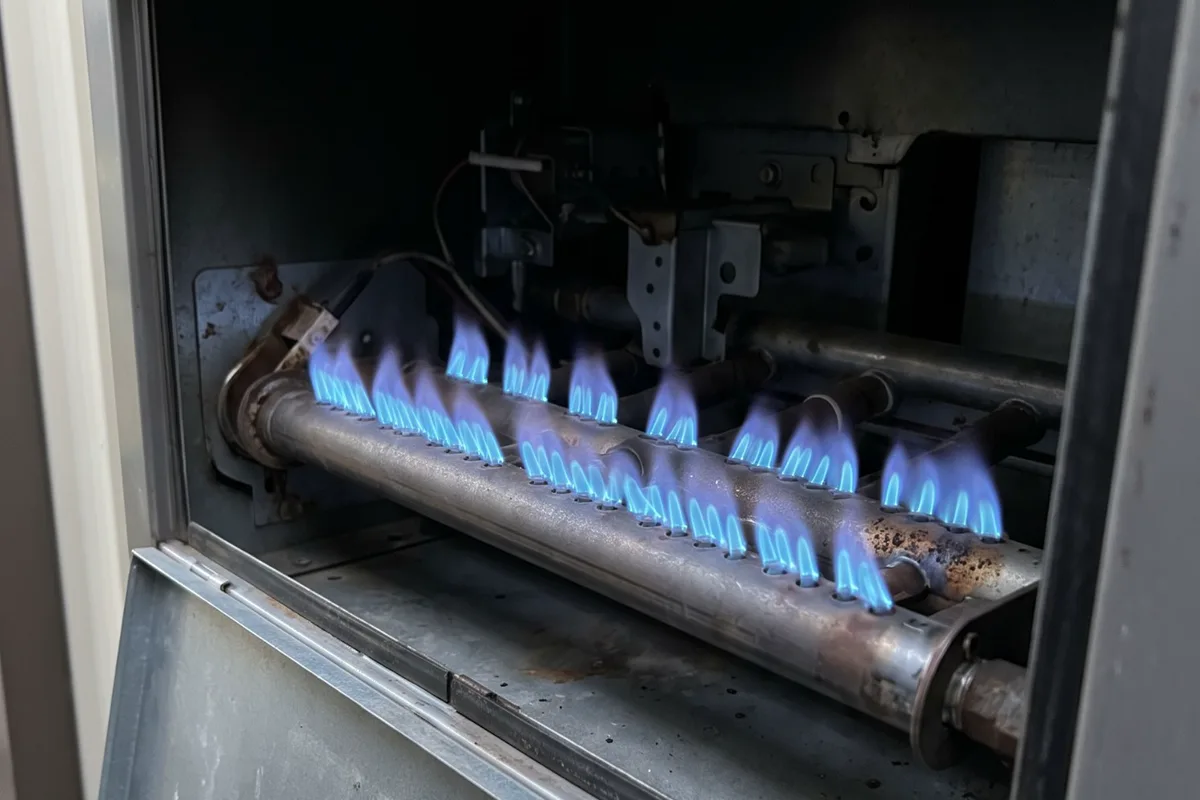
Carbon monoxide can't be seen or smelt, so a heater that seems fine is no proof it's safe. ESV says any change in how a gas heater runs, such as the flame colour, means a qualified gasfitter should inspect it, and that an old heater or one that hasn't been serviced for several years is worth considering replacing. A carbon monoxide alarm helps, but it never replaces servicing.
Gas servicing and repair is work for a licensed Type A gasfitter. The power supply, controller and wiring that run the heater are a licensed electrician's side, and many no-heat faults turn out to be there.
Reverse-cycle heating: the test run
Switch each unit to Heat, not Auto, and set it a few degrees above room temperature. Give it twenty minutes. The air should be steadily warm, and outside the fan should turn and the unit should sound even. Point the louvres down, because warm air rises.
Clean the filters first. The Victorian Government suggests doing it about twice a year, and Energy Rating says dirty filters significantly reduce airflow and can reduce heating performance. Clear leaves from around the outdoor unit so it can draw air freely.
Expect pauses on cold mornings. Melbourne sits in the Cold zone on the Zoned Energy Rating Label, where performance in frosting conditions below 5.5 °C is critical, and a unit that collects ice will stop heating for a few minutes to defrost, sometimes with steam outside. Weak or cold air on a mild autumn day is a different matter and needs a service.
Electric heaters, blankets and the switchboard
Get portable heaters out of the cupboard and look them over before winter: cords not frayed or kinked, plugs not scorched, guards in place. Plug them straight into a wall outlet, not a power board, and keep them well clear of curtains and bedding. Check electric blankets for worn cords, scorch marks or creases in the wiring before they go back on the bed.
It's worth the care. In June 2024 CFA's Chief Officer said more than 140 of the 780 residential structure fires CFA attended the previous year were caused by electrical equipment, including appliances and air conditioning.
Test your safety switches while you're at it. Energy Safe Victoria's advice is to press the test button on each one every three months; it should trip and cut the power. If it doesn't, call a licensed electrician. A heater or panel heater that trips the safety switch should be unplugged and left off until it's checked.
Smoke alarms and carbon monoxide alarms
Winter is when heaters, blankets and closed-up houses come together. Fire Rescue Victoria reports 21 preventable residential fire deaths across Victoria in 2025, with the most in winter. FRV's advice is to test smoke alarms every month by pressing and holding the test button until the alarm beeps three times, so make the autumn check the start of that habit.
If you have a carbon monoxide alarm, test it and check its date too. ESV says hardwired carbon monoxide alarms must be installed by a licensed electrician.
If something fails the test
Write down what happened before calling anyone: what the heater did when asked for heat, any code on the controller, whether a safety switch tripped and whether a reset held. That tells a technician which side of the system to look at. ESV's advice is to reset a tripped safety switch and call a licensed electrician if it won't reset. Reset it once only; if it drops straight back, leave it off.
Then run it sensibly once it's sorted. The Victorian Government suggests 18 to 20 °C for heating, and says each degree higher adds around 10% to running costs. If you rent, a heating appliance that has stopped working is on Consumer Affairs Victoria's list of urgent repairs, so report it to your agent or rental provider in writing.
Common questions
Quick answers
- Why does my heater smell when I turn it on for the first time in winter?A dusty, slightly burnt smell on the first run of the season is usually dust burning off the heat exchanger, coil or element, and it fades.
- Does my gas ducted heater have a filter I can clean?Many do.
- My gas heater flame looks different. Is that a problem?Yes, treat it as one.
- What should I do if my carbon monoxide alarm goes off?Treat it as real.
Sources for this guide
14 sources, with the date each was checked
- 1.Bureau of Meteorology: Mean minimum temperature (°C) 14.0 14.4 12.7 10.0 7.8 5.9 5.2 5.7 6.8 8.4 10.3 12.2 9.5 81 1943 2026 Accessed 30 September 2026.
- 2.Department of Energy, Environment and Climate Action (energy.vic.gov.au), page last updated 14/04/25: Victorians typically use more energy for heating than cooling, so look for a unit with a higher heating efficiency. Accessed 30 September 2026.
- 3.Energy Safe Victoria: To avoid the risk, we recommend that all gas heaters are serviced at least every two years by a qualified gasfitter. A qualified gasfitter will inspect your heater and check its installation, including testing for CO… Accessed 30 September 2026.
- 4.Energy Safe Victoria: It is recommended that ducted heaters are serviced every two years and during this service a CO test should be conducted at the heating vent outlets in all rooms. Accessed 30 September 2026.
- 5.Energy Safe Victoria: All gas heaters can spill carbon monoxide (CO) – a gas you can’t see or smell that can make you seriously unwell or kill you. Accessed 30 September 2026.
- 6.Solar Victoria (updated 20 November 2025): Check the manufacturer’s instructions or manual and have the air conditioner serviced regularly at the recommended frequency to ensure it continues to operate efficiently. Cleaning the filters regularly helps the system… Accessed 30 September 2026.
- 7.Energy Rating (GEMS Regulator / DCCEEW): Dirty filters significantly reduce the amount of airflow and the energy efficiency of the unit. It can also impact the effectiveness of its heating. Cleaning clogged filters, or replacing a worn one, can lower the… Accessed 30 September 2026.
- 8.Commonwealth of Australia (2019), 'The new zoned energy rating label for air conditioners—What installers and retailers need to know', hosted on energyrating.gov.au: Melbourne is in a black ‘COLD’ area—read the black Cold ratings. Accessed 30 September 2026.
- 9.Country Fire Authority (CFA): “No one thinks a house fire is going to happen to them, but last year CFA responded to 780 residential structure fires. More than 140 of those were caused by electrical equipment including appliances and air… Accessed 30 September 2026.
- 10.Energy Safe Victoria: Follow these steps to check your safety switch every three months: Press in the test buttons on each safety switch which will cut the power and trip the switch into the off position. You may hear a clunking sound. If… Accessed 30 September 2026.
- 11.Fire Rescue Victoria: Across Victoria, in figures compiled by CFA and FRV, there were a total of 21 preventable residential fire fatalities in 2025. This compares to 18 equivalent fatalities in 2024, with the highest number of deaths… Accessed 30 September 2026.
- 12.Fire Rescue Victoria: TEST your smoke alarm batteries Every month Press and hold the test button until the smoke alarm beeps three times. Accessed 30 September 2026.
- 13.Energy Safe Victoria: Locate your electricity box outside your home and check whether the safety switch has tripped. If it has tripped, reset the switch. If the switch won’t reset, call a licensed electrician. Accessed 30 September 2026.
- 14.Consumer Affairs Victoria: Anything on this list is legally defined as an urgent repair: burst water service blocked or broken toilet system serious roof leak gas leak dangerous electrical fault flooding or serious flood damage serious… Accessed 30 September 2026.
Planning advice for homeowners. Installation requirements depend on the property and equipment. Where this guide refers to Victorian safety or rental rules, use the linked official guidance for the current requirements.