
Is it safe to use evaporative cooling when there is bushfire smoke or haze?
- An evaporative cooler works by pushing outside air through the house, so on smoky days it brings the smoke inside.
- Victoria's Better Health Channel says evaporative coolers should not be used when it's smoky, and that split systems can be used with doors and windows closed.
- Refrigerated systems recirculate indoor air. Switch off any fresh-air or ventilation function on smoky days.
- Plan a cool, closed room for smoky hot days, especially if someone at home has asthma or a heart or lung condition.
- After smoke or ash, have the cooler's pads and water checked before its next long run.
Two systems, two ways of treating air
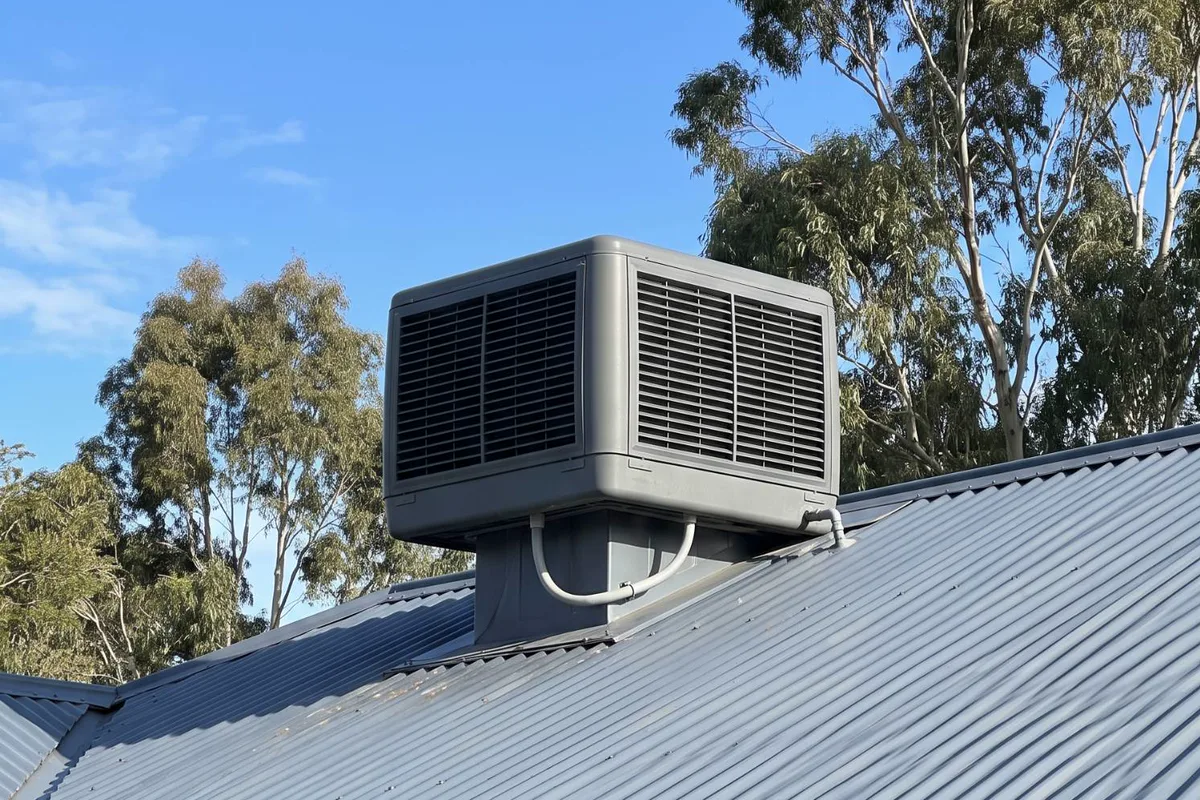
An evaporative cooler blows outside air over wet pads to cool it, then pushes that air through the house and out through open windows and doors. That constant flushing is why it works so well on a dry northerly day. It's also why it struggles when the outside air is the problem: whatever is in the air outside, the cooler delivers to every room.
Refrigerated air conditioning works differently. A split system, and most home ducted reverse-cycle systems, take air from inside, cool it over a coil and send it back, with doors and windows closed. Outside air doesn't pass through the house; the system moves heat out through the outdoor unit. Some systems have a fresh-air or ventilation function, and that part does bring outside air in.
What the health advice says
Victoria's Better Health Channel says evaporative air conditioners should not be used when it's smoky, because they quickly draw smoke into the house, and notes they can replace the air in a home every two to three minutes. It says split systems can be used when it's smoky outside provided external doors and windows are closed, and that units with a fresh-air or ventilation function should have it switched off.
Haze reaches Melbourne's west from bushfires, planned burns and sometimes industrial fires. Fine particles in smoke are the main health concern, and people with asthma or heart or lung conditions, older people, young children and pregnant women are usually most affected. Follow the health and EPA advice on the day, and if smoke is making someone unwell, get medical advice.
What to do on a smoky hot day
Turn the evaporative cooler off, including fan-only mode, and close the windows and doors you'd normally open for it. That leaves the house sealed but without cooling, which is fine on a mild smoky day and hard going on a hot one.
On a hot, smoky day the best option is a closed room with refrigerated cooling. If you have a split system in a bedroom or living area, shut that room up and run it in cool mode. Fans don't remove smoke, but they keep air moving in a closed room on a warm day. Check on neighbours and family who are more at risk from smoke and heat.
- Evaporative cooler off, including fan-only mode
- Windows and external doors closed
- Split system in cool mode in a closed room
- Any fresh-air or ventilation function switched off
Planning for smoky summers
Many homes in Melbourne's west have ducted evaporative cooling and no refrigerated air at all. One split system in the main bedroom or living room gives the household a cool, closed retreat on smoky days, on muggy days when evaporative cooling struggles, and efficient heating in winter. It doesn't mean giving up the evaporative system for the dry heat it handles well.
Other households replace an ageing evaporative system altogether. Converting to ducted reverse-cycle means removing the roof unit and installing an indoor unit, an outdoor unit and new insulated ducts, because old evaporative ducts rarely suit refrigerated air. It's a bigger job, but it gives cooling that works with the house closed and heating for the whole home. Our guide to evaporative versus refrigerated cooling compares the two through the year.
After the smoke clears
Once the air outside has cleared, open the house up and air it out. If ash has fallen, have the cooler's pads and water reservoir checked and cleaned before its next long run. Pads can hold the smell of smoke for a while, and ash in the water ends up blowing through the house. Don't climb onto the roof to check the unit yourself.
Clean split system filters after heavy use on smoky days too. The Victorian Government suggests cleaning reverse-cycle dust filters about twice a year, or more often with heavy use, and dirty filters cut airflow and efficiency.
Questions that come next
Sources for this article
4 sources, with the date each was checked
- 1.energy.gov.au (Australian Government, DCCEEW): Evaporative coolers work by blowing air over a film of water on a filter or sponge, cooling the sponge and the air through the process of evaporation. Outside air is drawn through the evaporative unit (generally on the… Accessed 30 September 2026.
- 2.YourHome (Australian Government): A reverse cycle air-conditioner is a type of heat pump that uses electricity to warm your home in winter and cool it in summer (refer to Heat pumps below). In heating mode, the system absorbs heat from the outside air… Accessed 30 September 2026.
- 3.Solar Victoria (updated 20 November 2025): Check the manufacturer’s instructions or manual and have the air conditioner serviced regularly at the recommended frequency to ensure it continues to operate efficiently. Cleaning the filters regularly helps the system… Accessed 30 September 2026.
- 4.Energy Rating (GEMS Regulator / DCCEEW): Dirty filters significantly reduce the amount of airflow and the energy efficiency of the unit. It can also impact the effectiveness of its heating. Cleaning clogged filters, or replacing a worn one, can lower the… Accessed 30 September 2026.