
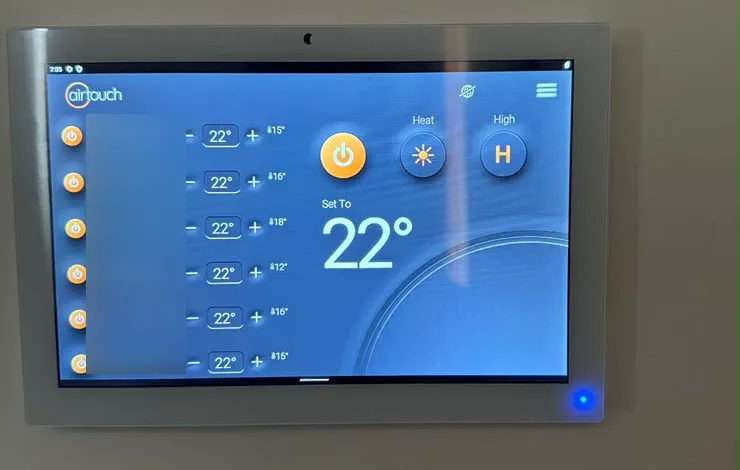
Is it worth upgrading my ducted system to AirTouch 5 zone control?
- AirTouch 5 is worth it when rooms on the same system end up at very different temperatures, or the old controller has failed.
- The optional zone sensors are the real upgrade. Without them, you mainly gain app control, schedules and a better screen.
- It can't fix an undersized unit, crushed ducts or worn dampers, so those are checked first.
- If the ducted unit is near the end of its life, fit AirTouch 5 with the replacement rather than before it.
Where a standard controller falls short
Most ducted systems come with a wall controller that sets one temperature and switches zones open or shut. The system reads the temperature in one place, often at the controller or the return air grille, and eases off when that spot is satisfied. Every open zone gets air until then, whether it needs it or not.
That works in a compact home where rooms behave alike. It works less well when a west-facing bedroom bakes on a hot northerly afternoon while the shaded lounge is already cool, or when the study at the far end never quite catches up. Those are the homes where AirTouch 5 earns its place.
What AirTouch 5 adds
AirTouch 5 is Polyaire's zone control system: a wall touchscreen, a zone module in the roof that drives the dampers, and a phone app. You can set schedules, switch zones from anywhere while your home internet is working, and trim how much air each zone gets, so a small bedroom isn't blasted while the living room catches up.
The bigger change comes with the optional zone temperature sensors. Each zone then reports its own temperature, and the system adjusts that zone's airflow to hold it near its own set point. The unit still makes one temperature of air for the whole house, but rooms stop overshooting and undershooting each other.
That shows up in running costs. The Victorian Government suggests 18°C to 20°C for heating and 24°C to 26°C for cooling living areas, and says each degree beyond that adds around 10% to running costs. A bedroom sitting two degrees warmer than you need all winter is money spent for no extra comfort.
Homes that gain the most
In homes like these, room sensors and schedules change how the house feels day to day. In a small, open-plan home where two zones are nearly always used together, the gain is much smaller, and a simpler controller may do the job.
Double-storey homes on one ducted system are a special case. Upstairs runs warmer in summer, and per-zone sensors help, but they can't fully balance two floors served by one unit. Ask whether the duct design needs attention as well.
- Long single-storey homes where the far rooms lag behind the living area.
- Rooms facing different ways, such as a west-facing front bedroom and a south-facing lounge.
- Different routines, like a home office used by day and bedrooms at night.
- Systems whose old zone controller has failed or is hard to read.
What it can't fix
A smarter controller can only work with the air it is given. An undersized unit, ducts that are crushed or poorly insulated, or a return air grille that is too small will still leave rooms short. Zoning also can't divide an open-plan space with nothing to separate it.
Dampers matter as much as the screen. Motors that have burnt out in summer roof heat, or blades that stick, undo the benefit, so worn dampers are replaced before the new controller goes in. A ducted unit also needs a minimum airflow, so too many tiny zones lead to noise or shutdowns whatever controller is fitted.
Timing the upgrade
If your ducted unit is in good order, AirTouch 5 can be fitted to many existing systems once the make and model check out. Send photos of the indoor unit labels and the current controller, and we confirm compatibility before quoting. Existing dampers in good condition can often stay.
If the unit is old or due for replacement, wait and fit AirTouch 5 with the new system. Zoning is easier to plan in at the start, and you avoid compatibility work on a unit that is about to go. Wiring for the console and zone module is electrical installation work, and it comes with a Certificate of Electrical Safety.
Questions that come next
Sources for this article
3 sources, with the date each was checked
- 1.Solar Victoria (updated 20 November 2025): To heat a room, try setting the temperature between 18°C to 20°C. Every 1°C higher will add around 10% to your heating bill. Set your air conditioner thermostat for cooling between 24°C and 26°C for living areas – every… Accessed 30 September 2026.
- 2.Department of Energy, Environment and Climate Action (energy.vic.gov.au), page last updated 14/04/25: We recommend providing 1.1 to 1.4kW of heating output for every 10m² of your home covered by a ducted system, depending on the individual characteristics of your home. ... We recommend zones for your ducted system, as… Accessed 30 September 2026.
- 3.Energy Safe Victoria: Whenever a licensed electrician completes any electrical installation work, they must provide a Certificate of Electrical Safety (COES). Accessed 30 September 2026.