
Is a multi-head split system or ducted air conditioning better for a single-storey house?
- If most rooms are used most days and the roof space is workable, zoned ducted usually gives the better whole-house result.
- A multi-head suits two to four rooms, a roof that is hard to work in, or a home with space outside for only one unit.
- Both rely on one outdoor unit, so neither protects you from a breakdown the way separate splits do.
- Wall units are more efficient than ducted, but zoning narrows the gap by conditioning only the rooms in use.
Start with the rooms you actually use
The deciding question is your routine, not the brochure. Write down which rooms need heating or cooling, and when. A household that wants the living area comfortable by day and three bedrooms comfortable overnight is describing a whole-house job. A couple who only care about the lounge and the main bedroom is describing two rooms.
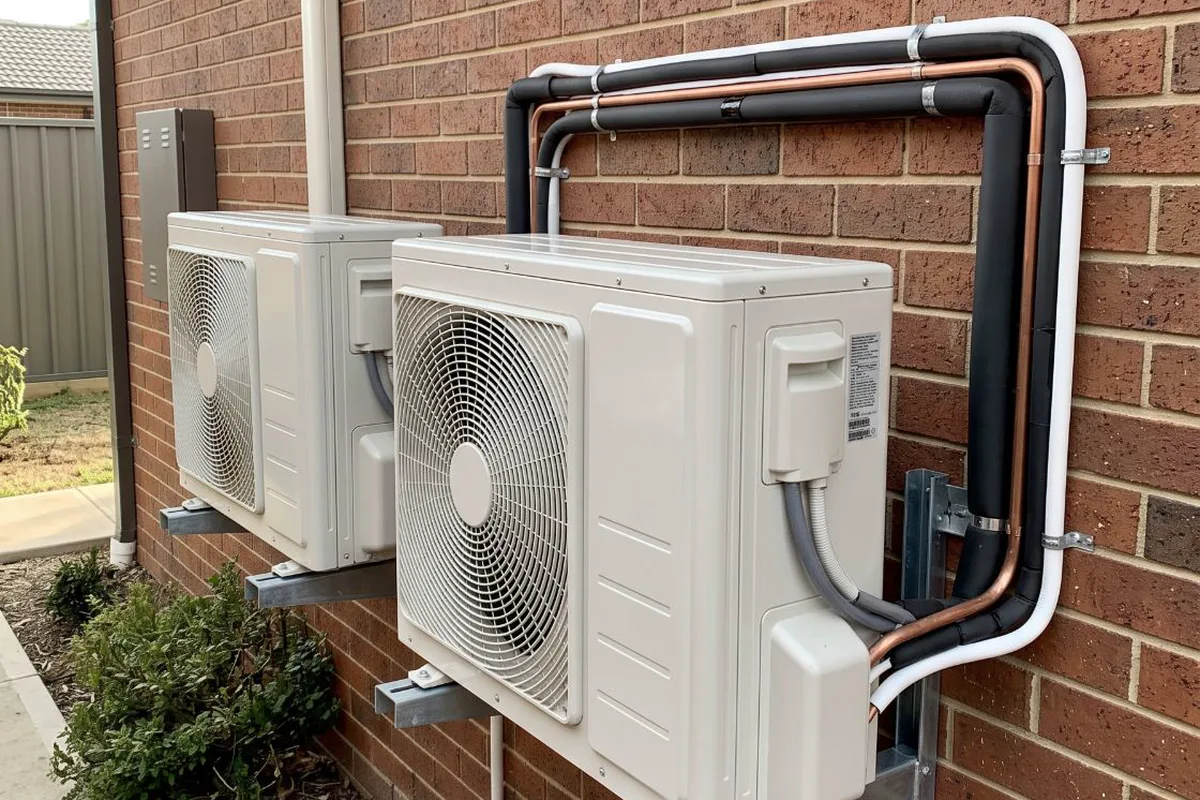
Ducted reverse cycle serves the whole house from one indoor unit in the roof, with zones so living areas and bedrooms run separately. A multi-head runs two or more wall heads from one outdoor unit, each with its own controller. Ducted earns its keep when most rooms are used most days. A multi-head earns its keep when only a handful are.
Comfort, noise and how it looks
Ducted spreads air through ceiling outlets, and the indoor unit sits in the roof, so in the rooms you mostly hear air moving through the vents. Nothing goes on the walls except a controller. A multi-head puts a head high on one wall of each room, blowing from one side, and you see it every day.
Per-room control works differently too. Each multi-head head has its own temperature setting, though every head must run in the same mode. A basic ducted system reads one temperature for the whole house, so rooms that warm up faster can overshoot unless the zones have their own sensors. Ask about that when you compare quotes.
Roof space decides a lot
Ducted needs room in the roof for the indoor unit, supply ducts and a return air path, plus safe access for servicing. Many single-storey homes with a pitched tiled roof have plenty. Low-pitched roofs, flat-roofed extensions and skillion sections at the back of older homes can make duct runs to some rooms awkward or impossible.
A multi-head needs none of that. Each head needs a pipe and drain route to the outdoor unit, usually through an outside wall. If the original house has good roof space and the rear extension has none, you can combine the two: ducted for the main house and a separate split for the extension.
Breakdowns and running only some rooms
A multi-head is sometimes pitched as the safer choice, but it shares ducted's weak point: one outdoor unit. If it stops, every head stops. If one room really matters, such as a bedroom for someone who struggles in the heat, separate single splits are the option that spreads the risk.
Running one room is where the two differ. A multi-head can run one head alone, although a small head running by itself can be less efficient than a matched single split. Ducted needs somewhere to send its air, so one small bedroom zone on its own can be noisy or inefficient unless the design allows for it.
Wall units beat ducted on efficiency because ducted has a larger fan and loses some energy through the ducts. The Victorian Government recommends zoning ducted systems so each area can be heated or cooled on its own, and that is how ducted closes much of the gap in daily use.
When each one wins
For a typical three or four bedroom single-storey home with workable roof space, where living areas are used by day and bedrooms at night, we usually lean towards zoned ducted. It suits how the house is lived in, keeps the walls clear and treats every room alike.
Whichever way you go, check the installer holds the right refrigerant licence. A restricted split system licence does not cover installing multi-head systems.
- Ducted: most rooms used most days, workable roof space, and no heads wanted on the walls.
- Multi-head: two to four rooms that matter, a low or hard-to-reach roof, or space outside for one unit only.
- Separate splits: rooms that need different modes at once, or one room too important to lose in a breakdown.
Questions that come next
Sources for this article
3 sources, with the date each was checked
- 1.energy.gov.au (Australian Government, DCCEEW): The energy efficiency of reverse-cycle air conditioners on the Australian market ranges between 300% to 600% efficient. Air conditioners can achieve such high rates of energy efficiency because they do not use… Accessed 30 September 2026.
- 2.Department of Energy, Environment and Climate Action (energy.vic.gov.au), page last updated 14/04/25: We recommend providing 1.1 to 1.4kW of heating output for every 10m² of your home covered by a ducted system, depending on the individual characteristics of your home. ... We recommend zones for your ducted system, as… Accessed 30 September 2026.
- 3.Australian Refrigeration Council (ARC), Fact Sheet 13 (ARC5225, 11/22): The holder of a restricted ‘Splits’ licence is not qualified and not permitted to: ✗ Work with any split system air conditioner of more than 18kW cooling capacity ✗ Install multi head split system air conditioning… Accessed 30 September 2026.