
The key points
- A multi-head is one outdoor unit and one compressor feeding two or more indoor heads, each with its own pipes, drain and controller.
- Every head runs in the same mode. A home system can't heat one room while it cools another.
- The heads usually add up to more than the outdoor unit can deliver at once, which works when rooms are used at different times.
- If the outdoor unit stops, every room stops, so weigh how much any one room matters.
- It suits tight sites and staggered routines, and suits less well a house that pulls two ways in spring and autumn.
How one outdoor unit feeds several rooms
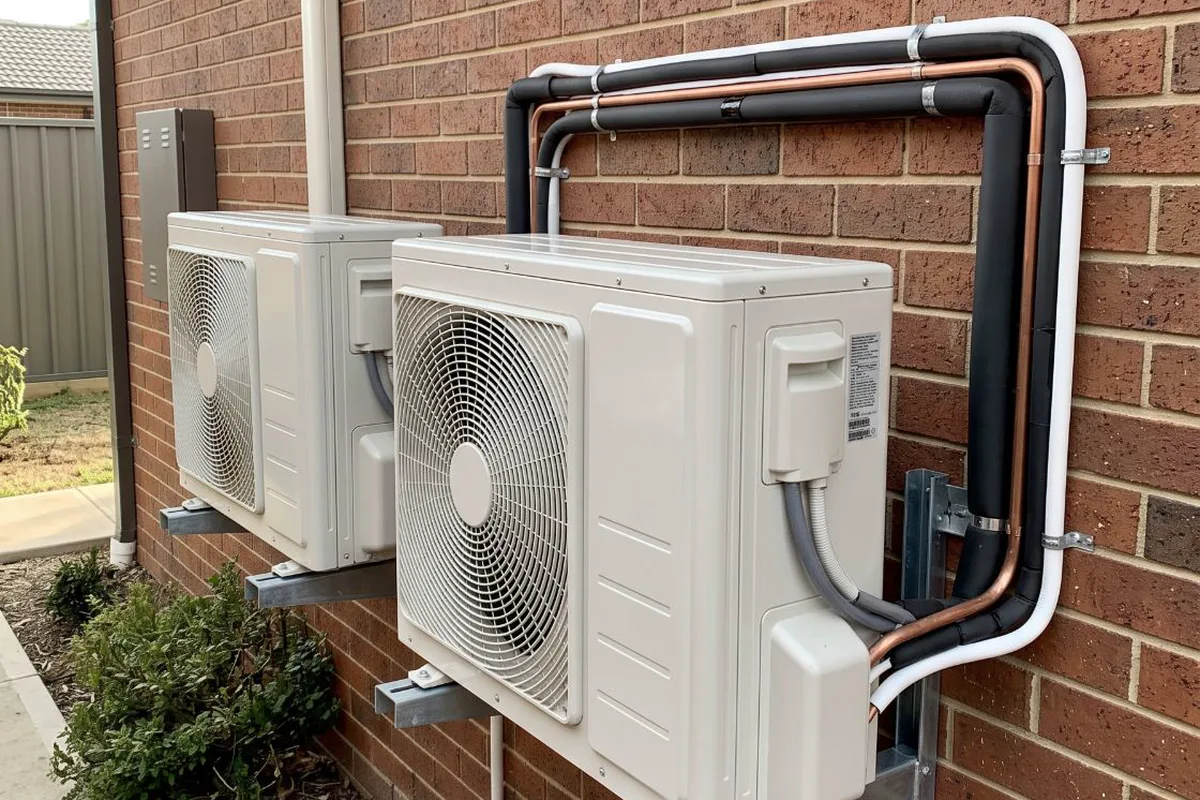
A single split pairs one indoor head with one outdoor unit. A multi-head keeps one outdoor unit, with one compressor and one outdoor coil, and connects two or more indoor heads to it. Each head has its own pair of refrigerant pipes, its own drain and its own controller, and valves inside the outdoor unit share refrigerant between whichever heads are calling.
Most home multi-heads run each head's pipes straight back to the outdoor unit, so its side carries a row of connections, one pair per room. Larger systems may use a branch box part-way. Either way, the manufacturer limits the number of heads, the length of each run, the total pipe length and how far above or below the outdoor unit a head can sit.
The compressor is an inverter, so it speeds up and slows down to match demand. With one bedroom head on, it ticks over. With every room on during a hot evening, it runs flat out and shares that output around.
One mode at a time
The outdoor coil can absorb heat or release it, not both, so every head must be in the same mode. If the lounge is cooling and someone switches a bedroom head to heat, one of them stops and shows a mode-conflict light or code until the modes match. Many brands let you nominate a priority head, or give priority to whichever head was switched on first.
In midwinter and midsummer this rarely matters. In spring and autumn it can. A west-facing lounge in a Williamstown cottage can want cooling at 4pm while a shaded south bedroom wants heat after dark. Auto mode on one head makes clashes more likely, so on a multi-head it's best to choose heat or cool on each controller yourself.
Systems that heat and cool different rooms at once do exist, but they're commercial equipment. A residential multi-head works one way at a time.
One outdoor unit, one point of failure
Every head depends on the same compressor, fan, circuit board and power supply. A fault in the outdoor unit or a tripped circuit takes out every room at once. Laverton averages 27 days a year at or above 30 °C, and July's mean minimum is 5.2 °C, so a breakdown at the wrong moment matters.
With separate splits, a breakdown costs you one room. With a multi-head it costs you the lot. That's the trade-off to weigh if one room is critical, such as a bedroom for someone who struggles in heat or a home office you rely on. Some households put most rooms on a multi-head and give the critical room its own split.
Defrost works the same way. On a frosty morning the single outdoor coil pauses to clear its ice, and every head that's heating waits while it does.
Comparing models, efficiency and noise
Comparing multi-heads is harder than comparing single splits. In stores, the Zoned Energy Rating Label is mandatory on unitary and single-split units, and multi-head combinations aren't named in that rule, so you often won't see a star label for your exact set of heads. Ask for the manufacturer's figures for the specific combination. Melbourne is in the label's Cold zone, where performance in frosting conditions below 5.5 °C is critical, so look closely at heating output in cold weather.
Noise is often in a multi-head's favour. One outdoor unit makes one noise in one spot, which can be easier on neighbours than three units along a side fence. Indoors, each head is about as quiet as a single split of the same size.
The homes a multi-head suits, and the ones it doesn't
A multi-head makes most sense when the site, not the rooms, is the problem: a townhouse with one small courtyard, an apartment allowed one unit on the balcony, a narrow side path, or a period frontage in Newport or Williamstown you'd rather keep clear of boxes. It also suits households whose rooms are used at different times.
It suits less well a house whose rooms pull in opposite directions in the shoulder seasons, a double storey where heads would be a long pipe run from the only outdoor spot, or a home where one room must always stay comfortable. Where most of the house needs covering and the roof space allows, ducted reverse-cycle is the other comparison worth pricing.
- Good fit: one spot outside, several rooms, staggered routines
- Good fit: a frontage or courtyard you want kept clear
- Think twice: rooms that need opposite modes in one afternoon
- Think twice: one room that can never go without
- Think twice: heads a long way from the only outdoor spot
Installation, licences and looking after it
Each pipe run is pressure tested and vacuumed before refrigerant is released into it, and every head is run in both modes, alone and together. The Australian Refrigeration Council says a holder of only the restricted split system licence may not install multi-head systems, while a full refrigeration and air conditioning licence covers any system. It's a fair question to ask whoever quotes.
The outdoor unit gets its own circuit, and the Wiring Rules call for a lockable isolating switch next to it, not on it. Because the heads are usually powered through the outdoor unit, that one switch shuts down every room for servicing. A head can only be added later if the outdoor unit has a spare connection and capacity, so mention any future room at the start.
Servicing covers every head and the outdoor unit. The Victorian Government suggests cleaning dust filters about twice a year, more often with heavy use. If a warning light appears, check every controller is in the same mode before booking a repair.
Common questions
Quick answers
- How do I clean my split system filters?Turn the unit off, lift the front panel, slide the filters out and vacuum off the dust.
- Can one reverse-cycle air conditioner meet both rental heating and cooling standards?Yes.
- What is the switch next to my outdoor unit for?It's an isolating switch that cuts all power to the air conditioner, so a technician can work on the system safely without relying on the switchboard.
- My rental has no fixed heater in the living area. Is that allowed?No.
Sources for this guide
7 sources, with the date each was checked
- 1.YourHome (Australian Government): A reverse cycle air-conditioner is a type of heat pump that uses electricity to warm your home in winter and cool it in summer (refer to Heat pumps below). In heating mode, the system absorbs heat from the outside air… Accessed 30 September 2026.
- 2.Bureau of Meteorology: Mean number of days ≥ 30 °C 6.9 6.0 4.5 0.7 0.0 0.0 0.0 0.0 0.1 0.9 2.8 5.1 27.0 82 1943 2026 Mean number of days ≥ 35 °C 3.6 2.4 0.9 0.0 0.0 0.0 0.0 0.0 0.0 0.1 0.5 1.9 9.4 Accessed 30 September 2026.
- 3.Energy Rating (GEMS Regulator / DCCEEW): In stores, it’s mandatory for the Zoned Energy Rating Label to be displayed on single-phase, non-ducted, and unitary or single-split air conditioners up to 30 kW. ... Where products are sold online, it’s not mandatory… Accessed 30 September 2026.
- 4.Commonwealth of Australia (2019), 'The new zoned energy rating label for air conditioners—What installers and retailers need to know', hosted on energyrating.gov.au: Melbourne is in a black ‘COLD’ area—read the black Cold ratings. Accessed 30 September 2026.
- 5.Australian Refrigeration Council (ARC), Fact Sheet 13 (ARC5225, 11/22): The holder of a restricted ‘Splits’ licence is not qualified and not permitted to: ✗ Work with any split system air conditioner of more than 18kW cooling capacity ✗ Install multi head split system air conditioning… Accessed 30 September 2026.
- 6.Access Canberra Electrical Inspections (ACT Government), Electrical Fact Sheet, updated September 2019: Air-conditioning and heat pump systems incorporating a compressor shall be provided with an isolating switch (lockable) in accordance with Clause 2.3.2.2, installed adjacent to but not on the unit, which isolates all… Accessed 30 September 2026.
- 7.Solar Victoria (updated 20 November 2025): Check the manufacturer’s instructions or manual and have the air conditioner serviced regularly at the recommended frequency to ensure it continues to operate efficiently. Cleaning the filters regularly helps the system… Accessed 30 September 2026.
Planning advice for homeowners. Installation requirements depend on the property and equipment. Where this guide refers to Victorian safety or rental rules, use the linked official guidance for the current requirements.