
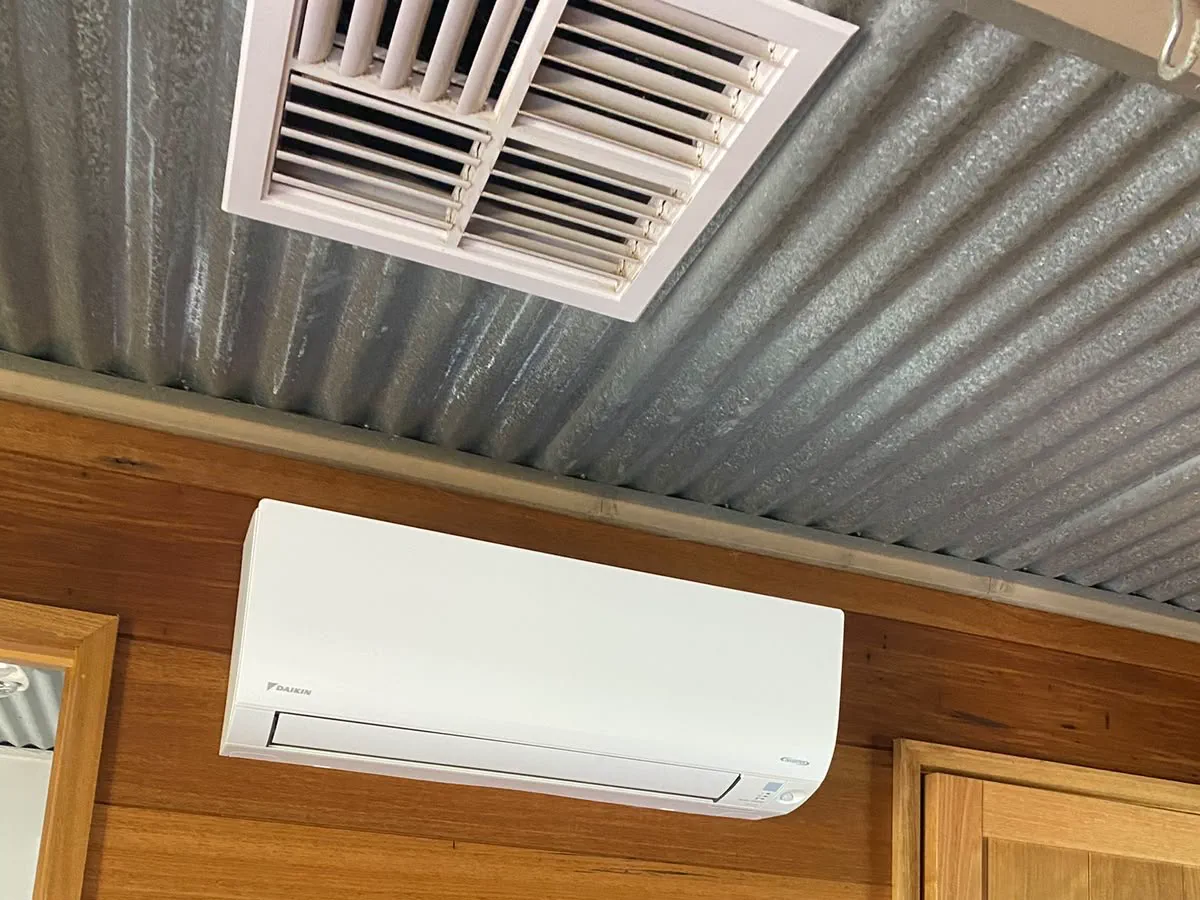
What happens during a split system installation?
- Most of the day's decisions are made before it starts: unit size, head position, outdoor unit spot, pipe route and switchboard capacity.
- The installer mounts the head, runs pipe, drain and cable through the wall, and sets the outdoor unit on a bracket or pad.
- Split systems usually need their own circuit from the switchboard and a lockable isolator beside the outdoor unit.
- Before the refrigerant is released, the pipework is pressure tested and vacuumed. This step shouldn't be rushed.
- At handover you should see it run in heat and cool, learn the remote and filters, and receive a Certificate of Electrical Safety.
Before the day: what's already decided
A smooth install day starts at the quote. By then the capacity should be matched to the room, the indoor head's position agreed, the outdoor unit's spot chosen with airflow and neighbours in mind, and the route for pipe, drain and cable worked out. The switchboard should have been checked for room for a new circuit.
If anything has changed since, such as new furniture, a different room or a fence going in where the outdoor unit was to sit, mention it before the day. Moving a head by a metre is easy on paper and harder once the hole is drilled.
What to prepare at home
Someone needs to be home at the start to confirm positions and at the end for the handover. In between, expect drilling noise, doors open while pipes and cables go through, and the power off for part of the job while the circuit is connected.
If the fridge, a home office or medical equipment can't lose power, say so beforehand so the shutdown can be planned around it.
- Clear a metre or two around the inside wall where the head goes
- Clear access to the outside wall and outdoor unit spot, including side gates
- Make the switchboard easy to reach
- Clear the manhole if cables or pipes will run through the roof space
- Keep pets secured away from open gates and doors
Mounting the head and running the pipework
The installer fixes a mounting plate level on the wall, then drills a hole for the pipe, drain and cable. The hole slopes slightly down to the outside so water drains out rather than back into the room, and the head hangs on the plate with the pipes passing through behind it.
Outside, the copper refrigerant pipes, condensate drain and interconnecting cable run to the outdoor unit, usually inside a cover along the wall. The drain needs a steady fall the whole way, or a condensate pump where it can't fall. The outdoor unit goes on a wall bracket or ground pad, level, with clear space for airflow and service.
In Victoria, refrigerated air-conditioning work is a class of plumbing work regulated by the Building and Plumbing Commission, and installing a split system needs a refrigerant handling licence. It's reasonable to ask who will do each part of the job.
The electrical connection
Most split systems need a dedicated circuit from the switchboard. Energy Safe Victoria guidance says that where the manufacturer's specifications require a dedicated circuit or safety switch protection, they must be followed. The electrician runs the new cable, fits the circuit's protection at the board and connects the outdoor unit and the cable to the head.
The Wiring Rules require air conditioners with a compressor to have a lockable isolating switch next to the unit but not on it, so you'll see a new isolator beside the outdoor unit. Energy Safe Victoria lists air conditioning as non-prescribed electrical work: the electrician completes a Certificate of Electrical Safety and must give you a copy within 30 days.
Pressure testing, vacuum and commissioning
Before the refrigerant held in the outdoor unit is released into the pipes, the installer pressure tests the joints, commonly with dry nitrogen, to confirm there are no leaks. A vacuum pump then draws air and moisture out of the pipework. Moisture left inside can harm the compressor and performance, so a proper vacuum takes time and is checked on a gauge.
Once the vacuum holds, the valves are opened and the system started. Commissioning means running it in cooling and heating, checking the air temperature at the head, confirming the drain flows outside and listening for vibration. Wall penetrations are then sealed inside and out.
Handover is your chance to ask questions. You should be shown how to set modes and timers, how to remove and clean the filters, where the isolator is, and which paperwork to keep with the manual.
Questions that come next
Sources for this article
5 sources, with the date each was checked
- 1.Building and Plumbing Commission (Victorian Building Authority, trading as the Building and Plumbing Commission): Under Part 4 of the Plumbing Regulations 2018, Refrigerated Air-conditioning work is: The construction, installation, replacement, repair, alteration, maintenance, testing or commissioning of refrigerated… Accessed 30 September 2026.
- 2.Australian Refrigeration Council (ARC): NO. If the refrigerant is contained in equipment, such as a split system air conditioner, a Refrigerant Trading Authorisation is not required. However a refrigerant handling licence is required to install this type of… Accessed 30 September 2026.
- 3.Energy Safe Victoria: This means that if the manufacturer’s specifications require an air conditioner to be installed on a dedicated circuit or protected by a residual current device then they must be adhered to. Accessed 30 September 2026.
- 4.Access Canberra Electrical Inspections (ACT Government), Electrical Fact Sheet, updated September 2019: Air-conditioning and heat pump systems incorporating a compressor shall be provided with an isolating switch (lockable) in accordance with Clause 2.3.2.2, installed adjacent to but not on the unit, which isolates all… Accessed 30 September 2026.
- 5.Energy Safe Victoria: 'Prescribed' certificates are for electrical installation work that requires inspection by a Licensed Electrical inspector. This includes (but is not limited to): Consumer mains cables, main switchboard, meter box and… Accessed 30 September 2026.