
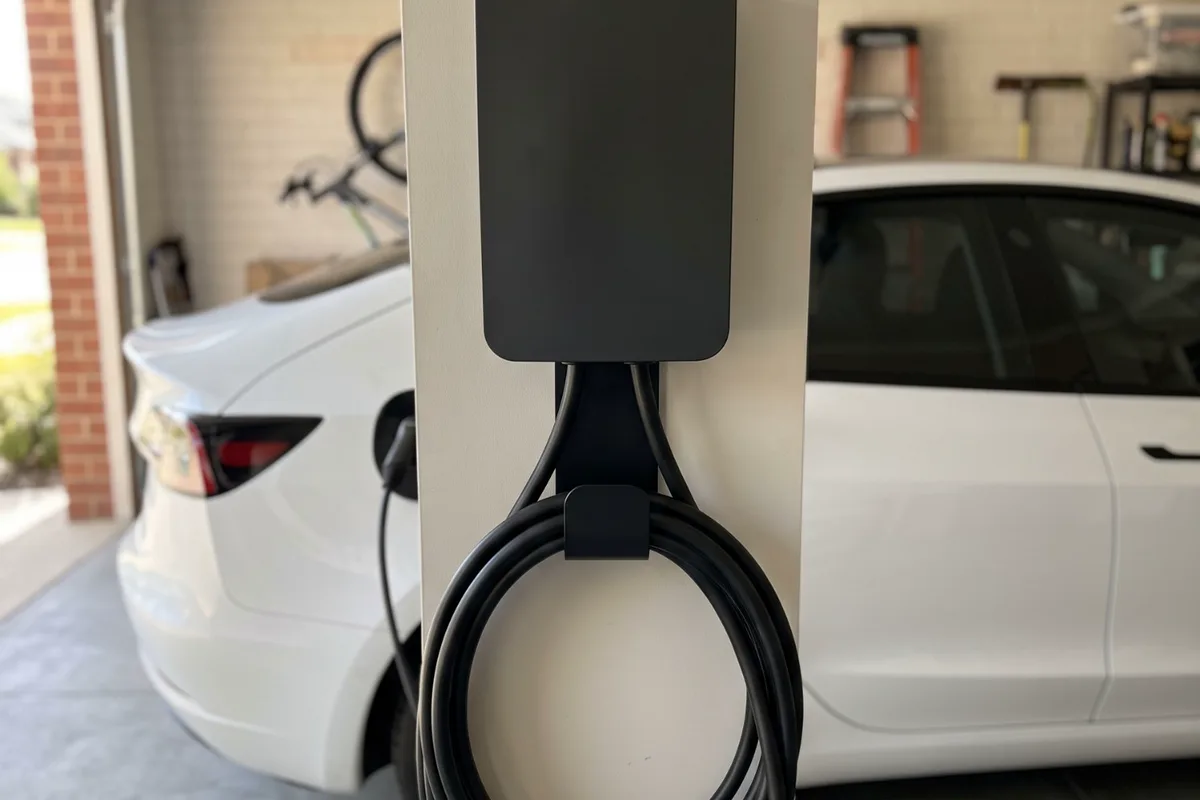
Should I install a Tesla Wall Connector or a universal EV charger?
- With one Tesla and plans to stay with the brand, the Wall Connector is a simple, sensible choice.
- It has the Type 2 plug used by most EVs sold in Australia, so other cars can often use it, though some features are built around Teslas.
- Mixed households, solar-following plans or a likely change of car can favour a universal charger.
- The installation is much the same either way: a dedicated circuit, the current set to suit it, and a certificate.
What the Wall Connector does well
The Tesla Wall Connector is built around Tesla cars and the Tesla app. Setup is straightforward, it pairs neatly with the car, and because most Teslas charge from the same corner, planning where it mounts is simple. For a household with one Tesla that plans to stay with the brand, that simplicity is worth a lot.
During commissioning, its maximum current is set to match the circuit, so it never draws more than the wiring was built for. It also has a Type 2 plug, the standard on most EVs sold in Australia, so a visitor's car or your next non-Tesla can often charge from it. Check the other car's manual, because some features only work with Teslas.
When a universal charger makes more sense
If the household has a Tesla and another brand, or you expect to change cars in the next few years, a universal charger keeps scheduling and energy reporting in one place for both cars. You manage charging from the charger's app rather than relying on each car's own settings.
Solar is the other big reason. Some universal chargers can follow your solar and charge from power the house isn't using, depending on the charger, the inverter and sometimes an extra meter. If charging from the roof is the goal, choose the charger around your solar system and bring both model numbers to the quote.
Tethered or socketed
The Wall Connector has a fixed cable. Many universal chargers come tethered too, and some are socketed, meaning each driver plugs in their own cable. A tethered cable is quicker for daily use. A socket suits a shared driveway, visitors, or cars that use different cables.
Think about where the cars park as well. A charger mounted between two spots, with a cable long enough to reach both charge ports, can serve two cars on alternate nights. That often decides the mounting point more than the brand does.
Two chargers, load management and sharing
If a second EV is likely, plan for it now. Some chargers can share one circuit's capacity between two units, and many can be set up with load management that slows charging when the house is busy. The Wall Connector and universal chargers handle this in different ways, so ask how your preferred models do it before you buy.
Load management shares the supply you already have; it doesn't add capacity. Where both cars drive long distances, or the home also runs large loads like ducted heating, a supply upgrade, including three-phase, may be the right call. We check the switchboard and supply before quoting either charger.
Our view
One Tesla, likely to stay that way, and no plans to charge from solar: the Wall Connector. Mixed cars, a likely change of brand, or solar charging as a priority: look closely at a universal charger. Either way, plan the circuit, protection and mounting for the car you have and the one you are likely to buy next.
Every final sub-circuit in a home needs safety switch protection, and the charger's own installation requirements set the rest. You receive a Certificate of Electrical Safety for the installation, whichever charger goes on the wall.
Questions that come next
Sources for this article
2 sources, with the date each was checked
- 1.Energy Safe Victoria: Clause 2.6.3.2.2 requires all final sub-circuits in a domestic installation be protected by a residual current device (RCD). A hot water service is included in this requirement Accessed 30 September 2026.
- 2.Energy Safe Victoria: Whenever a licensed electrician completes any electrical installation work, they must provide a Certificate of Electrical Safety (COES). Accessed 30 September 2026.