
The key points
- The burner heats a sealed metal heat exchanger, and a fan blows house air across the outside of it and out through the ducts.
- The heat exchanger and flue keep burnt gases out of the air you breathe, so their condition matters most.
- Air has to come back through the return grille and filter. A blocked return or dirty filter makes the heater overheat and cut out.
- Gas work on the heater is for a licensed Type A gasfitter; power, controls and ducts are separate jobs.
- Energy Safe Victoria recommends a service every two years, with a carbon monoxide test at the outlets in every room.
The big picture
A gas ducted heater burns gas inside a sealed chamber to heat a metal heat exchanger. A fan pulls air from the house, blows it across the outside of the hot heat exchanger and sends it through ducts to an outlet in each room. The burnt gases stay inside the heat exchanger and leave through a flue to outside.
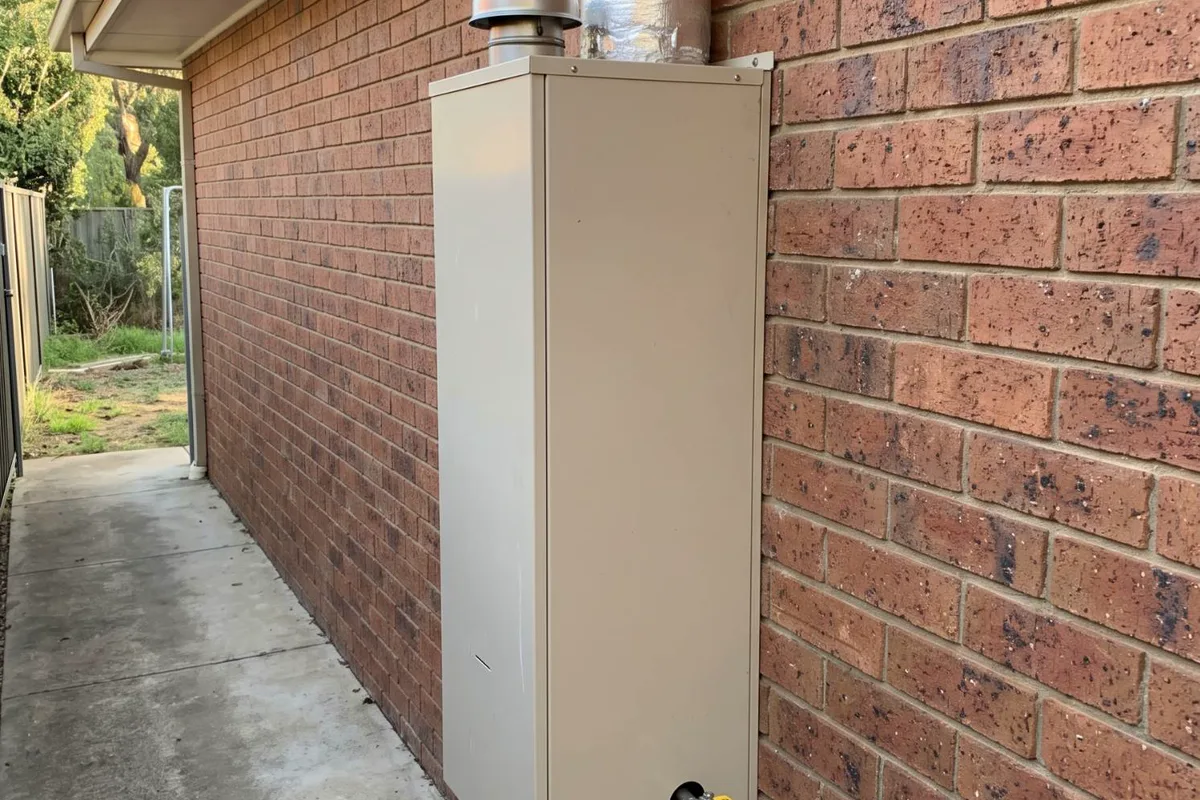
The heater sits in the roof space, under the floor or outside against a wall, depending on the house. Plenty of 1970s and 1980s homes in Melbourne's west have under-floor heaters with floor outlets, while homes built more recently tend to have a roof-space unit with ceiling outlets.
What happens when the thermostat calls for heat
When the room drops below the set temperature, the thermostat or wall controller signals the heater. On most modern heaters, a small fan first clears the combustion chamber, an igniter lights the burner and a flame sensor confirms the flame. If no flame is proved, the gas valve closes and the heater tries again or locks out.
Once the heat exchanger has warmed, the main circulation fan starts, so the first air from the outlets isn't cold. The heater runs until the thermostat is satisfied, the burner goes out, and the fan keeps running briefly to draw out the remaining heat.
Safety devices sit along the way. An overheat limit switch shuts the burner down if the heat exchanger gets too hot, usually because not enough air is moving across it. Other sensors watch the flame and the flue. When a heater keeps cutting out, it's often one of these doing its job.
The heat exchanger and flue: the safety-critical parts
The heat exchanger is the wall between the flame's exhaust and the air you breathe. After years of heating up and cooling down, metal can crack or corrode, and combustion gases can then mix into the air going to the rooms.
The flue carries the exhaust outside. A blocked, disconnected or damaged flue can spill exhaust back into the roof space or the house. Energy Safe Victoria warns that all gas heaters can spill carbon monoxide, a gas you can't see or smell that can make you seriously unwell or kill you.
That's why a ducted heater service includes a combustion spillage test. Energy Safe Victoria recommends servicing ducted gas heaters every two years, with a carbon monoxide test at the heating vent outlets in every room.
The fan, ducts and return air
The circulation fan moves a lot of air, and anything in its path affects how well the system heats. A clogged filter, a couch across the return air grille or rugs over floor outlets cut the air crossing the heat exchanger. The heater overheats, trips its limit switch, cools and restarts, which looks like a heater that can't make up its mind.
Ducts carry the warm air to each room. Under-floor ducts on older homes and flexible ducts in roof spaces both age: joints pull apart, sleeves split and insulation compresses. YourHome says ducts should be insulated to at least R1.5 with sealed joints. A leaking duct heats the roof or the subfloor instead of the bedroom.
Air also has to get back to the return grille. Bedrooms with doors shut need a gap under the door or a transfer grille, or they get less heat.
Thermostats, controllers and zones
The thermostat measures the temperature where it's mounted, usually in a hallway, and runs the heater until that spot is warm. If it sits in a draughty passage or near an outlet, the heater runs too long or too short for the rooms that matter.
Many systems have zones with motorised dampers, so living areas and bedrooms can be heated separately. The Victorian Government recommends zoning so each area can be heated on its own, which saves heating the whole house when you only use part of it.
Controllers and their cabling, zone motors and the heater's power supply aren't gas work. A dead heater is sometimes nothing more than a tripped circuit, a failed controller or a damaged thermostat cable.
Who looks after which part
Gas work on the heater is for a licensed gasfitter. Energy Safe Victoria says gas heater servicing and repair should be done by a licensed Type A gasfitter, and that it's illegal, and potentially fatal, for unlicensed people to do any gasfitting work. That covers the burner, gas valve, ignition, heat exchanger, flue and combustion testing.
The power supply, circuit, controllers and cabling are work for a licensed electrician, while ducts, outlets, filters and zone dampers are looked after by an air conditioning or duct technician. On our gas ducted jobs, the gas work is done by a licensed Type A gasfitter, and our team handles the electrical, controls and ductwork so the pieces line up.
- Yours: clean or replace the return air filter as the manual says
- Yours: keep the return grille and outlets clear of furniture and rugs
- Yours: note smells, noises, soot or changes in how it runs
- Not yours: anything inside the heater, the gas line or the flue
- Not yours: wiring, controllers or the heater's power supply
Signs it needs attention
A dusty smell for a few minutes on the first run of winter is normal as dust burns off. A smell that lingers, soot near outlets, a change in flame colour, or people feeling headachy, dizzy or sick while it runs are reasons to switch it off and have a gasfitter check it. Energy Safe Victoria advises watching for changes such as flame colour and having a qualified gasfitter inspect the heater if anything changes.
Less urgent signs are still worth booking: cold or lukewarm air, several tries to light, the heater cutting in and out, a new noise from the roof or subfloor, or rooms that no longer warm up. If you're weighing up whether an older heater is worth fixing, our repair-or-replace guide works through that decision.
Common questions
Quick answers
- Does my gas ducted heater have a filter I can clean?Many do.
- Is it safe to leave the heating on overnight?It depends on the heater.
- Why do my heating ducts tick or bang when the heater starts?Light ticking, or a single soft pop as the heating starts or stops, is usually metal parts warming and expanding: the heater's plenum, the return air box, duct collars…
- Who is qualified to do a rental gas safety check?A licensed or registered gasfitter endorsed for Type A gas appliance servicing.
Sources for this guide
9 sources, with the date each was checked
- 1.Energy Safe Victoria: All gas heaters can spill carbon monoxide (CO) – a gas you can’t see or smell that can make you seriously unwell or kill you. Accessed 30 September 2026.
- 2.Energy Safe Victoria: It is recommended that ducted heaters are serviced every two years and during this service a CO test should be conducted at the heating vent outlets in all rooms. Accessed 30 September 2026.
- 3.YourHome (Australian Government): Ducts must be well insulated, to at least R1.5, and joints sealed to prevent condensation and leakage. The roof should have reflective foil insulation installed and be vented to dispel hot air. Zoned systems cool only… Accessed 30 September 2026.
- 4.Department of Energy, Environment and Climate Action (energy.vic.gov.au), page last updated 14/04/25: We recommend providing 1.1 to 1.4kW of heating output for every 10m² of your home covered by a ducted system, depending on the individual characteristics of your home. ... We recommend zones for your ducted system, as… Accessed 30 September 2026.
- 5.Energy Safe Victoria: Type A appliances include domestic and light commercial type appliances such cookers, space heaters, central heaters, water heaters, catering equipment and leisure appliances. So, when looking to service and repair your… Accessed 30 September 2026.
- 6.Energy Safe Victoria: Gas and electricity are inherently dangerous and it’s illegal and potentially fatal for unlicensed and unqualified people to undertake any gasfitting or electrical work. Accessed 30 September 2026.
- 7.Department of Health (Victoria): When carbon monoxide is inhaled, it replaces oxygen in the blood, which may cause symptoms including tiredness, shortness of breath, headaches, dizziness, nausea, weakness, confusion or chest pain. Accessed 30 September 2026.
- 8.Building and Plumbing Commission (Victorian Building Authority, trading as the Building and Plumbing Commission): Under Part 4 of the Plumbing Regulations 2018, Refrigerated Air-conditioning work is: The construction, installation, replacement, repair, alteration, maintenance, testing or commissioning of refrigerated… Accessed 30 September 2026.
- 9.Department of Energy, Environment and Climate Action (Victoria): From 1 March 2027, if a gas hot water appliance breaks and cannot be repaired, it must be replaced with an electric alternative. No requirement to upgrade gas space heating or stovetop gas cooking to electric, however… Accessed 30 September 2026.
Planning advice for homeowners. Installation requirements depend on the property and equipment. Where this guide refers to Victorian safety or rental rules, use the linked official guidance for the current requirements.