
What affects the cost of installing a heat pump hot water system?
- Tank size and type set the starting point. An integrated unit is usually simpler to fit than a split heat pump.
- Reusing the old unit's spot keeps runs short. Moving it for airflow or noise adds plumbing, a base and cable.
- Replacing gas usually means a new circuit from the switchboard, with the gas capped by a licensed gasfitter.
- Removal, flue work and how the unit is switched (timer, solar or off-peak) all belong in the quote.
The unit and its tank
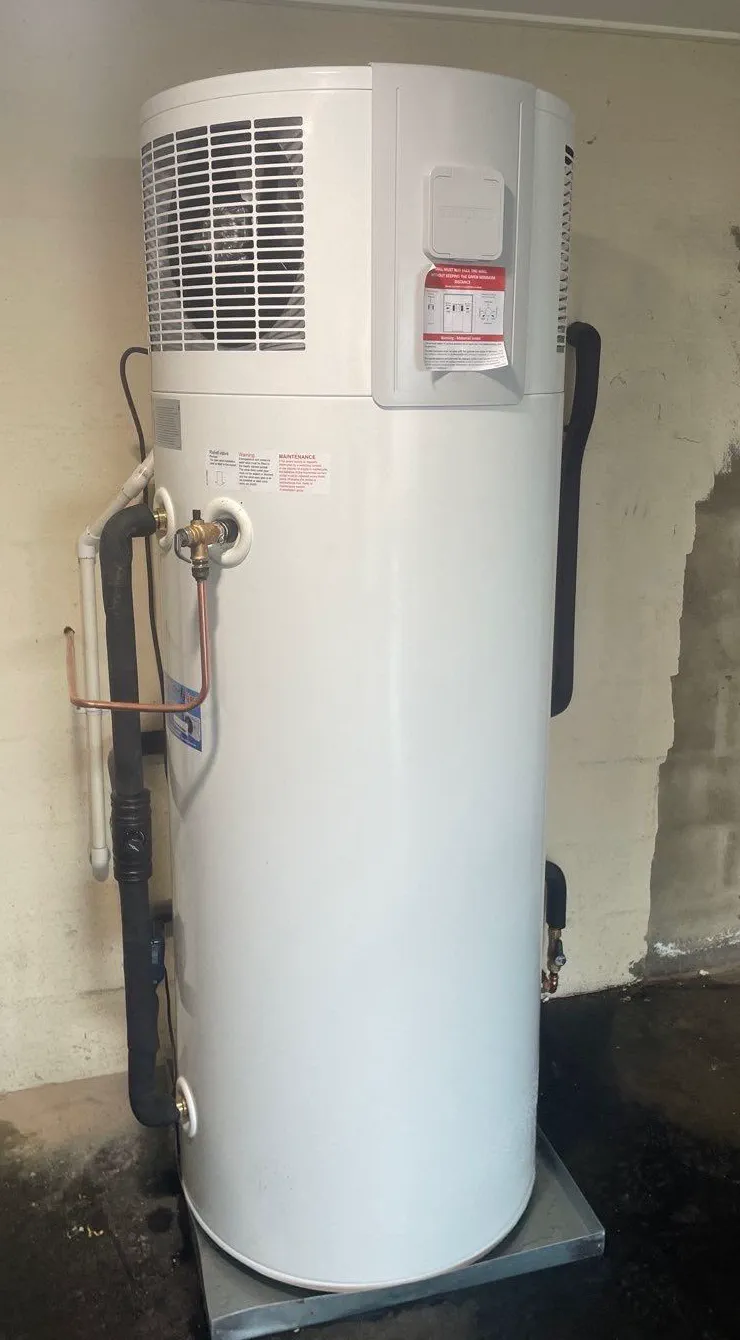
A heat pump water heater moves heat from the air into the water using a fan, compressor and refrigerant circuit. Integrated units have everything in one package on a single base. Split units keep the tank in one place with a separate outdoor heat pump joined by pipework, which can suit tight spots but adds work.
Tank size should follow how many people live in the home and when they use hot water, not the size of the old tank. A heat pump stores water rather than heating it on demand, so it has to cover your busiest stretch, such as back-to-back showers before work. Too small and you run out; too big and you pay for capacity you never use.
Same spot or a new one
The simplest place for a new unit is usually where the old one was, because the water pipes and cable are already close. But a heat pump needs things an old tank didn't: fresh air, room for its chilled exhaust, a level base, a drain for condensation and space for servicing. It hums while it runs, so a spot under a bedroom window may not suit.
Moving it adds plumbing by a licensed plumber, a new base and a longer cable run. A wall-hung gas continuous-flow unit leaves no base at all, so a heat pump replacing one needs a pad on the ground. On narrow blocks, getting a full-size tank down a side passage can also take planning.
Coming off gas
Replacing gas hot water adds steps. A licensed gasfitter caps the gas to the old unit, and a gas storage unit's flue may need removing with the roof or wall made good. A licensed plumber connects the water. Your quote should name who does each part of the job.
From 1 March 2027, a gas hot water system in an existing home that breaks and can't be repaired must be replaced with an electric alternative, unless an exemption applies. You don't have to replace a working unit, but planning the change before it fails gives you time to choose the spot and sort the circuit.
The circuit and switchboard
A gas water heater has no circuit of its own, or only a small supply for its controls, so a heat pump replacing it usually needs a new dedicated circuit, safety switch protection and an isolator at the unit. Energy Safe Victoria's guidance on the Wiring Rules says every final sub-circuit in a home, the hot water circuit included, needs RCD protection.
A board with a spare position and modern protection makes that straightforward. A full board, or one with old fuses, may need work first, which should appear as its own line. Replacing an electric tank is different: the existing circuit may be reused, but how it's switched matters.
Timers, solar and off-peak
Many electric tanks run on an off-peak circuit that only switches on overnight. That suits an element, but night is the coldest part of the day for a heat pump. With solar, a timer set to the middle of the day lets it heat on your own power. Without solar, it's set around your tariff.
Changing how the circuit is switched, adding a timer or moving the unit off a controlled load all change the electrical scope, so tell the installer about your solar and tariff when you ask for a price.
Removal and the finishing items
The old unit has to be drained, disconnected and taken away. An old heat pump holds refrigerant, and releasing regulated refrigerants into the air is illegal, so it's recovered by a licensed technician before the unit leaves. Flue removal and patching where a wall-hung unit was mounted also belong in the quote.
Get the full price in writing before work starts, with each trade's part listed. Hot water services are non-prescribed electrical work, and the electrical side ends with a Certificate of Electrical Safety.
- Unit type and tank size
- Location, base and any relocation
- Gas capping and flue removal by a licensed gasfitter
- Water connections by a licensed plumber
- New circuit, isolator and any switchboard work
- Timer or tariff set-up, and removal of the old unit
Questions that come next
Sources for this article
8 sources, with the date each was checked
- 1.Department of Transport and Planning (Victoria): Victoria’s new Building and Plumbing Amendment Regulations 2025 have been finalised, advancing Victoria’s shift toward all-electric buildings. From 1 January 2027, all new homes and most new commercial buildings will be… Accessed 30 September 2026.
- 2.Department of Energy, Environment and Climate Action (Victoria): From 1 March 2027, if a gas hot water appliance breaks and cannot be repaired, it must be replaced with an electric alternative. No requirement to upgrade gas space heating or stovetop gas cooking to electric, however… Accessed 30 September 2026.
- 3.Chief Parliamentary Counsel Victoria (Victorian Legislation): (3) Subregulations (1) and (2) do not apply to a person if— (a) there is insufficient space available in the building or no suitable outdoor space associated with the building to install or replace the reticulated gas… Accessed 30 September 2026.
- 4.Energy Safe Victoria: Clause 2.6.3.2.2 requires all final sub-circuits in a domestic installation be protected by a residual current device (RCD). A hot water service is included in this requirement Accessed 30 September 2026.
- 5.Department of Climate Change, Energy, the Environment and Water (DCCEEW): It's illegal to release regulated refrigerants into the air. This is because some refrigerants can stay in the atmosphere for decades or more and can be thousands of times worse for climate change than carbon dioxide… Accessed 30 September 2026.
- 6.Energy Safe Victoria: For electrical installation work performed within your electrical installation including but not limited to lights, power points, air conditioning, hot water service etc. Accessed 30 September 2026.
- 7.Energy Safe Victoria: Whenever a licensed electrician completes any electrical installation work, they must provide a Certificate of Electrical Safety (COES). Accessed 30 September 2026.
- 8.Consumer Affairs Victoria: From 1 March 2027, when an existing hot water system permanently fails and can't be repaired, rental providers must replace it with an energy-efficient electric hot water system. Accessed 30 September 2026.