
The short answer
When a safety switch trips with the rain, water is usually getting into part of the circuit it protects. The common suspects are outdoor lights and sensors, outdoor power points, garden lighting and cable joints buried in the yard. Water lets current leak to earth, the safety switch detects the leak and cuts the power.
That is the switch working as designed. Energy Safe Victoria says a safety switch monitors the flow of electricity through a circuit, detects a problem that may put people at risk and turns the power off within 0.03 of a second. The answer is to find and fix the leak, not to get rid of the protection.
Where the water gets in
Outdoor fittings take a beating. Seals harden and crack in the sun, covers get knocked off, and fittings meant for under a roof end up exposed to driving rain. A light with a cracked lens, or a sensor facing straight into the weather, can take in water in a single storm.
Outdoor power points are next. A point without an in-use cover, or with its cover left open, collects water, and so does a plug left in it with a lead lying on wet ground. Garden lighting often has joints at ground level or just under the mulch, where they sit wet for days after rain.
Underground cable is the hardest to find. A cable nicked by a spade, a joint made with the wrong connectors or a conduit that has filled with water may only leak after heavy or prolonged rain. That's why some trips happen in a downpour and others only after a wet week.
- Outdoor lights and sensor lights with failed seals or cracked lenses
- Outdoor power points without in-use covers, or with leads left plugged in
- Garden lights and their ground-level joints
- Underground cable runs to sheds, gates, pumps and garden lights
- Fittings below a roof leak, such as downlights and exhaust fans
What you can safely do
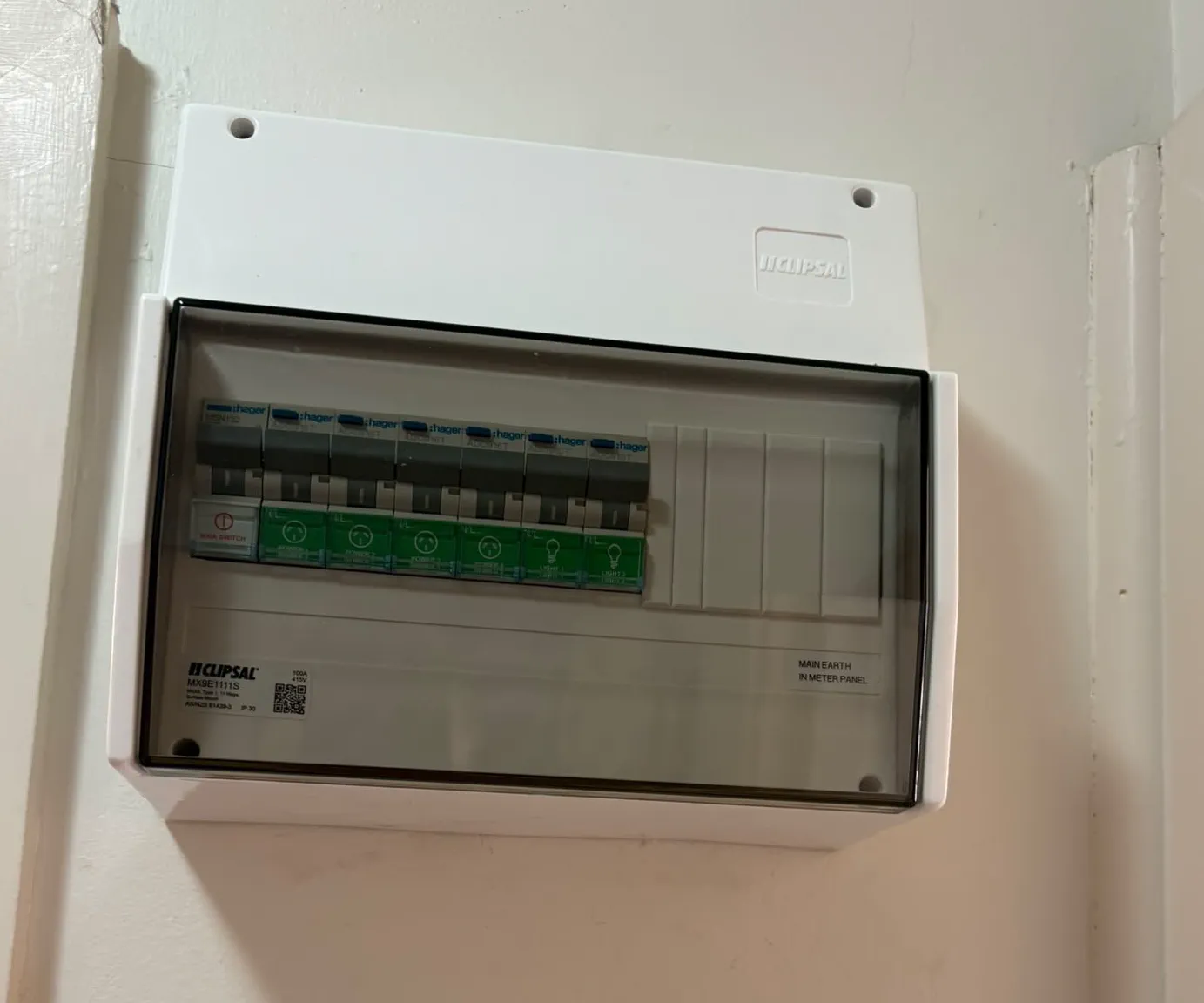
Reset the safety switch once. Energy Safe Victoria advises householders who lose power to check whether the safety switch has tripped and reset it, and to call a licensed electrician if it won't reset. If it trips again straight away, leave it off.
Stay away from anything wet and electrical. Don't touch a fitting that has water in it, don't open a cover or lens to tip the water out and don't pull plugs from a wet outdoor power point. If water is coming through a ceiling near a light, keep clear of that room and switch off at the switchboard only if you can reach it safely and stay dry.
Energy Safe Victoria says electrical work isn't a DIY job, even small jobs like changing power points or light switches. Drying out, resealing or replacing a fitting is work for a licensed electrician.
Help the electrician find it faster
Rain-related faults can be hard to catch, because everything may test fine on a dry day. A few notes make a big difference: which safety switch trips, whether it happens in light rain or only in heavy storms, how long after the rain starts, and whether it resets once things dry out.
List what's on that circuit outdoors, as far as you know: lights, sensors, power points, a shed, a pump, garden lights or a gate motor. Mention any recent digging, landscaping, new paving or roof leaks. If the board has a separate safety switch for each circuit, the one that tripped often points straight to the culprit.
How it's found and fixed
Fault finding usually starts with an insulation test on the affected circuit, then splitting it into sections to see which part leaks. Outdoor fittings are opened and checked, joints inspected and, if needed, the underground run tested on its own. Sometimes the fault is easiest to find on a wet day, while it's present.
The repair depends on what turns up: a fitting replaced with one suited to its exposed position, a power point given an in-use cover, a joint remade in a proper weatherproof enclosure, or a damaged underground cable replaced. Whenever a licensed electrician completes electrical installation work, repairs included, they must provide a Certificate of Electrical Safety.
Preventing the next wet-weather trip
Choose outdoor fittings rated for where they'll actually sit, not just for outdoors in general. A fitting fully exposed to rain on a west wall needs more protection than one under a deep eave, and near the bay, fittings and fixings need to cope with salt air as well.
Keep in-use covers closed, don't leave leads plugged in outside and keep mulch and soil clear of garden light joints. Energy Safe Victoria suggests pressing the test button on each safety switch every three months, so you know it's working before the next storm.
Questions that come next
Services that can help
Related jobs
Not sure what you need yet
Answer a few quick questions about your home for a plain answer, what we check before we price the job and what to read next.
All questionnairesGo a little deeper
Our guides, with checklists and questions to bring to the quote.
- Outdoor electrical safety: leads, garden tools, digging and wet weatherSafe habits for outdoor leads, power tools, digging near buried cables, wet weather and patio appliances, and what makes outdoor power fit for purpose.
- How and when to test your safety switchesHow to run the push-button test at home, what an electrician’s trip-time test measures that the button can’t, and what to do when a switch fails.
- Outdoor lights and power points near the bay: choosing fittings that lastHow salt air in Altona, Williamstown and other bayside streets wears out outdoor fittings, and the materials, ratings and positions that hold up longer.
- What electrical work you can and can't do yourself in VictoriaWhere Victorian law draws the line on home electrical work, the short list of jobs that are yours, and what to do when a job goes past it.
Quick answers
- Why does the kettle or toaster trip the safety switch?Usually the appliance has a fault that lets a little current leak to earth.
- Why is there water inside my outdoor light?Water gets into outdoor lights through perished seals, cracked lenses, unsealed cable entries or a fitting that isn't rated for where it's mounted.
- How do I tell which switch has tripped on my switchboard?Open the switchboard door and look along the rows of switches.
- Why does my safety switch trip when the power comes back on?When the power comes back, everything restarts at once.
- Why does my electric heater trip the safety switch?A safety switch trips when it detects electricity leaking to earth, and portable heaters are a common cause.
We work across Melbourne's west
Family-run and based in Altona Meadows. Pick your suburb for local notes and the jobs we see most there.
- Altona Meadows
- Altona
- Point Cook
- Seabrook
- Laverton
- Laverton North
- Werribee
- Werribee South
- Hoppers Crossing
- Wyndham Vale
- Williamstown
- Newport
- Spotswood
- Yarraville
- Kingsville
- Port Melbourne
- Derrimut
- Deer Park
- Ravenhall
- Maribyrnong
- West Melbourne
- Flemington
- Kensington
- Tullamarine
Sources for this article
5 sources, with the date each was checked
- 1.Energy Safe Victoria: monitors the flow of electricity through a circuit detects a problem that may pose a risk to personal safety turns the power off within 0.03 of a second always has a test button and '30ma' printed on them. Accessed 30 September 2026.
- 2.Energy Safe Victoria: Locate your electricity box outside your home and check whether the safety switch has tripped. If it has tripped, reset the switch. If the switch won’t reset, call a licensed electrician. Accessed 30 September 2026.
- 3.Energy Safe Victoria: Electrical work isn’t a DIY job, even for small jobs such as changing power points or light switches. Accessed 30 September 2026.
- 4.Energy Safe Victoria: Whenever a licensed electrician completes any electrical installation work, they must provide a Certificate of Electrical Safety (COES). Accessed 30 September 2026.
- 5.Energy Safe Victoria: Follow these steps to check your safety switch every three months: Press in the test buttons on each safety switch which will cut the power and trip the switch into the off position. You may hear a clunking sound. If… Accessed 30 September 2026.
Talk it through with us
Tell us what is happening at your place. Free, no-obligation quotes, and you get the price before we start.
Ask for a quote 03 9116 9050