
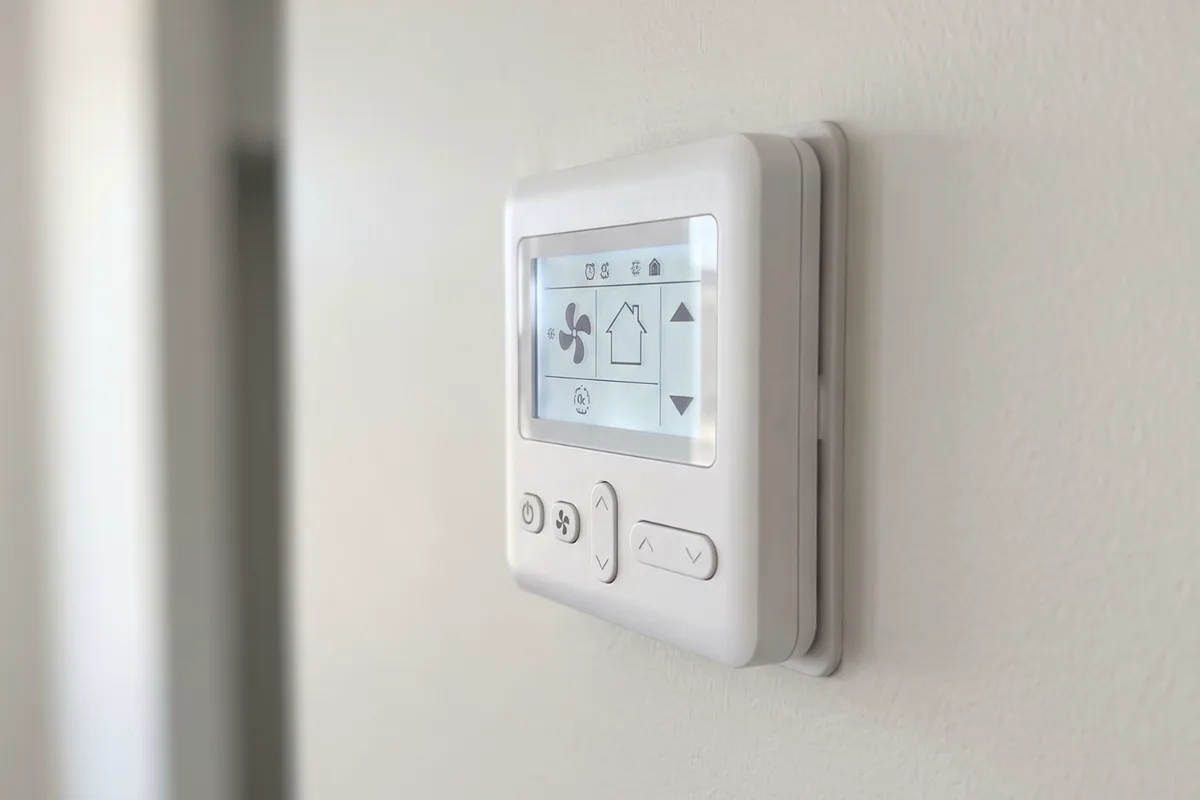
The short answer
In many homes, yes. A controller that has faded, lost its buttons, shows a blank screen or is simply too basic can often be replaced while the indoor unit, outdoor unit and ducts stay. The catch is compatibility. The controller talks to a control board inside the unit, and only certain controllers can talk to it.
If the system itself is reliable and the ducts are in good order, a new controller is a much smaller job than a new system. If the unit is old, noisy or keeps faulting, a new controller won't change that, and the money may be better put towards a replacement.
Compatibility comes first
The starting point is the model number of the indoor unit, and of the outdoor unit on a reverse-cycle system. It is usually on a label on the outdoor unit or in the manual. Don't climb into the roof space to find the indoor unit's label; a technician can read it at the visit.
From the model, a technician can tell which controllers the unit supports. The options usually fall into three groups: the maker's current replacement controller, an add-on zone and control system designed to work with that unit, or an interface module that lets a newer controller talk to an older board.
Some older systems have no compatible modern controller at all. Then the choices are a basic replacement with the same functions, a new control board where the maker still supplies one, or living with the existing controller until the system is replaced. Gas ducted heaters and ducted reverse-cycle systems use different controls, and a gas heater with add-on cooling may have controls for both, so mention everything the controller runs.
What a new controller can add
Modern controllers usually offer clearer screens, seven-day schedules and phone control over Wi-Fi. Many can run zones, opening and closing motorised dampers so you heat or cool only the rooms in use. The Victorian Government recommends zones for ducted systems so each area can be heated or cooled on its own.
Some zone controllers also read the temperature in each zone through room sensors and adjust that zone's airflow, rather than relying on one reading in the hallway. That can even out rooms that always run too hot or too cold, as long as the ducts and the unit have enough capacity to begin with.
If your system already has zones, a new controller may simply take over the existing dampers. If it doesn't, adding zones means motorised dampers in the roof space as well as the controller, which is a bigger job.
Where the controller goes
Many wall controllers measure the temperature where they're mounted. A controller in afternoon sun, above a heater, beside the oven or on a cold outside wall reads a temperature that isn't typical of the rooms it controls, so the system runs too long or not long enough.
Replacing the controller is a chance to move it to an inside wall in a main living area, or to add a separate sensor where the reading makes more sense. Moving it means running new control cable inside the wall, which is far easier in a home with an accessible roof space than in a double-storey home or one with a flat roof.
What a new controller won't fix
A controller can only ask for heating or cooling. If the unit can't deliver, because of a failing fan, a refrigerant leak, a fault in the heater or ducts that are torn or crushed, the new controller will show the right setting while the rooms stay uncomfortable.
Before spending on controls, have the system serviced or checked. Solar Victoria says a reverse-cycle system more than 15 years old will typically use more than three times the energy of a modern one, so on an older reverse-cycle unit it is worth comparing a new controller with replacing the system.
Once the new controller is in, sensible settings make the biggest difference to running costs. Solar Victoria suggests 18°C to 20°C for heating and 24°C to 26°C for cooling living areas, and says each degree beyond that adds around 10% to running costs.
What the job involves
Swapping a controller usually means removing the old one, connecting the new one to the existing control cable or a new cable, then setting it up and testing every mode and zone. Where an interface module or zone dampers are part of the job, some of the work happens at the unit in the roof space.
Control cable to a wall controller is low voltage, but anything that connects to the unit's mains supply or the switchboard is electrical work. Energy Safe Victoria says electrical work isn't a DIY job, even small jobs like changing power points or light switches, so leave the unit end to a licensed electrician or technician.
Questions that come next
Services that can help
Not sure what you need yet
Answer a few quick questions about your home for a plain answer, what we check before we price the job and what to read next.
All questionnairesGo a little deeper
Our guides, with checklists and questions to bring to the quote.
- Ducted zoning explainedZones, dampers, controllers and room sensors in plain terms, plus the airflow limits that decide whether zoning will fix your comfort problem.
- Air conditioner settings explained: modes, fan speeds, swing and timersWhat auto, dry, fan, sleep, eco, swing and the timer buttons on a split system remote or ducted controller actually do, and when each one is worth using.
- Cutting heating and cooling running costs without replacing the systemSettings, filters, zoning, timers, doors, curtains and servicing that bring down the running costs of the heating and cooling you already have.
- Making sense of your smart meter dataHow to get your smart meter's interval data, see when heating, cooling, hot water and other big loads run, and spot the patterns that point to a fault.
Quick answers
- Why has one zone stopped working on my ducted system?When one zone gets no air but the rest work, check the controller first: the zone may be switched off, on a schedule or, with temperature-controlled zones, already at…
- Why does my air conditioner turn off by itself?Most often a setting is doing it: an off timer, sleep mode, an eco or quiet mode, or an app schedule someone else set up.
- My air conditioner won't respond to the remote. What can I check?Start with the remote: fresh batteries, a clear line to the indoor unit, and no lock symbol or odd mode on its display.
- Why won't the louvres on my split system move?First check the swing setting on the remote.
- How do I prepare for an air conditioning service or installation?Clear a working space around the indoor unit and the outdoor unit, make sure the roof manhole is easy to reach if you have a ducted system, and secure pets.
We work across Melbourne's west
Family-run and based in Altona Meadows. Pick your suburb for local notes and the jobs we see most there.
- Altona Meadows
- Altona
- Point Cook
- Seabrook
- Laverton
- Laverton North
- Werribee
- Werribee South
- Hoppers Crossing
- Wyndham Vale
- Williamstown
- Newport
- Spotswood
- Yarraville
- Kingsville
- Port Melbourne
- Derrimut
- Deer Park
- Ravenhall
- Maribyrnong
- West Melbourne
- Flemington
- Kensington
- Tullamarine
Sources for this article
4 sources, with the date each was checked
- 1.Department of Energy, Environment and Climate Action (energy.vic.gov.au), page last updated 14/04/25: We recommend providing 1.1 to 1.4kW of heating output for every 10m² of your home covered by a ducted system, depending on the individual characteristics of your home. ... We recommend zones for your ducted system, as… Accessed 30 September 2026.
- 2.Solar Victoria (updated 2 October 2025): A system that is more than 15 years old for example will typically use more than three times the amount of energy than a modern reverse-cycle air conditioner. Accessed 30 September 2026.
- 3.Solar Victoria (updated 20 November 2025): To heat a room, try setting the temperature between 18°C to 20°C. Every 1°C higher will add around 10% to your heating bill. Set your air conditioner thermostat for cooling between 24°C and 26°C for living areas – every… Accessed 30 September 2026.
- 4.Energy Safe Victoria: Electrical work isn’t a DIY job, even for small jobs such as changing power points or light switches. Accessed 30 September 2026.
Talk it through with us
Tell us what is happening at your place. Free, no-obligation quotes, and you get the price before we start.
Ask for a quote 03 9116 9050