
The order that works
The simple answer: in an older home, start with safety and capacity. Check the wiring and the switchboard first, sort the smoke alarms next, run the circuits your future appliances will need, and add heating and cooling last. Done in that order, the switchboard is replaced once, ceilings and walls are opened once, and nothing new is fitted onto wiring that's about to come out.
Older homes in Melbourne's west are often upgraded over several years, from post-war brick and weatherboard homes in Altona and Laverton to the older cottages of Williamstown, Newport and Yarraville. Staging is sensible. What costs money is doing the stages in an order that undoes earlier work.
Stage one: find out what you have
Energy Safe Victoria advises owners of houses over 30 years old to have their wiring checked by a licensed electrician, and says that when buying a home built before the 1980s it's imperative to have the wiring checked before moving in. Its list of warning signs is a useful first look: old switchboards, particularly without a safety switch, old or broken switches and power points, flickering lights and sparks.
An electrical safety check goes further. The electrician looks at the switchboard, tests the circuits and safety switches, looks at the cable in the roof space where it can be reached and lists what's sound, what's unsafe and what can wait. That list becomes your plan. Fix anything unsafe straight away, and group the rest into stages.
Energy Safe Victoria says only an A grade electrician is qualified to inspect and install household wiring, so the check and the work stay with a licensed electrician.
Stage two: the switchboard and safety switches
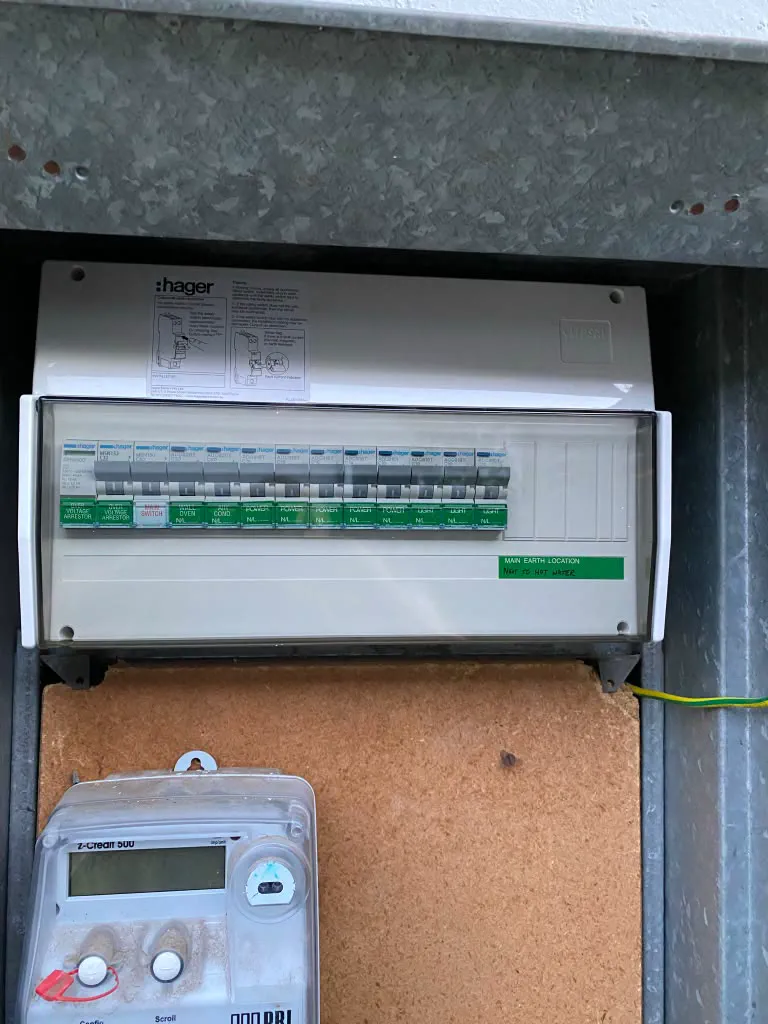
The switchboard is the base for everything that follows. When a switchboard is replaced, Energy Safe Victoria's guidance says the Wiring Rules require safety switches on all final sub-circuits, and the Wiring Rules also call for additional safety switch protection when an existing installation is altered. Adding circuits to an old board can bring that work with it, so it often makes sense to replace the board before the other stages.
Size the new board for where the house is heading. Leave space for the circuits you expect to add, such as air conditioning, an induction cooktop, an EV charger or heat pump hot water, and for surge protection if you want it. A board that's full on day one can need replacing again much sooner than you'd like.
If a main switchboard is replaced, the power can't go back on to the new board until a Licensed Electrical Inspector has inspected it, so that's planned into the day. Old boards can also hide asbestos. WorkSafe Victoria lists ceramic fuses and pitch-based switchboards among asbestos-containing materials, and says a licensed asbestos removalist may be needed if a mounting board has deteriorated. Never drill, sand or break an old panel.
Stage three: wiring that needs replacing
If the check finds old rubber-insulated cable, damaged cable or circuits that can't be made safe, plan the rewiring before any plastering, painting, new kitchens or bathrooms. Rewiring after a renovation means cutting into new finishes. Rewiring during one, while walls and ceilings are open, is far simpler.
A rewire can be staged too, circuit by circuit or area by area, as long as each stage is planned against the new switchboard. Each stage comes with a Certificate of Electrical Safety, which builds a paper trail of what was replaced and when.
Stage four: smoke alarms
Smoke alarms belong in the early stages, but after any rewiring, so new alarms go onto the finished circuits. Fire Rescue Victoria's summary of the rules says homes built, largely renovated or extended after 1 May 2014 need interconnected, hard-wired smoke alarms with a backup battery. If your plans include a large renovation or an extension, plan for interconnected alarms.
A hard-wired smoke alarm must be installed by a qualified electrician. Fitting the alarm cable while ceilings are open avoids extra holes later.
Stage five: circuits for what's coming
Think five or ten years ahead. Will you add air conditioning to the bedrooms, swap a gas cooktop for induction, charge an electric car or replace the hot water? Each of those usually needs its own circuit. If a manufacturer's specifications require an air conditioner to be on a dedicated circuit or protected by a safety switch, Energy Safe Victoria says those specifications must be followed.
Hot water is worth planning now. For existing owner-occupied homes, from 1 March 2027 a gas hot water appliance that breaks and can't be repaired must be replaced with an electric alternative. Owners don't have to switch gas heating or cooking. Running a circuit to the likely hot water spot while the work is underway avoids a rushed job when the old unit fails.
Cable that's run and capped off at the board is far cheaper than cutting back into finished walls. Label both ends and keep a note of where each run goes.
Last: heating and cooling
Heating and cooling come last for two reasons. The switchboard and circuits are ready for them, and any insulation or draught sealing you do along the way changes the size of system the house needs. A system sized for a draughty, uninsulated house is often bigger than the house needs once those jobs are done.
Ducted systems need the roof space, so coordinate them with any ceiling insulation and cable runs. Split systems are easier to add room by room, which suits a staged plan.
- Electrical safety check and a written list
- Unsafe items fixed straight away
- Switchboard replaced with room to grow
- Old wiring replaced before new finishes
- Hard-wired, interconnected smoke alarms
- Circuits run for future appliances
- Heating and cooling sized for the improved house
Common questions
Services in this guide
Related jobs
Not sure what you need yet
Answer a few quick questions about your home for a plain answer, what we check before we price the job and what to read next.
All questionnairesQuick answers
- Will my fridge and freezer be OK during a switchboard upgrade?Usually, with some planning.
- What is a sub-board, and do I have one?A sub-board is a smaller switchboard fed by its own cable from a circuit breaker on your main switchboard.
- Do I need to be home for a switchboard upgrade?Someone should be there at the start and at the end, and the electrician needs access to the switchboard and to the rooms inside for testing.
- Why does a Licensed Electrical Inspector need to check my new switchboard?Because replacing a main switchboard is prescribed work in Victoria.
- What photos help with an electrical enquiry?Three or four clear photos usually do it: the switchboard with its door open and every cover left in place, a wider shot of where the job is, and any appliance or…
From the blog
- Upgrading the electrical in a heritage home in Williamstown or YarravilleFront-wall meter boxes, lath and plaster, basalt walls and period fittings all shape how a heritage home in Melbourne's inner west gets rewired.
- What affects the cost of rewiring a house?Testing, storeys, roof and subfloor access, wall types, added points, the switchboard and making good decide what a rewire involves. Here's how to compare quotes.
- Rewire before you renovate, or during?Unsafe circuits get fixed now. Otherwise, rewire during the renovation, after framing and before plaster, and bring the rest of the house into the same window.
- Will I need a switchboard upgrade for an EV charger?An empty switchboard slot is only one consideration. Bring your vehicle, charging routine and future appliance plans into the assessment.
We work across Melbourne's west
Family-run and based in Altona Meadows. Pick your suburb for local notes and the jobs we see most there.
- Altona Meadows
- Altona
- Point Cook
- Seabrook
- Laverton
- Laverton North
- Werribee
- Werribee South
- Hoppers Crossing
- Wyndham Vale
- Williamstown
- Newport
- Spotswood
- Yarraville
- Kingsville
- Port Melbourne
- Derrimut
- Deer Park
- Ravenhall
- Maribyrnong
- West Melbourne
- Flemington
- Kensington
- Tullamarine
Sources for this guide
14 sources, with the date each was checked
- 1.Victorian Government, Hobsons Bay Planning Scheme (PDF snapshot, last updated by VC292 on 11/09/2025): SPECIAL CHARACTER AREAS, ALTONA 1.0 24/02/2022 C131hbay Neighbourhood character objectives To preserve the characteristics of the neighbourhood, comprising intact post-war brick and weatherboard dwellings with… Accessed 30 September 2026.
- 2.Energy Safe Victoria: Old switchboards, particularly those without a safety switch Old power switches or power points, particularly broken ones Flickering lights Sparks from switchboards, switches or power points. If your house is over 30… Accessed 30 September 2026.
- 3.Energy Safe Victoria: When buying a home built before the 1980s it is imperative the wiring is checked by a licensed electrical inspector or registered electrical contractor prior to moving in. Accessed 30 September 2026.
- 4.Energy Safe Victoria: Only an A grade electrician is qualified to inspect and install household wiring. Accessed 30 September 2026.
- 5.Energy Safe Victoria: If a switchboard is required to be replaced then as per clause 2.6.3.2.5 (Alterations to installations and replacement of switchboards) of AS/NZS 3000: RCD’s are required on all final sub-circuits. Accessed 30 September 2026.
- 6.Energy Safe Victoria: Clause 2.6.3.2.5 of the Wiring Rules states: Additional protection by RCDs shall be provided in existing electrical installations where alterations or a switchboard replacement is completed. Accessed 30 September 2026.
- 7.Energy Safe Victoria: The electrician has eight business days after the work is completed to have that work inspected by a licensed electrical inspector (LEI). If an electrician replaces a main switchboard at a property, power cannot go back… Accessed 30 September 2026.
- 8.WorkSafe Victoria: Fuse blankets and ceramic fuses in switchboards Pitch-based (eg Zelemite, Ausbestos, Lebah) electrical switchboards Accessed 30 September 2026.
- 9.WorkSafe Victoria: If the condition of electrical mounting boards has deteriorated or ACD is present an asbestos removal licence holder may be required to undertake asbestos removal work For example, if an ACM electrical mounting panel… Accessed 30 September 2026.
- 10.Energy Safe Victoria: Whenever a licensed electrician completes any electrical installation work, they must provide a Certificate of Electrical Safety (COES). Accessed 30 September 2026.
- 11.Fire Rescue Victoria: Residential home constructed, largely renovated, or extended after 1 May 2014 Interconnected, hard wired smoke alarms that are connected to 240 volt mains power and have a back-up battery. Accessed 30 September 2026.
- 12.Consumer Affairs Victoria: A hard-wired smoke alarm must be installed by a qualified electrician, but anyone can change a smoke alarm battery. Accessed 30 September 2026.
- 13.Energy Safe Victoria: This means that if the manufacturer’s specifications require an air conditioner to be installed on a dedicated circuit or protected by a residual current device then they must be adhered to. Accessed 30 September 2026.
- 14.Department of Energy, Environment and Climate Action (Victoria): From 1 March 2027, if a gas hot water appliance breaks and cannot be repaired, it must be replaced with an electric alternative. No requirement to upgrade gas space heating or stovetop gas cooking to electric, however… Accessed 30 September 2026.
Planning advice for homeowners. Installation requirements depend on the property and equipment. Where this guide refers to Victorian safety or rental rules, use the linked official guidance for the current requirements.
Talk it through with us
Tell us what is happening at your place. Free, no-obligation quotes, and you get the price before we start.
Ask for a quote 03 9116 9050