What changes when you swap
The simple answer: replacing an evaporative cooler with refrigerated air conditioning means removing the roof unit, deciding which ducts can stay, adding an outdoor unit, a return air path and usually a new circuit, and gaining heating as well as cooling. The way you use the house changes too, because refrigerated air works with the windows and doors shut.
An evaporative cooler blows outside air over a wet pad to cool it, pushes it through the house and lets it out through open windows and doors. A refrigerated system, usually ducted reverse-cycle, is a heat pump. In cooling mode it moves heat from inside the house to the outside air, and in heating mode it does the reverse. It recirculates the air already inside, so the house stays closed up.
Why people make the change
Evaporative coolers work best in low-humidity conditions. On a muggy summer day, or when a cool change brings moist air, the pad can't cool the air as much and the house can feel damp rather than cool. Refrigerated cooling takes moisture out of the air as it cools, so it keeps working when the weather turns sticky.
The bigger reason is usually heating. An evaporative cooler only cools, so many homes run it alongside a gas ducted heater with a second set of outlets. A ducted reverse-cycle system heats and cools through one set of ducts and one controller, which suits households planning to move away from gas.
It's worth being clear about running costs. Ducted evaporative coolers use less than half the electricity of an air conditioner of similar capacity. Reverse-cycle is more cost-efficient than gas for heating, but for cooling alone the evaporative cooler is the cheaper one to run.
What happens to the roof unit
The evaporative unit on the roof is disconnected and lifted off. Its electrical supply is made safe or reused by a licensed electrician, and the water line that fed it is capped off. The opening in the roof where the cooler's drop duct came through then has to be closed and weatherproofed, often by a roofer.
Ask each quote who does each of those steps and whether the roof patching is included. It's a common gap between quotes, and on a tiled or older iron roof it's worth having someone match the roofing properly.
Can the ducts and outlets stay?
Sometimes in part, but often not. Evaporative systems move a large volume of air, so their ducts tend to be big, and they don't always carry the insulation refrigerated air needs. Ducts for ducted air conditioning should be insulated to at least R1.5 with sealed joints, or the roof space steals the cooling and heating before it reaches the room.
Outlet positions also differ. Evaporative outlets are often in the middle of a room or hallway, while refrigerated outlets work best placed for the room's layout, sized for each room's load and paired with zones. Every duct run should be inspected before anything is quoted, and a quote should say which ducts are reused and which are new.
Zoning is one of the main gains. The Victorian Government recommends zones for ducted systems so each area can be heated or cooled on its own, and as a sizing guide it suggests 1.1 to 1.4 kW of heating output for every 10 square metres, depending on the home.
Return air: the part evaporative systems don't have
An evaporative cooler doesn't need a return, because its air leaves through the windows. A refrigerated system draws air back to the indoor unit in the roof through a return air grille, usually in a hallway or central living area, with a filter behind it.
The return needs a clear path from the rooms. Doors that are kept shut, with no gap underneath, can starve a zone of return air and make the system noisy or uneven. Where the return goes affects the ceiling layout, so it's one of the first things to plan.
The outdoor unit and the power supply
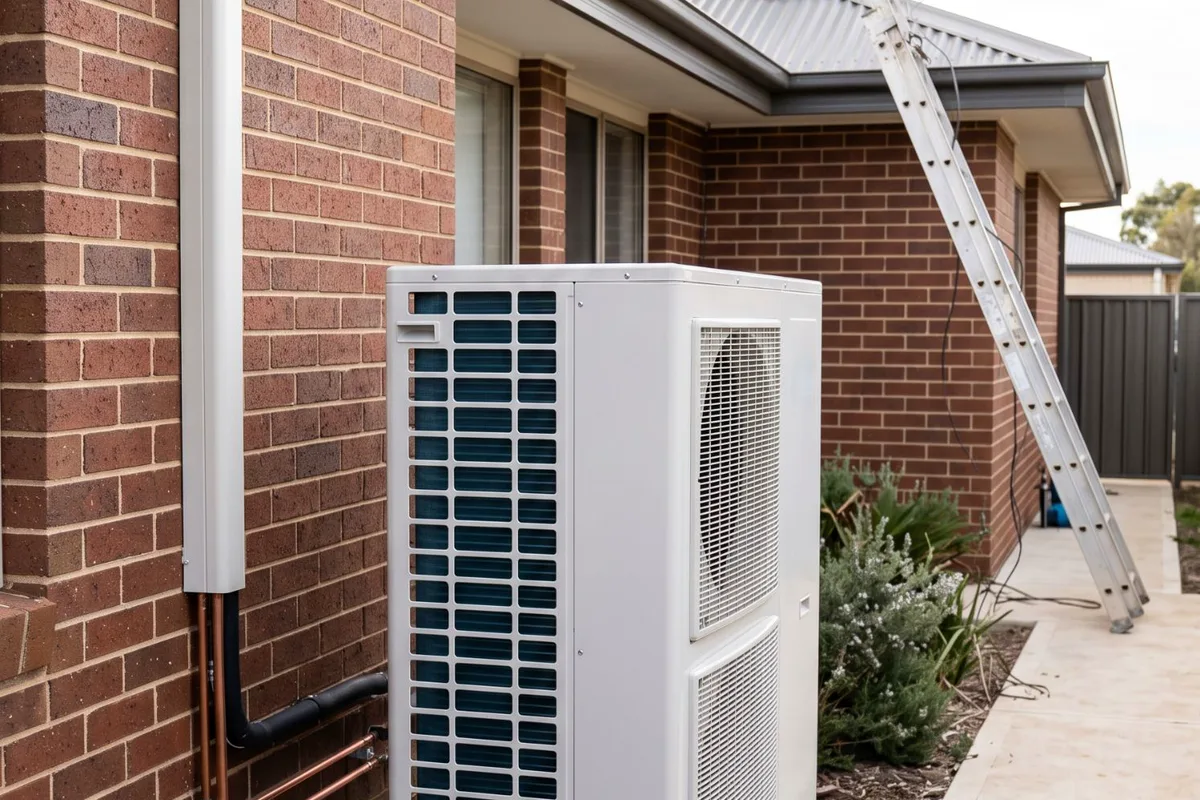
Refrigerated systems add an outdoor unit, usually on the ground beside the house, connected to the indoor unit in the roof by refrigerant pipes, a drain and a cable. It needs clear airflow, room for servicing and a spot away from bedroom windows, yours and the neighbours'. Installing it needs a refrigerant handling licence under the national scheme.
A ducted reverse-cycle unit draws far more power than an evaporative cooler, so it usually needs its own circuit and a check of the switchboard. Energy Safe Victoria notes that the Wiring Rules require additional safety switch protection when an existing installation is altered. If the board needs replacing, the power can't go back on to a new main switchboard until a Licensed Electrical Inspector has inspected it, so that's planned into the job.
The electrical work comes with a Certificate of Electrical Safety.
Other options, and rentals
Ducted reverse-cycle isn't the only path. Some households keep the evaporative cooler for dry summer days and add a split system to the living area for heating and humid days. Others replace the whole system with split or multi-head units in the rooms they use most. A room-by-room plan makes the comparison fair.
For rental providers, the Victorian Government says that from 1 March 2027 rental homes need energy-efficient cooling in the living area at the start of a new lease, and existing evaporative cooling meets that standard. By 1 July 2030, it says all rentals need efficient electric cooling in the living area. Check the current requirements before deciding whether to replace a working cooler in a rental.
Common questions
Services in this guide
Related jobs
Not sure what you need yet
Answer a few quick questions about your home for a plain answer, what we check before we price the job and what to read next.
All questionnairesQuick answers
- Why has one zone stopped working on my ducted system?When one zone gets no air but the rest work, check the controller first: the zone may be switched off, on a schedule or, with temperature-controlled zones, already at…
- Can one reverse-cycle air conditioner meet both rental heating and cooling standards?Yes.
- Can a rental's failed gas hot water be replaced with gas after March 2027?No.
- Why does my main switch trip?Many main switches are only isolators and can't trip on their own.
- Why do my lights dim when the air conditioner or fridge starts?A brief dip as a motor starts is common.
From the blog
- What's involved in adding ducted air conditioning to an existing home?Retrofitting ducted reverse-cycle to a lived-in home: roof space, return air, outlet layout, the outdoor unit, power supply and what the disruption looks like.
- Is ducted air conditioning worth it in a small home or unit?In a two- or three-bedroom home or unit, a couple of well-placed splits often beat ducted. Ducted still makes sense in some small homes. Here is where the line falls.
- Split system or ducted for an investment property?Splits, multi-heads and ducted compared for rentals on durability, servicing, how renters use them, the 2027 cooling standard and what happens when one fails.
- What affects the cost of ducted air conditioning?Capacity, zones, outlets, roof access, storeys, duct reuse and the electrical supply all shape a ducted install. Here's how to compare quotes on the same basis.
We work across Melbourne's west
Family-run and based in Altona Meadows. Pick your suburb for local notes and the jobs we see most there.
- Altona Meadows
- Altona
- Point Cook
- Seabrook
- Laverton
- Laverton North
- Werribee
- Werribee South
- Hoppers Crossing
- Wyndham Vale
- Williamstown
- Newport
- Spotswood
- Yarraville
- Kingsville
- Port Melbourne
- Derrimut
- Deer Park
- Ravenhall
- Maribyrnong
- West Melbourne
- Flemington
- Kensington
- Tullamarine
Sources for this guide
8 sources, with the date each was checked
- 1.energy.gov.au (Australian Government, DCCEEW): Evaporative coolers work by blowing air over a film of water on a filter or sponge, cooling the sponge and the air through the process of evaporation. Outside air is drawn through the evaporative unit (generally on the… Accessed 30 September 2026.
- 2.YourHome (Australian Government): A reverse cycle air-conditioner is a type of heat pump that uses electricity to warm your home in winter and cool it in summer (refer to Heat pumps below). In heating mode, the system absorbs heat from the outside air… Accessed 30 September 2026.
- 3.Department of Energy, Environment and Climate Action (energy.vic.gov.au), page last updated 14/04/25: We recommend providing 1.1 to 1.4kW of heating output for every 10m² of your home covered by a ducted system, depending on the individual characteristics of your home. ... We recommend zones for your ducted system, as… Accessed 30 September 2026.
- 4.Australian Refrigeration Council (ARC): A Refrigerant Handling Licence must be held by any person who carries out work in relation to refrigeration and air conditioning (RAC) equipment. Carrying out work in relation to RAC equipment means to do anything with… Accessed 30 September 2026.
- 5.Energy Safe Victoria: Clause 2.6.3.2.5 of the Wiring Rules states: Additional protection by RCDs shall be provided in existing electrical installations where alterations or a switchboard replacement is completed. Accessed 30 September 2026.
- 6.Energy Safe Victoria: The electrician has eight business days after the work is completed to have that work inspected by a licensed electrical inspector (LEI). If an electrician replaces a main switchboard at a property, power cannot go back… Accessed 30 September 2026.
- 7.Energy Safe Victoria: Whenever a licensed electrician completes any electrical installation work, they must provide a Certificate of Electrical Safety (COES). Accessed 30 September 2026.
- 8.Department of Energy, Environment and Climate Action (energy.vic.gov.au), page last updated 05/08/26: From 1 March 2027, at the start of a new lease, rental homes must include: energy-efficient cooling in the living area (noting that if evaporative cooling is already installed, it meets the standard) ... By 1 July 2030… Accessed 30 September 2026.
Planning advice for homeowners. Installation requirements depend on the property and equipment. Where this guide refers to Victorian safety or rental rules, use the linked official guidance for the current requirements.
Talk it through with us
Tell us what is happening at your place. Free, no-obligation quotes, and you get the price before we start.
Ask for a quote 03 9116 9050